


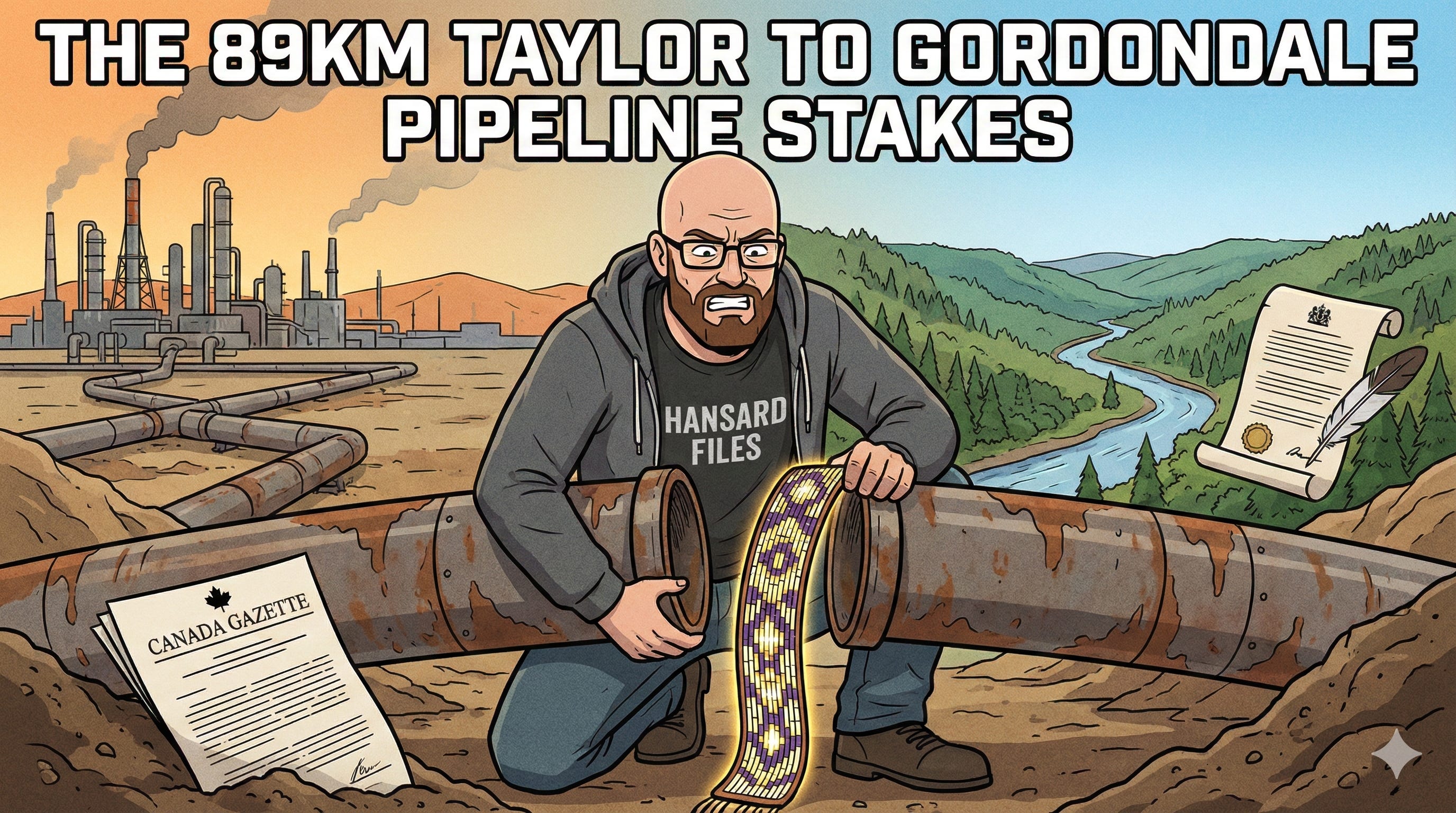
Deep in the Montney region of northeastern British Columbia, the landscape is defined by its vast subterranean energy reserves and the historical, enduring presence of Indigenous communities. On Friday, February 20, 2026, the Canadian government issued an extraordinary order published in a special edition of the Canada Gazette. This order directly approved the construction and operation of the Taylor to Gordondale Pipeline Project. Behind this seemingly standard regulatory notice lies a complex narrative of economic ambition, intense environmental scrutiny, and a profound shift in how Canada consults with First Nations.
For decades, the extraction of resources in western Canada has operated on a tightrope. On one side is the undeniable gravitational pull of global energy markets. On the other side is the cumulative toll that industrial development extracts from the land and the people who have inhabited it for millennia. The approval of this specific infrastructure project reveals exactly how modern regulatory bodies are attempting to thread that needle.
The Economic Engine of the Taylor to Gordondale Pipeline
The physical footprint of the project is substantial but highly localized. The conduit consists of a new interprovincial pipeline spanning approximately 89 kilometres, extending from Taylor, British Columbia, to the Gordondale area of Alberta, located about 19 kilometres past the provincial border. Its primary function is to transport condensate, natural gas liquids, and crude oil from the Montney region directly into the waiting processing plants and storage sites near Edmonton and Fort Saskatchewan.
Pouce Coupé Pipe Line Ltd., the applicant and license holder, operates under the ownership of Pembina Pipeline Corporation. With a capital cost of approximately $341 million in 2024 dollars, the pipeline is engineered with the capacity to transport 118,000 barrels per day of condensate. This massive volume will effectively free up space on the existing Pouce Coupé pipeline system, allowing older infrastructure to carry more natural gas liquids to a thirsty market.
To minimize the scarring of untouched landscapes, the pipeline route parallels existing and approved pipeline rights-of-way for approximately 94 percent of its length. The operation footprint rests heavily on private agricultural land, which accounts for 86 percent of the route, leaving 14 percent on Crown land.
The financial rationale presented to the Canada Energy Regulator paints a picture of critical domestic need. Demand for condensate in western Canada, used primarily as a diluent for heavy crude oil and bitumen, already severely outstrips domestic supply. Over the past two years, 37 percent of this demand was met entirely through imports from the United States. Without the intervention of this new pipeline, models project this imbalance will only widen over time, exacerbated by newly constructed crude oil egress routes like the Trans Mountain Expansion Project.
The macroeconomic benefits ripple outward from the point of construction. The project is estimated to contribute an impressive $112 million to the Gross Domestic Product of British Columbia, $70 million to Alberta, and $30 million to the rest of Canada. The construction phase alone is expected to generate 1,872 person-years of work across the country, encompassing 330 direct construction jobs.
Navigating the Yahey Precedent and Indigenous Rights
While the economic calculus is straightforward, the legal and moral calculus is far more intricate. The project area is located squarely within Treaty 8 territory. Crucially, it sits partially within the Blueberry Claim Area, a region made famous by the landmark Yahey v. British Columbia decision in the Supreme Court of British Columbia.
In the Yahey decision, the court found that the cumulative effects of decades of industrial development had significantly impacted the Blueberry River First Nations’ ability to meaningfully exercise their Treaty 8 rights. While that specific court decision technically binds only the provincial government, the Commission of the Canada Energy Regulator recognized it as an unavoidable contextual factor. The Commission declared that existing cumulative effects on the rights of Indigenous Peoples in the project area are already “high” and adverse. They acknowledged that the residual effects of the new pipeline would contribute to these high adverse impacts.
Furthermore, the legal landscape in Canada has shifted following the Federal Court’s decision regarding the Kebaowek First Nation. That ruling established that the United Nations Declaration on the Rights of Indigenous Peoples acts as an interpretive framework, giving rise to an enhanced duty to consult. The Commission applied these principles directly to their evaluation of the project, looking deeply at the adequacy of consultation and accommodation measures.
Through dual consultation processes running concurrently from December 2023 to December 2025, the Crown Consultation Coordinator engaged with 36 distinct Indigenous groups. Indigenous participants provided evidence demonstrating that the severe cumulative effects recognized in British Columbia also bleed over into the Alberta portion of the project area. They voiced concerns that additional development would further contribute to substantial challenges in maintaining their traditional ways of life and transmitting cultural knowledge.
The 40 Conditions and Mitigating Cumulative Effects
The approval of the project was not a blank check. The Governor in Council, on the recommendation of the Minister of Natural Resources, directed the Commission to issue the Certificate of Public Convenience and Necessity subject to 40 strict, binding conditions.
These conditions are a testament to the modern regulatory environment, transforming vague promises into enforceable mandates. Because the Commission found that the project’s potential effects on the rights of Indigenous Peoples would be of “high adverse severity,” they mandated profound structural oversight.
Two conditions stand out as unprecedented mechanisms for accommodation:
Condition 17: The proponent is legally required to establish an Indigenous Project Committee. This committee will provide direct oversight and participation in project activities. Its responsibilities will likely include the oversight of culturally sensitive areas and the provision of advice on the implementation of offset methodologies.
Condition 39: The proponent must develop a comprehensive Offset Measures Plan, which requires explicit approval from the Commission. The Commission determined that restoration-based offsets are absolutely necessary given the project’s contribution to an already highly impacted area. If physical restoration offset measures are not possible, the proponent must implement alternative measures, which may include direct financial contributions.
The integration of Indigenous knowledge and oversight does not end with committee meetings. The pipeline’s lifecycle regulation includes highly specific mandates for ongoing involvement. Eighteen of the 40 imposed conditions explicitly require the proponent to engage with Indigenous Peoples.
According to the regulatory framework, Indigenous groups are guaranteed the following opportunities:
Reviewing all condition filings with dedicated support, as mandated by a pre-construction plan.
Participating actively in both construction monitoring and post-construction monitoring.
Ensuring the proponent adheres strictly to the Environmental Protection Plan and the Reclamation and Restoration Plan.
Monitoring the actual success of land reclamation and checking for invasive plant species in the years following construction.
Before a single tree is felled, the proponent has committed to including Indigenous construction monitors in the physical flagging, staking, and fencing of the route. They must also submit a pre-construction harvesting report to confirm they have facilitated access for Indigenous groups wishing to harvest traditional plants along the right-of-way prior to ground disturbance.
Balancing Climate Goals with 118,000 Barrels a Day
Beyond human rights and economics, the pipeline faces the undeniable reality of a changing climate and fragile ecosystems. The Commission assessed the direct and upstream greenhouse gas emissions associated with both the construction and operation phases of the pipeline.
During construction, the clearing of land, the burning of vegetation, and the operation of heavy machinery will generate approximately 69.3 kilotonnes of carbon dioxide equivalent. The Commission determined that the proponent’s mitigation measures, which include a strict timber salvage plan, are appropriate.
However, looking toward the decades of operation, the regulatory body imposed a forward-thinking mandate. Under Condition 38, the proponent must develop a concrete net-zero greenhouse gas emissions plan for the life of the project. Even though the pipeline itself is projected to contribute a relatively minuscule 0.04 kilotonnes of carbon dioxide equivalent per year to the atmosphere during operation (representing less than 0.001 percent of Canada’s annual total), the net-zero requirement reflects the rigid new standards of Canadian energy policy.
The local environment also requires meticulous navigation. The Commission reviewed the project against the rigorous standards of the Species at Risk Act. While no known occurrences of critical habitat for listed aquatic species were found, the local assessment area overlaps directly with the critical habitat of two vulnerable bat species: the little brown myotis and the northern myotis.
To protect these fragile populations, the Commission relied heavily on the proponent’s Environmental Protection Plan. Through strategic routing avoidance and mandatory field surveys required under Condition 11, the Commission concluded that fatal impacts to this critical habitat are highly unlikely. For broader ecological impacts, such as effects on wetlands and vegetation, the decision to parallel existing linear disturbances will limit the damage to a low-to-medium magnitude, with comprehensive reclamation projects slated to restore the footprint post-construction.
The regulatory apparatus will not vanish once the pipeline is buried. The Canada Energy Regulator functions as a lifecycle regulator, actively monitoring and enforcing compliance with all 40 conditions long after the oil begins to flow. They hold the authority to conduct inspections, demand audits, review emergency response exercises, and initiate enforcement actions if the proponent strays from the agreed-upon path.
The approval of the Taylor to Gordondale infrastructure is not simply the authorization of a steel tube in the ground. It is a highly negotiated treaty between the relentless demands of a petroleum-hungry economy, the unyielding reality of global climate targets, and a long-overdue reckoning with the rights of the Indigenous communities whose lands bear the ultimate cost.
At Hansard Files, we believe the true story of our nation is buried in the footnotes of gazettes and the appendices of regulatory filings. Subscribe to support independent, deep-dive investigations into the policies shaping our world.
Source Documents
Canada Gazette. (2026, February 21). Part I, Vol. 160, No. 8.
Canada Gazette. (2026, February 20). Part I, Extra Vol. 160, No. 2.
Wait... a pipeline got approved?? How?!??
I probably shouldn't be as cynical as I am but it seems to me the Native Grievance Industry are more interested in keeping the pipeline of money flowing than protecting the environment.