


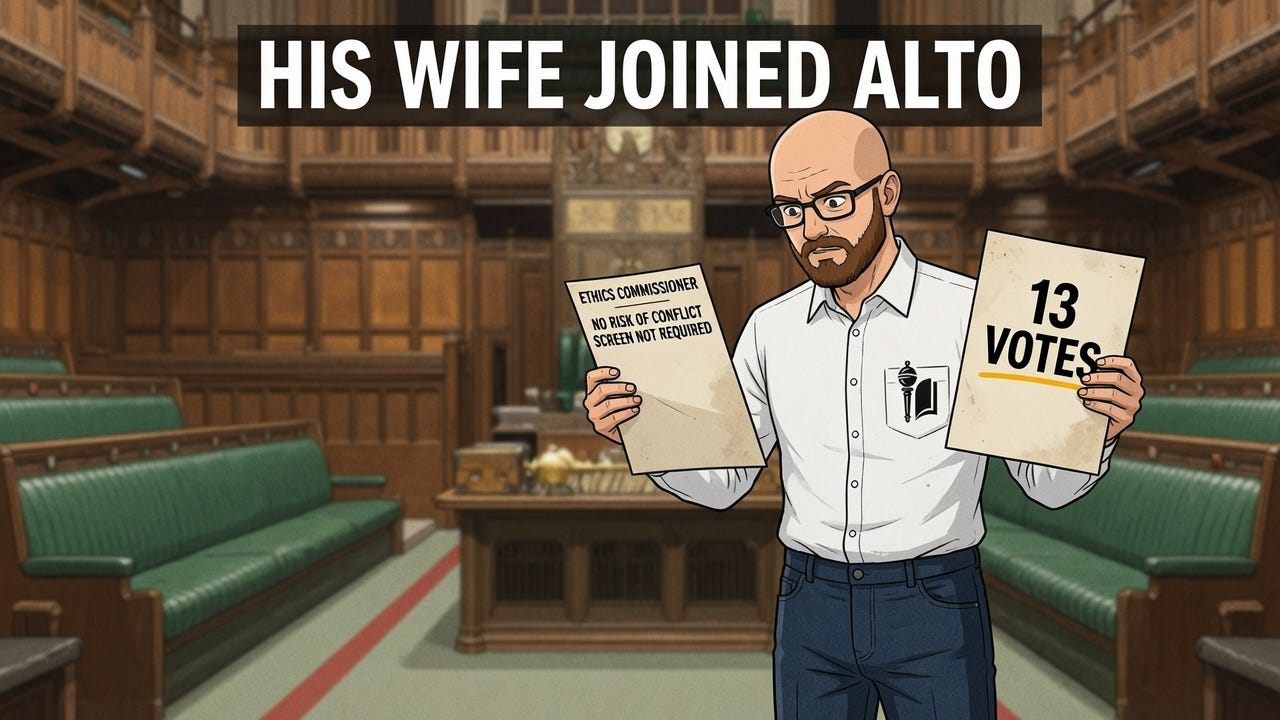
On July 3, 2025, a person close to Finance Minister François-Philippe Champagne received a senior executive job offer from Alto. That person was his wife. According to the account later put before the Standing Committee on Access to Information, Privacy and Ethics, the offer prompted immediate verbal consultation with the Conflict of Interest and Ethics Commissioner.
The company was not a minor contractor. Alto is the wholly owned VIA Rail subsidiary building the federal high-speed rail initiative along the Quebec City-Windsor corridor, roughly 1,000 kilometres of planned line. It was incorporated in March 2022 under Orders in Council directing VIA Rail to create the subsidiary. Champagne’s wife would join it as a Senior Vice-President.
On September 10, 2025, Champagne formalized an internal conflict-of-interest screen. He sent a copy of his recusal letter to the Prime Minister and to the Ethics Commissioner. The screen was his own instrument. It was non-public. It was not, on the record he later presented, a finding against him by the Commissioner.
What opposition MPs later counted was simpler. Despite that self-imposed screen, Champagne participated in 13 parliamentary votes on the file and promoted the high-speed rail implementation bill that would carry the network into law.
What the Ethics Commissioner said about the Alto ethics screen
On April 7, 2026, the Office of the Conflict of Interest and Ethics Commissioner answered Champagne in writing. Champagne put the message on the committee record: the Commissioner said there was no risk of conflict of interest, and a screen was not required.
The formal logic, as it appears in the synthesis of that hearing, runs through portfolio lines. Alto sits under Transport. The Finance Minister has no human-resources authority over the subsidiary. On that basis, the Commissioner closed the risk question. Champagne’s September screen, read against the April letter, becomes a voluntary extra he chose to keep, not a requirement the Commissioner imposed.
Champagne presented that sequence as diligence. He had consulted when the job offer arrived. He had put a screen in writing. He had asked for, and received, a written confirmation that no official screen was needed.
Opposition members heard a different story in the same facts. They criticized Champagne for casting thirteen votes and promoting the implementation bill after building a screen the Commissioner later said was not required. The committee room did not close that gap. It recorded it.
The ledger opposition members put beside the votes
The Ethics file did not stay limited to household employment. Opposition members also put two Alto-related money items into the same scrutiny.
They noted that Alto executives had received $2.8 million in performance bonuses without laying any track. Separately, they noted that the Department of Finance had paid $12,168 to an Alto employee who had already left the company months earlier, to write Champagne’s budget speech.
Those figures do not establish criminal wrongdoing. On the record available here, they are line items raised in committee as part of the political case against Champagne’s handling of the file. They sit beside the household fact, not in place of it: the minister’s spouse held a senior post at Alto; Finance had paid a former Alto hand for speechwriting; Alto had paid performance bonuses while the corridor, in those committee accounts, still had no track.
The clean legal answer remained the Commissioner’s. No risk. No required screen. The political answer remained the opposition’s: thirteen votes and public promotion after a self-imposed recusal instrument.
Why the file carried weight beyond one household
The reason Alto is not a quiet corporate footnote is already partly on the Hansard Files site, in prior pieces on corridor expropriation history and on Bill C-15’s breadth. This article does not re-litigate that ground. It needs only enough of it to explain why thirteen votes matter.
Bill C-15, the budget implementation vehicle tabled in November 2025, embeds the High-Speed Rail Network Act. Critics told Agriculture and related hearings that the Act removes traditional rights of redress for expropriated landowners under the Expropriation Act, leaves farmers with a nominal $1,500 offer and a three-month eviction notice, and allows aerial drone survey if landowners refuse entry. Those claims remain critics’ descriptions in the synthesis. They are not verified here against the statute text.
Producer groups, including Grain Farmers of Ontario and Quebec’s Union des producteurs agricoles, opposed the corridor design for a separate reason already in the committee material: potential fragmentation of farmland, including over 500 pieces of land in Quebec alone, with consequences for crop rotation, drainage, and land efficiency. Daniel Farrelly and Jacques Gourde also put cost overruns on the record, saying high-speed rail projects worldwide have exceeded budget by at least 50 percent, and that a $90 billion figure could rise to $150 billion or $200 billion.
None of that farmland dispute is the ethics ruling. It is the reason the implementation bill was never a free vote on a symbolic logo. When Champagne cast thirteen votes after building a screen the Commissioner later said was unnecessary, he was casting them on a file that already carried land-power allegations, producer opposition, and a multi-billion-dollar cost envelope.
The timeline the Ethics committee could not unwrite
The sequence the Ethics material supports is short and dated.
March 2022: Alto is incorporated as VIA Rail’s wholly owned subsidiary for the high-speed initiative.
February 2025: Prime Minister Justin Trudeau announces multi-billion-dollar federal funding for the project.
March 2025: Champagne is appointed Minister of Finance and National Revenue.
July 3, 2025: his wife receives a senior executive job offer from Alto; Champagne seeks immediate verbal consultation with the Ethics Commissioner.
September 10, 2025: Champagne implements an internal, non-public ethics screen and sends the recusal letter to the Prime Minister and the Commissioner.
November 2025: Bill C-15, incorporating the High-Speed Rail Network Act, is tabled.
April 7, 2026: the Commissioner writes that there is no risk of conflict of interest and a screen is not required.
Across that arc, opposition members count thirteen parliamentary votes and public promotion of the implementation bill after the September screen.
Champagne’s answer is the portfolio wall and the Commissioner’s letter. Opposition members’ answer is the household post, the screen he chose, the votes he still cast, the speechwriting payment, and the bonuses without track.
The record, limited to the synthesis behind this piece, does not show the Commissioner ordering a recusal from those votes. It shows Champagne building a screen the Commissioner later said was not required, then facing criticism for voting and promoting the bill anyway.
Thirteen votes after a screen nobody required
The sharpest sentence in the file is the Commissioner’s. There is no risk of conflict of interest. A screen is not required.
The sharpest number in the opposition case is thirteen.
Between them sits the gap the hearing leaves open: a voluntary ethics screen for Alto, a later Commissioner message saying no screen was required, and thirteen votes plus bill promotion after the September recusal letter.
The synthesis does not close that gap. It only fixes the dates, the household fact, the Commissioner’s April message, the vote count opposition members used, and the money items they placed next to it. Readers who want the expropriation and Bill C-15 architecture can find that fight elsewhere on this site. The Ethics room, on this material, was narrower: a voluntary screen, a clean formal ruling, and thirteen votes that still happened.
Hansard Files spends weeks in the committee rooms so you don’t have to. If stories like this matter to you, subscribe to keep this work independent.
Related Hansard Files Articles


For more great reporting on this topic visit:
Source Documents
• House of Commons, Standing Committee on Access to Information, Privacy and Ethics. Evidence (ETHIEV47-E).
• House of Commons, Standing Committee on Agriculture and Agri-Food. Evidence (AGRIEV42-E; AGRIEV43-E).
I think this situation supports the Ethics Commissioner and the Ethics Committee recommendations that the ethics legislation needs to be expanded to not just include actual conflicts of interest but also perceived conflicts. As a lawyer, we need to be careful when we take on cases that there are no conflicts or perceived conflicts. It is in our rules of professional conduct and it is enforced by the courts. It is odd to me that Parliament does not operate under similar rules.
https://www.ourcommons.ca/documentviewer/en/45-1/ETHI/report-5/page-24?utm_source=substack&utm_medium=email
I will go with voting is not a conflict of interest. A screen prevents influence over decisions. Votes confirm decisions that have already been made. It would probably have been best if the minister's wife had not accepted the position, but she did, and had every right to as a role that she had earned through her previous experience.