


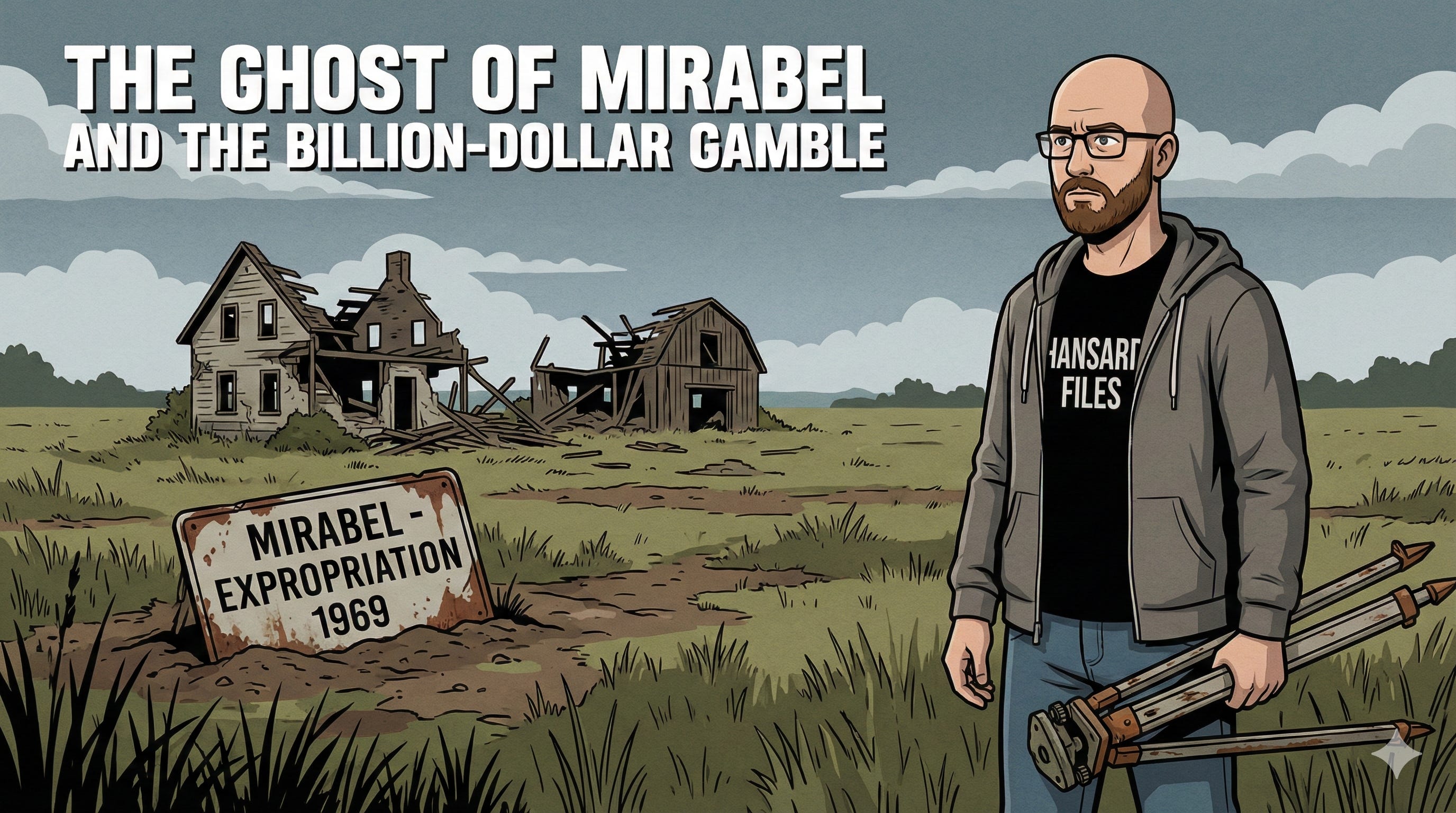
The ghosts of 1969 walked the floor of the House of Commons this week. They arrived not in chains, but in the furious, trembling voice of a Member of Parliament remembering a trauma that, nearly sixty years later, has not healed. On March 27, 1969, the federal government descended upon the quiet farming communities north of Montreal with a ruthlessness that would define a generation. In a single stroke, they seized 97,000 acres of land—an area larger than the entire city of Laval—to build what was promised to be the airport of the future.
They called it Mirabel.
To build it, they erased fourteen municipalities. They evicted over 3,000 families. They bulldozed homes, barns, and centuries of history, forcing farmers to watch as their livelihoods were turned to dust in the name of “modernity.” It was an act of bureaucratic violence so profound that the scars remain visible on the landscape and in the psyche of Quebec to this day.
Now, in February 2026, the government has returned with a new map, a new promise of modernity, and a new acronym: HFR.
High Frequency Rail is the single most ambitious infrastructure project in modern Canadian history. It promises to connect Quebec City to Toronto with a dedicated passenger line that will revolutionize travel, reduce emissions, and unclog the congested corridor. But to the residents living in its path, the project—led by a new entity known as the “Alto” office and a private consortium called “Cadence”—looks suspiciously like history repeating itself.
While the government spent the week of February 2 fast-tracking a multi-billion dollar “Canada Groceries and Essentials Benefit” to pacify an inflation-weary public, a much darker fight was breaking out over the right to own property, the definition of consultation, and the terrifying power of the state to take what it wants.
This is the story of a week where Ottawa tried to buy its way out of a crisis with one hand, while holding a sledgehammer in the other.
The Resurrection of the Expropriator
The debate that erupted on Thursday, February 5, was ostensibly about an apology. Jean-Denis Garon, the Bloc Québécois MP for Mirabel, rose to demand that the federal government finally apologize for the “collective trauma” of the 1969 expropriations. But his speech was not an exercise in nostalgia. It was a warning.
“We were promised modernity,” Garon told the hushed chamber. “Pierre Elliott Trudeau came to Mirabel and promised us that we would be stepping into the modern world... When [he] left the room, people did not feel reassured because their questions had not been answered.”
The parallels to the current High Frequency Rail project are chilling. Just as in 1969, the government has created a special vehicle to manage the project. Then, it was the Department of Transport acting with impunity. Today, it is the “Alto” project office, working in tandem with “Cadence,” the private consortium tasked with designing and building the line.
The fear gripping the communities along the proposed route—from Trois-Rivières to Peterborough—is that the mandate of High Frequency Rail is morphing into something far more invasive: High Speed Rail. The distinction matters. A high-frequency train can arguably share existing corridors or require modest widening. A true high-speed train (TGV style), which requires arrow-straight tracks and massive safety buffers, demands land. Lots of it.
“The rift of 1969 still hangs over our heads,” the debate revealed, as MPs detailed the anxiety of constituents who are currently living in limbo. Residents are reporting that they cannot resell their homes because the “Alto” office has flagged their properties as lying within the potential blast radius of the new line. “Knowing that they may not be able to resell their homes,” one MP noted, families are trapped in a bureaucratic freeze, waiting for a letter that might tell them they have to leave.
The government’s defense, articulated by ministers and parliamentary secretaries, is one of economic necessity and environmental stewardship. They argue that Canada is the only G7 country without high-speed rail, a humiliating statistic in a carbon-constrained world. They promise “consultation” and “fair compensation,” the same soothing words that were whispered to the farmers of Sainte-Scholastique in 1961 before the bulldozers arrived.
But the opposition is asking a fundamental question: How can you claim to solve the housing crisis while planning a project that might demolish existing homes?
Bread, Circuses, and Bill C-19
While the specter of expropriation loomed over Thursday’s session, the government spent the early part of the week engaging in a frantic attempt to put cash into the pockets of angry voters. On Monday, February 2, the government moved a motion to “deem” Bill C-19, the Canada Groceries and Essentials Benefit Act, passed at all stages.
This was legislative velocity at its most extreme. There were no weeks of committee hearings, no line-by-line analysis of the fiscal impact. The government, sensing the desperation of the electorate, essentially forced the bill through the legislative digestive system in record time.
The details of Bill C-19 reveal a government terrified of the cost-of-living crisis. The benefit is not a structural fix; it is a direct cash transfer. “For a couple with two children, the amount will increase from about $1,086 to $1,890,” Liberal MP Arielle Kayabaga announced, framing the payout as a lifeline for “12 million low- and modest-income” Canadians.
The juxtaposition is jarring. On one side of the ledger, the government is printing money to subsidize the cost of milk and bread, acknowledging that inflation has crushed the purchasing power of the working class. On the other side, through the HFR project, it is embarking on an infrastructure spend that will likely cost tens of billions of dollars and potentially displace the very people it is trying to help.
Conservative critics pounced on the irony. “This does not erase the Liberals’ generational setbacks,” argued one MP, calling the benefit a “Band-Aid” on a gaping economic wound. They argued that the government is simply returning a fraction of the tax revenue it collected, a “handout to Canadian citizens to fill the gap they created in the first place”.
But the political calculus is clear. In a minority parliament, with an election looming on the horizon of 2026, the government needs a win. They need cheques in mailboxes before the High Frequency Rail surveyors start planting flags in backyards.
The “Alto” Black Box
The most disturbing element of the HFR saga, as it emerged in the Hansard files this week, is the opacity of the “Alto” office. In modern public administration, accountability is often laundered through arms-length agencies and private-public partnerships. By delegating the HFR project to “Alto” and the private consortium “Cadence,” the government effectively buffers itself from direct criticism.
When an MP asks a question about a specific property in Laval or Peterborough, the Minister can simply refer to the “ongoing technical work” of the consortium. It is a convenient shield.
“How can anyone say that high-speed rail is being built without consultation?” asked a Bloc MP, channeling the frustration of mayors and councillors who feel cut out of the loop. The “Cadence” consortium is tasked with optimizing the route for speed and efficiency. Their primary allegiance is to the engineering constraints and the project budget, not to the heritage of a family farm in the Mauricie region.
This tension between technocratic efficiency and democratic accountability is the defining struggle of the 21st century. We see it in the “Cúram” IT fiasco mentioned in Question Period, where a system transition left seniors “in dire need”. We see it in the “Build Canada Homes” agency proposed in Bill C-20, yet another centralized bureaucracy designed to solve a problem—housing—that is intensely local.
And we see it most starkly in the High Frequency Rail project. The “Alto” office is operating with a mandate to build the future, but it is doing so in a country that has legally and emotionally entrenched property rights—and a long memory.
A Collision Course
As the week wrapped up on Friday, February 6, with debates on Standing Orders and the dry procedural mechanics of the House, the real story remained unresolved. The government has successfully authorized the grocery rebate cheques. The money will flow. For a few months, the anger over the price of celery and ground beef may subside.
But the surveyors are still coming.
The collision course is set. On one side is a federal government committed to a “net-zero” transport future, willing to spend billions and use the heavy hand of the state to carve a steel spine through the Quebec-Windsor corridor. On the other side are communities who remember Mirabel, who remember the broken promises of 1969, and who see in the “Alto” office the same arrogant face of a distant Ottawa.
Jean-Denis Garon’s motion for an apology was not just about the past. It was a preemptive strike against the future. “The people affected by this were fathers, mothers, children... On March 27, 1969, these 10,000 people all become the expropriated people of Mirabel, a label and an identity that will follow them their whole lives,” he warned.
If the government mishandles the High Frequency Rail project—if it allows “Cadence” and “Alto” to bulldoze without consent—it risks creating a new generation of the “expropriated,” a new class of citizens who view the state not as a benefactor, but as a predator.
As the House adjourned for the weekend, the wooden mace sat on the table—a replica of the one destroyed in the fire of 1916. It is a reminder that even the most solid institutions can be consumed by flames. The Liberals would do well to remember that political goodwill is even more flammable than wood.
Hansard Files isn’t just about reading the news; it’s about reading the fine print that history is written in. While the cameras focus on the shouting matches, we dig through the transcripts to find the stories that will define Canada’s future. Subscribe today to help us keep digging.
Source Documents
House of Commons. (2026, February 2). Hansard (Vol. 152, No. 077).
House of Commons. (2026, February 3). Hansard (Vol. 152, No. 078).
House of Commons. (2026, February 4). Hansard (Vol. 152, No. 079).
House of Commons. (2026, February 5). Hansard (Vol. 152, No. 080).
House of Commons. (2026, February 6). Hansard (Vol. 152, No. 081).
When Trudeau the Elder passed away in 2000, Chretien wanted to beatify his mentor. His attempt to rename Mount Logan (highest mountain in Canada) to Mount Trudeau didn't work out. Chretien imposed a name change on Montreal (Dorval) Airport.
At the time and ever since, I argued they should have renamed Mirabel Airport to recognize the Elder because Mirabel was part of and much like his legacy. Like the Elder, Mirabel was controversial, hugely expensive, damaging to Canadians and ultimately useless.
You wrote about this about a month and a half before I even knew about the project and I live right in its path! Great article.
I’ve met the MP from Mirabel since. Very nice guy who is trying his best to help his community.