


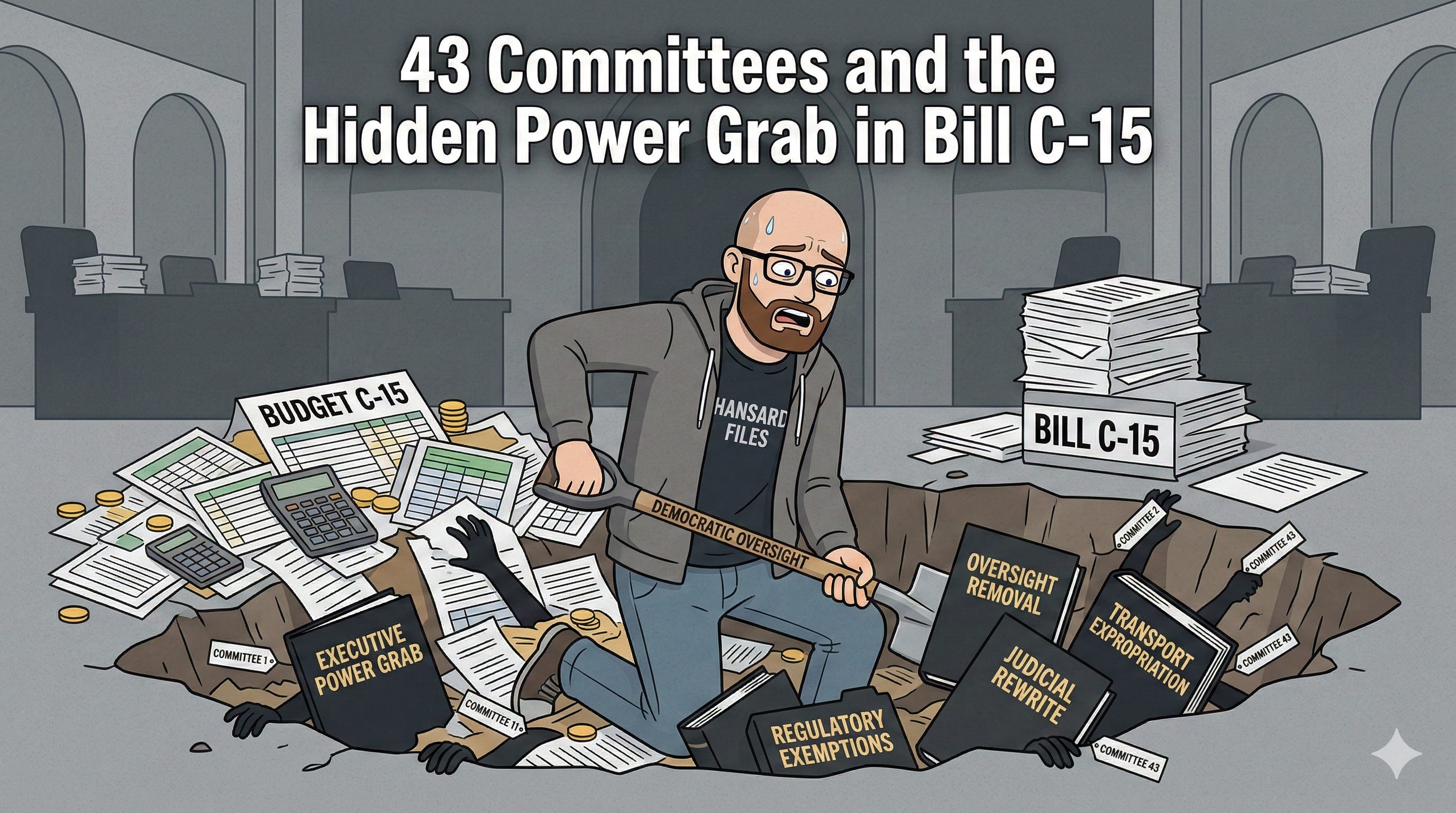
In the frigid weeks of February 2026, a quiet but monumental legislative struggle unfolded across the parliamentary precinct in Ottawa. If you walked the halls of the House of Commons, you would find an astonishing 43 separate committee meetings wrestling with a single, sprawling document. That document is Bill C-15, officially known as the Budget 2025 Implementation Act. To the casual observer, an implementation act is a routine financial mechanism designed to allocate funds. However, a meticulous review of the transcripts from these 43 meetings reveals a very different reality. The federal government is using this legislation to rewrite the foundational rules of Canadian governance.
The sheer scale of the legislation has forced every corner of the federal apparatus to mobilize. From the Standing Committee on Agriculture and Agri-Food to the Standing Committee on National Defence, parliamentarians are discovering provisions that strip away regulatory oversight, alter judicial appointments, and grant the executive branch sweeping new powers. The government insists these changes are necessary to navigate a fractured global economy and to protect the nation. Critics argue that the bill sacrifices democratic transparency on the altar of speed and corporate expediency.
The Unprecedented Scope of Bill C-15
To understand the magnitude of what is happening, one must look at the breadth of the committee hearings. In a typical parliamentary session, a budget bill is primarily the domain of the Standing Committee on Finance. Yet, the tentacles of this legislation are so far-reaching that the Finance Committee had to farm out its review. The Standing Committee on Industry and Technology, the Standing Committee on Environment and Sustainable Development, and the Standing Committee on Public Safety all received formal requests to review specific divisions of the act.
On February 5, Minister of Finance François-Philippe Champagne appeared before the Finance Committee. He set the tone for the government’s aggressive legislative posture. He described the current global macroeconomic environment not as a mere transition, but as a fundamental rupture. According to the Minister, the speed, scope, and scale of change in geopolitics and technology require Canada to abandon its traditional, methodical approach to governance. The government’s core argument is that to build the strongest economy in the G7, the state must eliminate friction.
But friction in a democracy often takes the form of oversight, public consultation, and legal checks and balances. The hearings across the 43 meetings highlight a systematic effort to dismantle these very mechanisms. Whether it is the Minister of Transport accelerating land expropriation for a high-speed rail network or the President of the Treasury Board introducing corporate regulatory exemptions, the underlying philosophy remains identical. The executive branch is asking Parliament to trust it with extraordinary, unchecked authority.
The Regulatory Sandbox and Corporate Exemptions
Perhaps the most contentious element buried within the budget is the proposal for a “regulatory sandbox,” debated intensely at the Standing Committee on Government Operations and Estimates. On February 12, the President of the Treasury Board, Shafqat Ali, defended the measure as a tool to keep pace with innovation. The concept is straightforward on paper. It allows businesses to test new products and technologies in a relaxed regulatory environment for a limited period.
However, the legislative language tells a darker story. The provisions grant cabinet ministers the power to exempt select corporations from almost any law or regulation in Canada, save for the Criminal Code. During the hearings, opposition members hammered the government on the potential for abuse. They pointed out that a minister could theoretically exempt a favoured company from the Conflict of Interest Act or shield a foreign state-owned enterprise from the Investment Canada Act.
When pressed for a definitive guarantee that ethics and national security laws would not be suspended for corporate allies, government officials deflected. They retreated to talking points about maintaining appropriate controls and protecting the health and safety of Canadians. But the refusal to explicitly exclude anti-corruption and national security statutes from the sandbox provisions left committee members alarmed. It paints a picture of a government willing to bypass the rule of law to appease corporate innovators and secure domestic investments.
Fast-Tracking Nation-Building at a Cost
The theme of executive empowerment continues in the realm of infrastructure. At the Finance Committee, Minister of Transport Steven MacKinnon testified about the High-Speed Rail Network Act, a massive project folded into the budget implementation bill. The network promises to connect 18 million Canadians between Quebec City and Toronto, creating 50,000 jobs and significantly reducing carbon emissions. It is framed as a nation-building triumph on par with the St. Lawrence Seaway.
Yet, to achieve this vision, the government is rewriting the rules of land ownership and expropriation. The legislation explicitly eliminates Section 98 of the Canada Transportation Act for this specific project. This section historically guarantees an independent review by the Canadian Transportation Agency to ensure that a proposed rail line is reasonable for affected communities. By removing this oversight, the government can issue prohibition notices to landowners without mandatory warning periods, freezing their ability to develop or sell their property instantly.
When challenged on this erosion of property rights, the Minister was blunt. Maintaining independent reviews would delay the project. The government argues that because the rail network benefits the nation as a whole, the state must move quickly. Citizens are stripped of their right to an impact assessment and forced to take their appeals to the Federal Court of Appeal, an expensive and daunting legal hurdle. The rights of farmers and homeowners are treated as acceptable collateral damage in the race to modernize Canada’s transit infrastructure.
A Bureaucracy Under Strain
While the Finance and Government Operations committees debated macroeconomic philosophy, the operational reality of the government was scrutinized elsewhere. At the Standing Committee on Public Accounts, the Auditor General and the Comptroller General faced questions about billions of dollars in professional services contracts. The ghost of past procurement scandals loomed large as officials from the Canada Border Services Agency testified about millions spent on external consultants for IT systems.
Bill C-15 promises to reduce the size of the public service by 16,000 full-time equivalents, offering voluntary early retirement incentives to cut costs. Yet, committee members noted the bitter irony. As the government cuts internal capacity, it simultaneously grants itself the power to fast-track massive corporate projects and complex technological procurements without traditional oversight.
Meanwhile, the Standing Committee on Official Languages and the Standing Committee on Canadian Heritage examined the cultural and linguistic impacts of the government’s rapid policy shifts. The Minister of Canadian Identity and Culture, Marc Miller, highlighted a half-billion-dollar investment for the audiovisual sector and corrections to the Broadcasting Act. He argued that protecting Canada’s cultural sovereignty is a vital economic policy in an unstable world. However, beneath the surface of these funding announcements lies the same centralized control mechanisms seen in the infrastructure and finance files. The government is directing capital to favored sectors while bypassing the rigorous parliamentary debates that usually accompany standalone cultural legislation.
The Resource Sector and National Security
The push for a self-sufficient economy also dominated the Standing Committee on Natural Resources. Here, the focus was firmly on the management of Canadian energy exports. Experts in nuclear energy, including representatives from McMaster University, testified about the immense export possibilities for Canadian technology and isotopes. They emphasized that Canada’s recent successes in nuclear refurbishment have positioned the country at the center of global energy discussions. But once again, the shadow of the budget implementation act was present. The streamlined regulatory processes are designed to push these resource projects forward at breakneck speed, raising concerns about long-term environmental and safety oversight.
This accelerated industrial policy directly intersects with the work of the Standing Committee on National Defence and the Standing Committee on Public Safety. The Canadian Security Intelligence Service and the RCMP appeared before multiple panels to discuss the threats facing Canada’s Arctic sovereignty and domestic security. As the government attempts to rapidly build out critical mineral supply chains and high-speed transit networks, intelligence officials warned of the increasing diversity and tempo of foreign threats.
The creation of the new Defence Investment Agency, authorized by the budget, aims to move military procurement forward efficiently. But critics ask a vital question. If the government uses its new regulatory sandbox powers to exempt certain corporations from national security reviews to speed up development, who is actually protecting the nation?
A Ripple Effect Across the Federal Apparatus
The expansive nature of the budget implementation act means its impacts are felt far beyond finance and infrastructure. The 43 committee meetings reveal a piece of legislation that touches nearly every aspect of Canadian life.
At the Standing Committee on Justice and Human Rights, members scrutinized changes to the allotment of judges in Ontario. The Minister of Justice, Sean Fraser, explained that the bill would repurpose superior court judges to serve in a unified family court. While framed as an efficiency measure, it represents a significant structural change to the provincial judiciary, tucked quietly into a federal fiscal document.
Similarly, at the Standing Committee on Human Resources, Skills and Social Development, dental hygienists and career colleges testified on divisions of the bill impacting health equity and the Canadian Dental Care Plan. The legislation intertwines technical fiscal allocations with profound shifts in public health administration.
The Cost of Agility in a Dangerous World
As the transcripts from these 43 meetings are synthesized, a cohesive and troubling narrative emerges. The federal government has accurately diagnosed that the world is becoming more unstable and competitive. They are correct that Canada must adapt rapidly to secure its economic future and protect its citizens. But the solution proposed in the implementation act is a dangerous gamble.
The legislation trades democratic friction for executive agility. It consolidates power within the cabinet, allowing ministers to rewrite rules, bypass independent oversight, and alter the fundamental rights of Canadians without the traditional scrutiny of Parliament. The sheer size of the bill is a tactic in itself. By spreading the controversies across 43 different committee meetings, the government makes it nearly impossible for the public and the media to grasp the full scope of the transformation taking place.
The debates echoing through the committee rooms of Ottawa are not merely arguments over line items in a ledger. They represent a fundamental struggle over the future of Canadian democracy. The government is asking citizens to trust a centralized, fast-moving authority to guide them through a global rupture. But as the testimonies reveal, that trust requires sacrificing the legal and procedural safeguards that have long defined the nation. The ultimate question facing Parliament is whether the promise of a resilient, modernized economy is worth the hidden price embedded in the pages of this unprecedented legislative sweep.
The investigations you read here take countless hours of sifting through dense parliamentary archives to bring the truth to light. Support independent, deep-dive journalism by subscribing to Hansard Files today.
Source Documents
House of Commons Standing Committee on Finance. (2026, February 5). Evidence (Meeting No. 23)
House of Commons Standing Committee on Government Operations and Estimates. (2026, February 12). Evidence (Meeting No. 27)
House of Commons Standing Committee on Finance. (2026, February 2). Evidence (Meeting No. 20)
House of Commons Standing Committee on Public Accounts. (2025, December 11). Evidence (Meeting No. 21)
House of Commons Standing Committee on Canadian Heritage. (2026, February 12). Evidence (Meeting No. 24)
House of Commons Standing Committee on Natural Resources. (2026, February 10). Evidence (Meeting No. 23)
House of Commons Standing Committee on National Defence. (2026, February 9). Evidence (Meeting No. 24)
House of Commons Standing Committee on Justice and Human Rights. (2026, February 23). Evidence (Meeting No. 18)
House of Commons Standing Committee on Human Resources, Skills and Social Development and the Status of Persons with Disabilities. (2026, February 12). Evidence (Meeting No. 25)
I wish those who fixate on individuals would pay more attention to process changes like this.
Whether someone likes or trusts Mark Carney as an individual or not, this is a process change that is unlikely to be reversed by a future executive branch. Canadians look to the USA in horror with the unaccountable activities of their executive branch, much of which was slowly handed over to that branch over decades, and then somehow think something good can come out of a similar direction being taken by Canada. Canada’s Democratic Institutions have already been greatly weakened over the last century by incrementally adopting flawed processes from the USA.
I don't believe this is a case of "friction in a democracy", but that what is being described as friction IS the democracy.
Canada and the USA seem to really like the idea of returning to their origins of being a pure Monarchy.
The changes are appalling but what's worse is the lack of transparency. If you believe this is be the path forward, then be forthright and put it before the voters, before the election. The approach is dishonest and deceptive (as is the associated attempt to rewrite standard accounting practices for government budgets). Together with the profoundly unconstitutional provisions of the Online Harms Act and the Combatting Hate Act, we have the makings of the most autocratic and illiberal government we've had since Canada was ruled by Queen Victoria.