


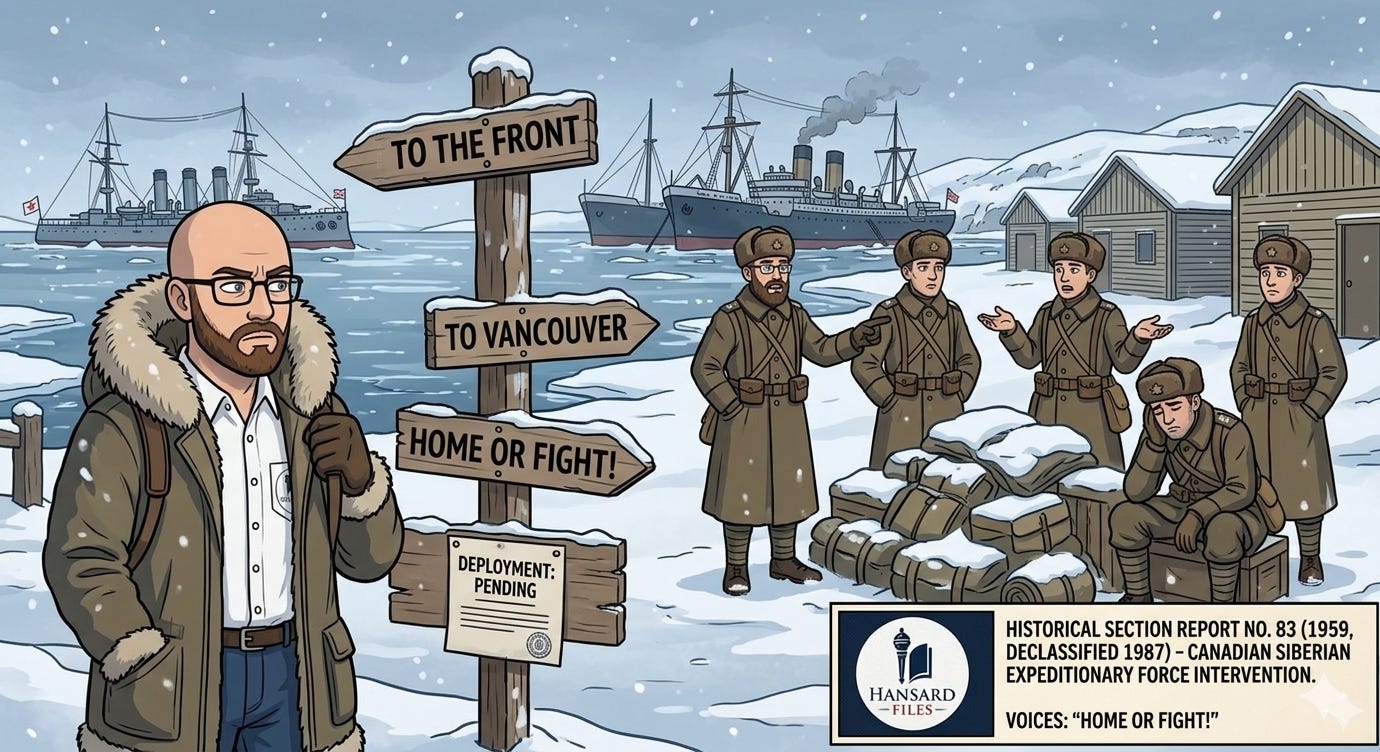
On 11 November 1918, the guns fell silent across France and Belgium. Across Canada, the relief was overwhelming. The killing was over. Families who had waited four years for their sons and husbands began counting the days. But somewhere in the machinery of government, a different kind of arithmetic was underway. Thousands of Canadian soldiers were being mobilized, not for demobilization, but for Siberia.
The Canadian Siberian Expeditionary Force is one of the least-examined episodes in this country’s military history. Not because the records are thin. In fact, Report No. 83 of the Historical Section (G.S.), Army Headquarters, compiled by Captain J.A. Swottenham R.C.E. and declassified in 1987, offers a remarkably candid account of what happened. The reason it stays buried is perhaps simpler: it tells an uncomfortable story about a mission that was confused from the start, contested at home, and abandoned before it accomplished very much at all.
The World After Brest-Litovsk
To understand why Allied governments thought sending troops to Siberia made sense, you have to go back to December 1917 and the armistice between Russia and the Central Powers. The Treaty of Brest-Litovsk, which followed, handed Germany what it had long wanted: territorial gains, foodstuffs, oil, and minerals from Ukraine, the Caucasus, and the Caspian region.
The strategic danger was stark. A prostrate Russia allowed Germany to shift men and ammunition from the Eastern to the Western Front at precisely the moment when American forces had not yet arrived in appreciable numbers. There were also enormous military stores at Vladivostok and Archangel, originally intended for Russian use against Germany, now at risk of falling into German hands.
Those were the concrete military reasons. But they weren’t the only ones. The Bolshevik truce had produced widespread reaction inside Russia. Cossacks on the Don had raised counter-revolutionary standards. The mass of the Siberian people, who desired order, showed little affinity for the new Bolshevik regime. And a pro-Allied Czech Corps, widely dispersed along the middle Volga and at Vladivostok, gave the Allies something to rally around.
The plain task, as the report puts it plainly, was to reconstitute the Eastern Front and withhold Russian supplies from Germany.
Japan, Wilson, and Months of Paralysis
The problem was execution. Japan was the only Allied power with troops readily available for intervention in force in Eastern Russia. But a Japanese invasion alone risked driving the Russian people into the arms of the Bolsheviks. For that reason, multi-power intervention was deemed essential.
In December 1917, the views of Japan and the United States were sought. Japan favoured intervention but said American participation would be unpopular at home. The United States favoured neither joint action with Japan nor unilateral Japanese action. Valuable months elapsed, undecided despite appeals from the Supreme War Council, until a specific crisis broke the impasse.
Bolshevik efforts to disarm the Czech Corps in Russia, at German instigation, provided the catalyst. The Czechs, who had been guaranteed safe passage through Russia, turned and fought back with extraordinary success. By 6 June 1918 they controlled the Trans-Siberian Railway from a hundred miles west of the Urals eastward to Krasnoyarsk. By 13 July their advance had reached Irkutsk. By mid-September, aided by the Allies, they had restored railway communication along the entire Trans-Siberian route.
On 5 July 1918, the United States announced a limited intervention in Siberia “for the purpose of rendering protection to the Czecho-Slovaks.” The arrangement to which President Wilson finally consented called for Britain and America to send 7,000 troops each, with Japan providing a force capable of advancing to the aid of the Czech Corps at Lake Baikal. The Japanese landed more than 70,000 men, using the pretext that the Americans had exceeded their own stated total by adding some 2,000 administrative troops.
How Canada Got Pulled In
A week after the American decision was announced, the War Office sought the views of the Canadian Prime Minister on the availability of Canadian troops for Siberia. Sir Robert Borden and the Minister of Militia, General Newburn, happened to be in London at the time and could examine the British suggestion on the spot.
Borden was favourably disposed, for reasons not wholly military. Discussing the considerations that justified sending a small force, he said: “Intimate relations with that rapidly developing country will be a great advantage to Canada in the future. Other nations will make very vigorous and determined efforts to obtain a foothold and our interposition with a small military force would tend to bring Canada into favourable notice by the strongest elements in that great community.”
It was a frank statement of commercial interest. Canada wasn’t just answering an Allied call. Borden saw Siberia as an economic opportunity.
On 12 July the Canadian government in Ottawa was advised to organize a brigade headquarters, two battalions of infantry, a battery of field artillery, a machine gun company, and certain other troops. The British battalion already in Siberia would join this force under Canadian command. The whole would be known as the Canadian Siberian Expeditionary Force and would represent the British Empire in the Allied forces operating in Siberia.
The approved contingent, 5,000 strong, eventually consisted of a Headquarters Canadian Expeditionary Force (Siberia), the 16th Infantry Brigade, a base headquarters, and a full complement of supporting units including cavalry, artillery, signals, machine gunners, a field ambulance, a stationary hospital, and an ordnance detachment.
Raising the force was harder than authorizing it. Voluntary enlistment was attempted. It didn’t work. Men were taken under the Military Service Act and concentrated on the West Coast in readiness for Vladivostok. It was not until 11 October that an advance party of 600 all ranks actually sailed from Vancouver, joined by the force commander, Major-General J.H. Elmsley, already in Siberia. The full authorization had been signed on 12 August. A month had passed between the British request and final Canadian approval, during which the War Office had grown impatient and made an attempt to expedite matters through the Governor-General, causing Borden to cable angrily that no reply would be sent to the British Government’s message except through him.
The Armistice and the Change That Changed Nothing
Then came 11 November 1918. Germany collapsed. Every argument that had led to intervention had now disappeared. There was no longer an Eastern Front to reconstitute, no German army to withhold Russian supplies from, no Czech Corps in mortal danger requiring rescue.
What the report doesn’t flinch from is what happened next: the expedition continued anyway.
British, French, and Italian units had proceeded west from Vladivostok to the vicinity of Omsk, where they acted as a stabilizing influence on the anti-Bolshevik forces in West Siberia. The Americans, still in Eastern Siberia, were doing little more than guarding military stores and forwarding supplies to the Czechs. The Japanese had advanced to Lake Baikal but refused to have anything to do with operations west of it. Canada’s own role was undefined.
Borden was wisely of the opinion that the disposition of Canadian troops should be left to the judgment of General Elmsley. But before further Canadian troops could be sent, the Armistice had been signed. In its wake, a wave of resentment against any further participation in Russian affairs swept through Canada. The Acting Prime Minister, Sir Thomas White, addressed Borden in England through the Overseas Minister, Sir Edward Kemp: “All our colleagues are of opinion that public opinion here will not sustain us in continuing to send troops, many of whom are draftees under the Military Service Act and Order in Council, now that the war is ended. We are all of opinion that no further troops should be sent and that Canadian forces in Siberia should, as soon as situation will permit, be returned to Canada.”
Borden Holds the Line, Briefly
Borden did not immediately capitulate. He advocated for retaining Canadian troops in Siberia until the spring, arguing that the additional forces originally planned should still proceed, “as well as for economic considerations which are manifest.” He pointed out that Canada’s prestige would be singularly impaired by deliberate withdrawal from a definite undertaking under these conditions. Then he left the matter to the Council.
The Council decided the troops would remain until spring. The War Office was notified and, at the same time, informed of restrictions on the employment of Canadians: the Dominion Government could not permit them to engage in military operations, nor, without its express consent, to move up country.
The situation in Siberia, meanwhile, was deteriorating. The general situation among the Allies was reported as disturbed: there was no general agreement, the Americans were inactive, and the Japanese, bent on commercial penetration, were said to be subsidizing insurgent elements. As early as August, the President of the Privy Council had requested Borden to define the exact relationship of the Canadian force to the Americans and the Japanese. Conflict between the last two was not unlikely, and Canadian sentiment would almost certainly align itself on the side of the Americans, while the British, bound by the Anglo-Japanese alliance, might request Canadian neutrality.
It was therefore stated that, though the dispatch of troops would continue, those troops would not move inland pending clarification of British policy. Further, it might be necessary to withdraw them altogether unless their mission was made clear.
Borden was, justifiably, exasperated at this vacillation.
“Home or Fight”
By early January 1919, the War Office had effectively concluded the mission was over. It sent an extraordinary communication recommending, first, that the two British battalions should be withdrawn to Vladivostok, and second, that the Canadian forces should be returned to Canada. The Canadian force, now numbering 1,200 men in Siberia, was not immediately returned at that juncture, nor were ships carrying 2,700 men recalled.
General Elmsley had vigorously protested against withdrawal on 8 January. Hamstrung as he was, Elmsley could do little with the troops. “Home or Fight!” became their oft-expressed sentiment. There was friction between the Canadian commander and General Alfred Knox, head of the British Military Mission in Siberia, who advocated a tangible Allied force at the front. Knox had written with some exasperation: “I still hope they [the Canadian Government] will send troops to go the whole hog. If they only think of playing the American-Japanese sitting game in the Far East, I honestly don’t see much use in their coming at all.”
The climate at Vladivostok, where all Canadians were concentrated, was described as reminiscent of Eastern Canada and not unpleasant. Voluntary societies working with the Canadian Red Cross provided some amenities. It was, in its way, an almost absurdist situation: thousands of Canadian men, concentrated in a Pacific port city on the edge of a civil war they had been forbidden to enter, waiting to go home.
The Quiet Withdrawal
The economics that had partly driven the expedition had stopped making sense entirely. Canada could reap no advantages under the chaotic conditions prevailing in Siberia. On 30 December 1918, at a meeting of the Imperial War Cabinet, Borden had broken the long impasse by recommending a new departure in Russian policy: an invitation to the Russian governments, both White and Red, to send representatives to Paris for a conference with the Allied and associated nations.
His suggestion was described by at least one historian as a futile, almost childish attempt to stop one of the bloodiest civil wars ever fought. Lloyd George welcomed the idea regardless, and made it the basis of a formal proposal. On 23 January 1919, a message drafted by President Wilson was sent out to the different governments and groups, including the Bolsheviks, inviting them to attend a conference to be held 15 February 1919 on the island of Prinkipo, in the Sea of Marmora. The proposal foundered when the Russian Whites unanimously and indignantly rejected the invitation. Moral considerations, they said, did not permit them to confer on an equal basis with what they called traitors, murderers, and robbers.
At the end of January, the Canadian Government decided to demobilize troops awaiting shipment in British Columbia. Early in February, Borden informed Lloyd George of an intention to withdraw troops from Siberia about April. There was no protest. When Lord Balfour and Churchill placed before Borden the consequences of a general withdrawal, including the likelihood that the Bolsheviks would overrun and control all of Russia, Borden replied that such considerations would not carry the judgment of the Canadian people in favour of further military effort. The British Government had no option but to acquiesce, as it was felt impossible to continue urging the Dominion Government to persist against its will in a task of much difficulty and anxiety.
The first party of Canadian troops embarked at Vladivostok on 21 April 1919. The last went on board on 5 June.
Failure, Indirectly
The report’s final verdict is unsparing. As an aggressive enterprise, intervention in Siberia was, it states plainly, an unmitigated failure. Allied policy was singularly lacking and no concerted measures materialized. Yet far-reaching results were achieved indirectly.
Had there been no intervention, the Bolsheviks would undoubtedly have been victorious far sooner, able to divert men and munitions to support political, social, and economic disorders in other countries. As it was, it was lack of strength, not lack of will, that prevented them from aiding Soviet movements in Hungary and Bavaria. Their preoccupation with the White Russian armies resulted in the independence of Finland, the Baltic States, and Poland. The frontier of Bolshevism was thus pushed farther east until after the Second World War.
Canada’s 5,000 men had spent months in Vladivostok without a clear mission, under restrictions that prevented them from doing what their commander believed they were there to do, waiting for politicians on three continents to reach conclusions that their own troops had already reached on the waterfront: it was time to go home.
What you’re reading here is a story about what happens when governments deploy soldiers before they’ve decided what those soldiers are actually for. The document that makes this story possible sat classified for decades. That, too, is worth remembering.
Hansard Files spends weeks in the archives so you don’t have to. If stories like this matter to you, subscribe to keep this work independent.
Related Hansard Files Articles


Source Documents
Swottenham, J.A., Capt., R.C.E. (1959, October 20). Report No. 83: Allied Intervention in Siberia, 1918-1919. Historical Section (G.S.), Army Headquarters. Declassified July 14, 1987. Directorate of History, National Defence Headquarters, Ottawa, Canada.
Thank you for this! It gives me context that I have long wondered about since discovering that my cousin, Ephraim Herbert Coleman, went to Vladivostok as part of the Canadian Siberian Expeditionary Force in 1919. Coleman was seconded to the British Military Mission under Major-General Alfred Knox. He produced a manuscript entitled "In the Footsteps of Robinson Crusoe: Diary of a member of the Canadian Siberian Expeditionary Force." It is largely a travelogue of villages the unit he was with visited, with a variety of accounts by local inhabitants of injustices they had experienced at the hands of the Bolsheviks. The booklet can be found in Library and Archives of Canada as part of the Ephraim Herbert Coleman Fonds, MG30, Series E139, File 1-3 (the booklet is File 3).
Thank you for delving into Hansard, and pointing out these wonderful stories that are in Canada's official record, but that rarely see the light of day. I enjoy your articles.
That sounds like a terribly tangled wed, indeed. I was completely unaware of that expedition!!