


On May 5, 1945, the guns finally stopped. The order had gone down the line: cease fire at 0800 hours. For the vast majority of the Allied forces, this moment marked the end of the crusade. The Nazis had capitulated. The war in Europe was over.
But for the men of the 3rd Canadian Infantry Division, the silence was not an end. It was the signal for “Operation Eclipse” to begin.
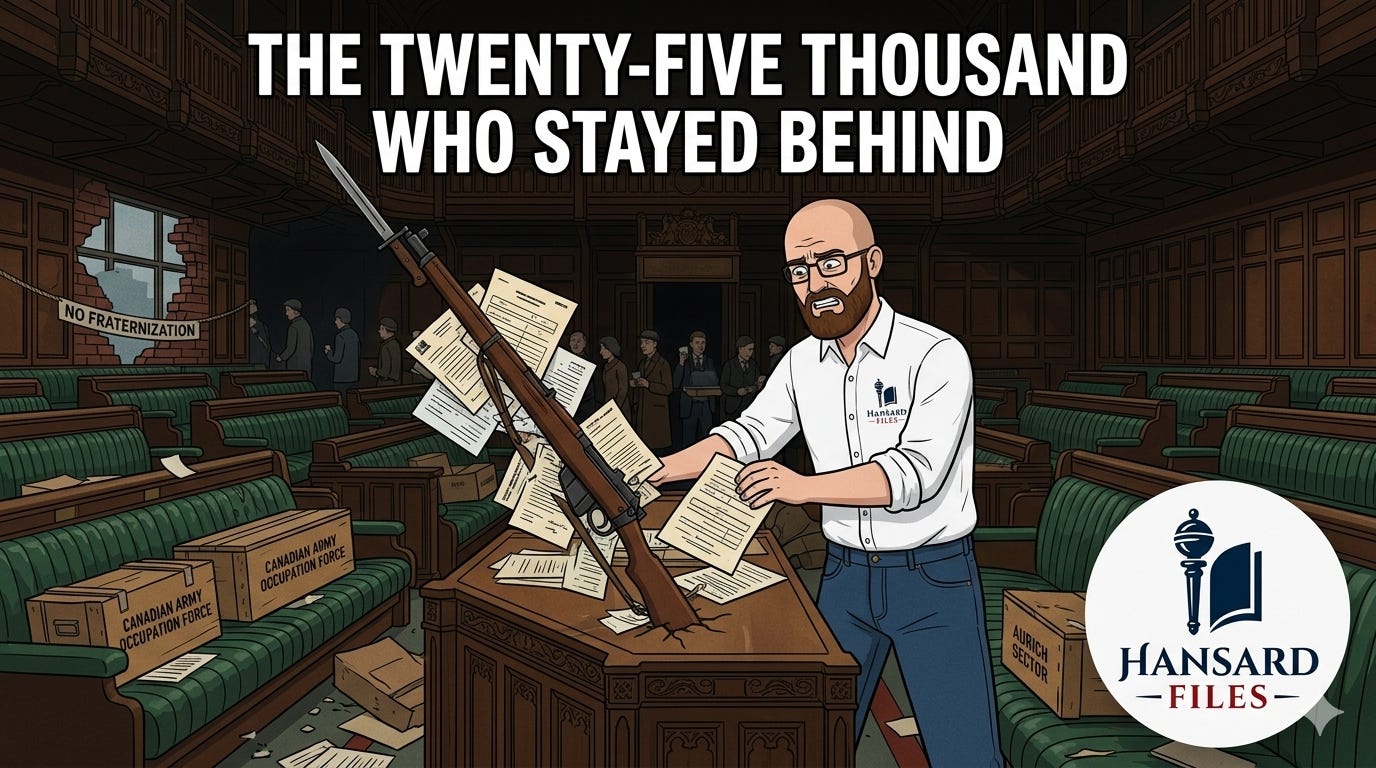
While parades filled the streets of London and Toronto, twenty-five thousand Canadian soldiers were ordered not to pack their kitbags for home, but to advance deeper into the German Reich. Their mission was no longer to kill the enemy, but to rule him. They were the Canadian Army Occupation Force (CAOF), a unique formation tasked with governing a specific slice of North-West Germany—the Aurich peninsula and the Oldenburg sector.
History remembers the combat. It remembers Juno Beach and the Scheldt. It largely forgets the year that followed, when young Canadians, hardened by battle, had to transform overnight into police officers, judges, and administrators in a land shattered by their own artillery.
Operation Eclipse: The Plan to Break a Nation
Long before the surrender, Allied planners at 21 Army Group had been drafting the blueprint for the post-war reality. They called it “Operation Eclipse.” The name itself suggested the total overshadowing of the Nazi state. The objective was absolute: “Once and for all no possible shadow of doubt shall be left in the mind of a single German that the military might of the Third Reich has been shattered”.
The plan was ruthless in its binary logic. It had two phases:
Destructive: To render the German military machine “completely innocuous for all time”.
Constructive: To re-establish law and order so a new government could eventually emerge.
The Canadians were handed a sector of operations that included the naval base of Wilhelmshaven and the historic city of Aurich. But the planners had expected a fight to the bitter end. They warned of “Werewolves”—fanatical Nazi guerrilla bands expected to wage an insurgency from the mountains and forests. They anticipated sabotage, the concealment of archives, and the use of local police as “a cloak for military bodies”.
What the Canadians found instead was not a guerrilla war, but a logistical avalanche.
The Geography of Surrender
The German command structure had collapsed faster than the Eclipse planners anticipated. Instead of hunting down holdouts, the 3rd Division found itself managing a flood of defeated humanity.
In the days following the ceasefire, the Canadian Corps had to facilitate the movement of the German 25th Army out of Holland. This was a massive, defeated host. They marched them across the causeway into the containment zone north of the Ems-Jade Canal.
The numbers were staggering. By May 29, just three weeks after the surrender, the Canadians were guarding 120,000 German prisoners of war in their sector alone. These weren’t just soldiers; they were the remnants of a broken superpower, now entirely dependent on their former enemies for food, water, and order.
The Canadians established their headquarters at Aurich, with the 2nd Corps HQ at Bad Zwischenahn. From these command posts, they looked out over a landscape of total ruin. The infrastructure was pulverized. The “searchlights” of the British Army of the Rhine (BAOR) had been withdrawn, leaving the streets dark.
The Human Wreckage
If the surrendering Wehrmacht was a logistical headache, the Displaced Persons (DPs) were a humanitarian nightmare. The Canadian sector was awash with slave laborers, concentration camp survivors, and refugees who had been dragged into Germany from every corner of Europe.
Report No. 174 describes the situation with stark bureaucratic brevity: “In any one sector it was possible to find people of every nationality who were destitute and who did not wish to remain in Germany”.
The morale of these people was “exceedingly low”. Many had been cut off from their families for five years, with no communication. They were starving, traumatized, and often sick. The Canadian soldiers, trained to storm beaches and clear trenches, were suddenly social workers. They had to establish camps, source food in a famine-struck land, and organize repatriation transports.
The Sullen Peace
The most chilling aspect of the occupation, however, was the attitude of the German civilians. The “Werewolf” insurgency never materialized, but something colder took its place.
Canadian intelligence reports noted a disturbing psychological disconnect in the local population. “Outwardly, the Germans appeared quite mild and resigned to the defeat of the German armies,” the report observed. But beneath the submissive surface, the soldiers felt the “existence of German pride, a pride which... has not been beaten down”.
The Canadians quickly realized that the “re-education” promised in Operation Eclipse would be a generational struggle. To the civilians in the Aurich sector, the catastrophe of 1945 wasn’t a moral awakening; it was just a tactical loss. “They had merely lost a war which, one gathers from their attitude, was only one war among others yet to come”.
Fraternization and the Morale Crisis
For the young Canadian soldiers, the “No Fraternization” policy became the defining tension of their daily lives. They were ordered to have no social contact with the enemy population. They were conquerors, not guests.
But as the months dragged on, the strict separation between the lonely soldiers and the destitute German population began to erode. The report cites “fraternization” and “general morale” as the two most serious problems facing the CAOF command.
The soldiers were bored. They had won the war, yet they were stuck in a ruined province while their comrades in other units were shipping out. A unit report from August 1945 bluntly stated: “It is believed that the morale of the Div has suffered in that no information as to policy re occupation troops has been issued”.
The leadership tried to fill the void with educational programs and training, ostensibly to fit the men for civilian jobs back in Canada. But the delay in repatriation gnawed at them. The Canadian Government had only committed to providing the occupation force until March 1946, a “period yet to be determined”.
The Long Way Home
By the winter of 1945, the CAOF was managing not just a military occupation but the survival of a society. They had to get the German population through the winter, providing food and fuel to prevent mass starvation and disease. The soldiers who had fought their way across the Rhine were now distributing coal to the people who had cheered Hitler.
The end finally came in the spring of 1946. On May 15, the last entry in the CAOF war diary recorded the weather as “Rain and cool”. The command of the area was handed over to the British 52nd Lowland Infantry Division.
Two years almost to the day after D-Day, the Canadians withdrew from the soil of defeated Germany. They left behind a stabilized sector, a disarmed enemy, and a population that had survived the abyss of Year Zero.
The Canadian Army Occupation Force is often a footnote in the grand narrative of WWII—overshadowed by the combat that preceded it and the Cold War that followed. But for one year, 25,000 Canadians stood on the ruins of the Third Reich, proving that the hardest part of war isn’t always the fighting. It’s the cleaning up.
Digging through declassified military reports takes time and resources. If you value this kind of deep historical forensic work, please subscribe to Hansard Files.
Source Documents
Historical Section (G.S.). (1986). Report No. 174: The Canadian Army Occupation Force in Germany, May 1945 to June 1946. Department of National Defence.
Thank you for that. A fascinating bit of history I'd never heard before!!
Thanks for an excellent article. I have followed Canadian military history for decades and didn’t realize our assignment in postwar Germany was that substantial and challenging.