


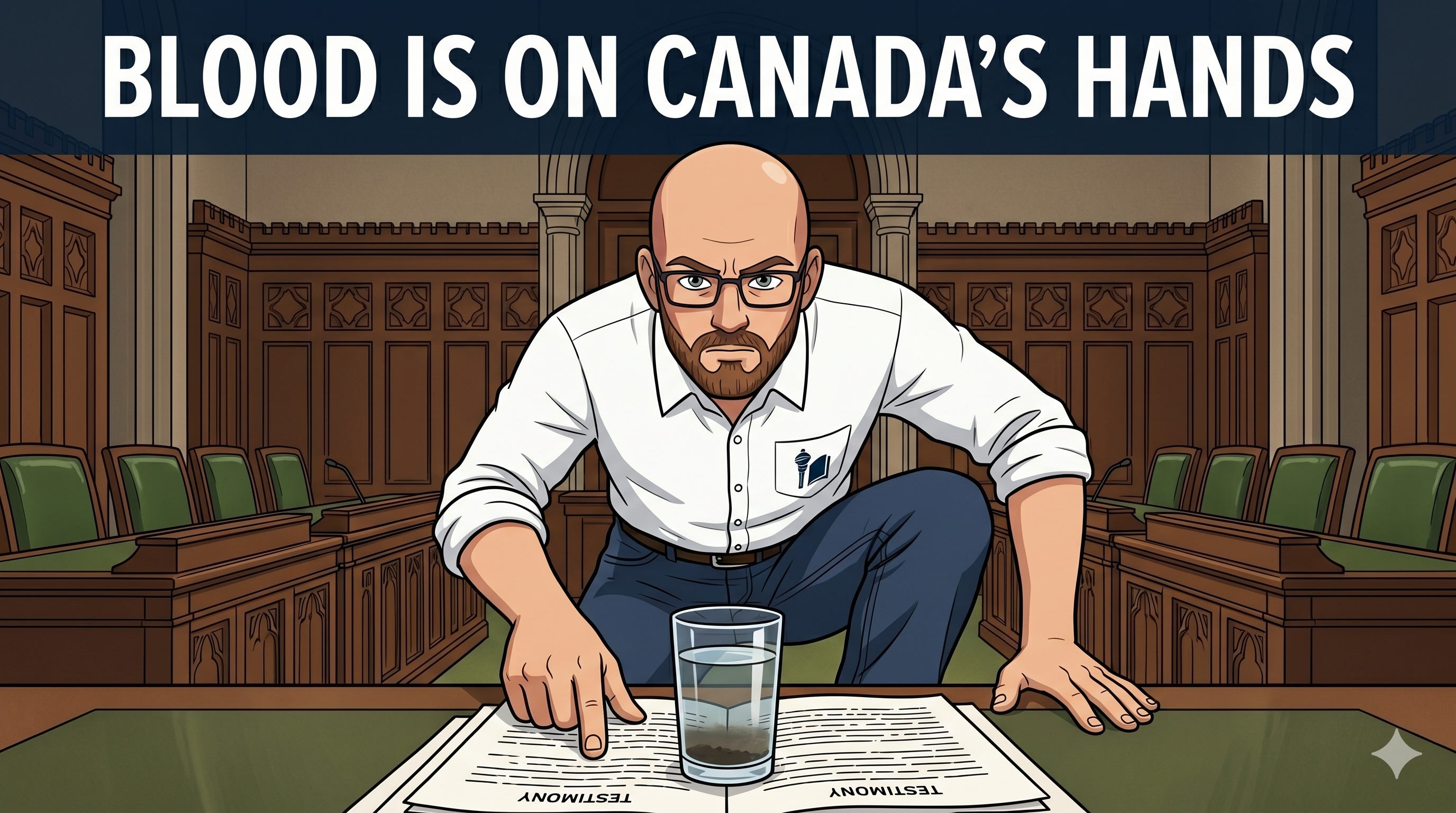
Chief Billy-Joe Tuccaro came to the committee room with a number. Not a policy position, not a legal argument. A number. Twenty-four. That is the average number of people in the Mikisew Cree First Nation currently diagnosed with cancer. His community has between 500 and 600 members.
He did the math out loud for the senators.
“In 20 years,” he told the committee, “we are all going to be gone.”
Then he said something else, something the parliamentary record now holds in permanent ink:
“Blood is on Canada’s hands.”
What Alberta Did on May 19
To understand why Chief Tuccaro was sitting in front of a Senate committee, you need to understand what happened on May 19, 2026. That is the date Alberta announced it would begin treating and releasing toxic oil sands tailings into local watersheds, water that flows through and around the traditional territory of the Mikisew Cree First Nation in the Athabasca region.
The Mikisew Cree were not consulted before that decision was made.
Witnesses before the Senate committee studying the duty to consult and accommodate Indigenous peoples made the connection explicit. Alberta’s move came in the shadow of two pieces of legislation that critics argue were designed to accelerate exactly this kind of decision: the federal One Canadian Economy Act and Alberta’s own Expedited 120-Day Approvals Act. Together, according to testimony before the committee, these laws create a legal environment that compresses timelines in ways that can effectively squeeze out meaningful Indigenous consultation before approvals are locked in.
The duty to consult, witnesses argued, is being treated not as a genuine obligation but as a procedural checkbox.
The Gap Between the Law and the Land
Canada’s courts have said for decades that the Crown has a constitutional duty to consult Indigenous peoples before taking actions that might affect their rights. The principle is not disputed. What is disputed, and what the Senate committee heard at length, is whether that duty is being honoured in any meaningful sense.
Mark Cliffe-Phillips, one of the witnesses who testified, put the problem plainly. “The best consultation is not consultation conducted after decisions have effectively already been made,” he told senators. “The best consultation occurs early enough to shape decisions, not simply react to them.”
That distinction, between consultation that shapes a decision and consultation that reacts to one already made, sits at the heart of the crisis the Mikisew Cree are living through. By the time Chief Tuccaro was invited to speak to a Senate committee, the tailings policy had already been announced. Alberta had already moved.
Witnesses also pointed to a structural problem that extends far beyond any single province or project. The duty to consult is estimated to be triggered hundreds of thousands of times per year across federal and provincial levels in Canada. The volume is enormous. The infrastructure to handle it meaningfully, according to testimony, is not.
The Kebaowek First Nation, also represented in testimony, took a different approach to the gap. Rather than waiting for the Crown to consult them in good faith, Kebaowek created its own Rights and Responsibilities Assessment Law, a community-developed framework to operationalize Free, Prior, and Informed Consent, referred to in the testimony as FPIC. The idea was to stop depending on the Crown’s process and build one of their own.
The Mackenzie Valley Environmental Impact Review Board was held up as a counter-example of what good process looks like. There, consultation is embedded in the review structure from the start, built on modern land claims, not bolted on after decisions are nearly finalized. Witnesses pointed to it as proof that the systemic failure is a choice, not an inevitability.
Forty-Eight People in Two Years
Chief Tuccaro’s testimony did not stay at the abstract level of legal frameworks and policy design. He brought the committee back, repeatedly, to what is happening in Fort Chipewyan.
Between 2024 and mid-2026 alone, the Mikisew Cree First Nation recorded 48 cancer diagnoses. In a community of 500 to 600 people. That works out to roughly one diagnosis for every twelve community members in a roughly two-year span.
He was not presenting this as an allegation of causation. He was presenting it as a reality that his community is living. The connection between toxic tailings releases upstream and the health of communities downstream is a question that has followed the oil sands industry for years. Chief Tuccaro’s testimony did not resolve that scientific question. It landed something else entirely: a chief of a small First Nation, sitting in a federal committee room, telling Canada’s senators that his people are being diagnosed with cancer at a rate his community cannot sustain, and that no one consulted them before the latest decision to release more contaminants into their water.
“I’m begging,” he told the committee.
What UNDRIP Was Supposed to Fix
Canada passed legislation to align federal law with the United Nations Declaration on the Rights of Indigenous Peoples. UNDRIP includes the principle of Free, Prior, and Informed Consent. Witnesses before the committee were direct: the gap between UNDRIP’s promise and what the Mikisew Cree experienced on May 19 is not a technicality. It is the entire problem.
The testimony described a pattern. Crown consultation processes too often begin after the critical decision windows have already closed. They are designed, witnesses suggested, around the minimum legal threshold, not around the kind of genuine engagement that would allow an Indigenous nation to meaningfully influence an outcome. When communities push back, the default response from governments and proponents is litigation, not redesign.
Chief Tuccaro’s appearance before the committee was, in one sense, itself evidence of the gap. A chief whose community is recording cancer diagnoses at a rate that, if sustained, could hollow out his nation inside a generation, was using the parliamentary committee process as a last resort. He had already watched a decision get made without him. He was now asking senators to understand what that decision might cost.
The committee did not vote on anything that day. No legislation was amended. No regulatory order was stayed. The toxic tailings are still being released.
What the parliamentary record now contains is a chief’s testimony, a number, and a sentence that will not age out of the Hansard: “Blood is on Canada’s hands.”
Hansard Files reads the primary record so you don’t have to. If accountability journalism like this matters to you, consider subscribing to keep this work independent.
Related Hansard Files Articles


Source Documents
Senate of Canada. (2026). Evidence of the Standing Senate Committee on Aboriginal Peoples (or relevant committee). Study on the duty to consult and accommodate Indigenous peoples (34ev-57753.pdf). Senate of Canada.
This is appalling and inexcusable.
This is exactly how the government of an independent Alberta will continue to act.