


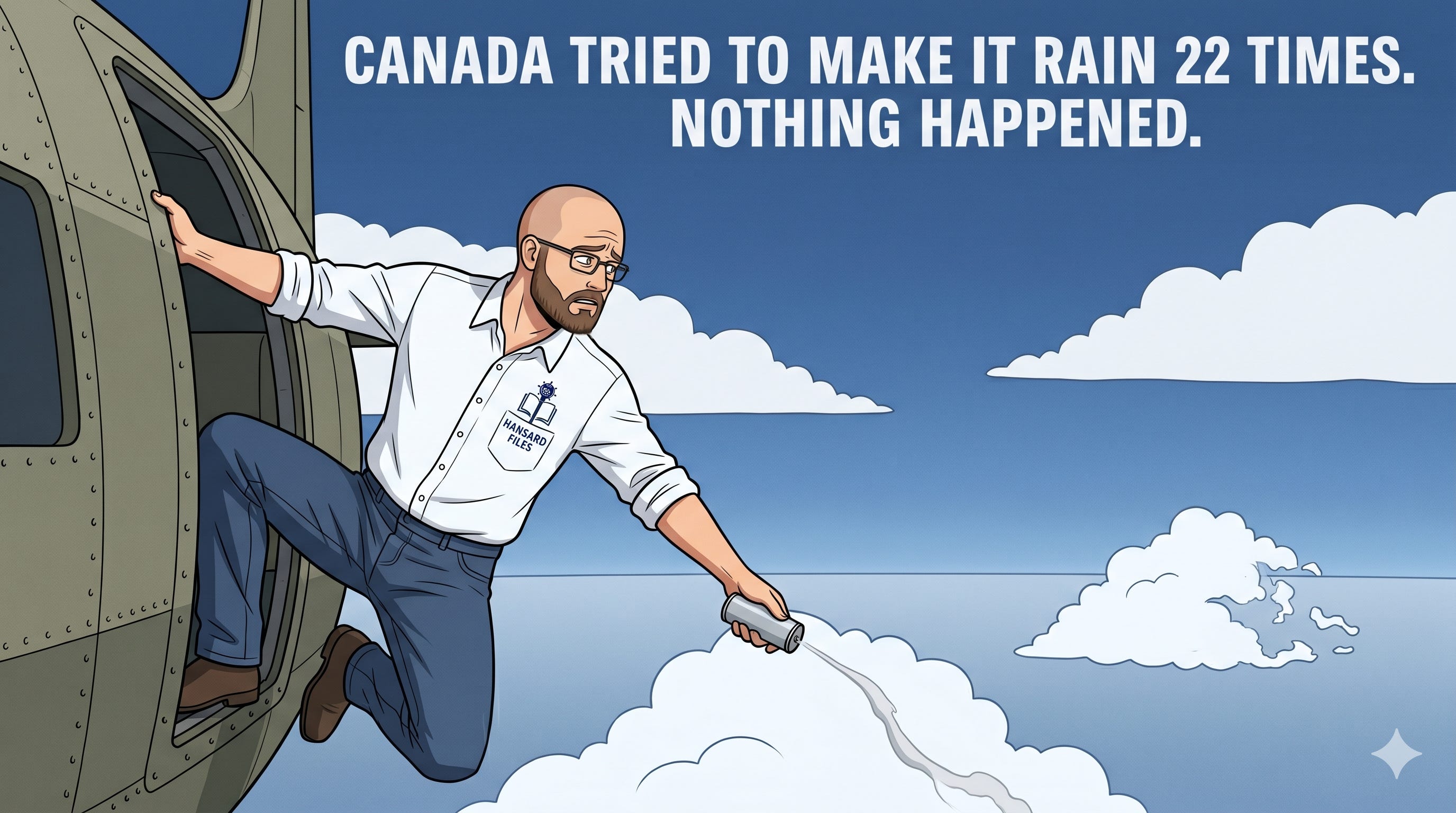
The aircraft was a North Star, heavy and instrumented for ice research, known around Rockcliffe Air Base as the “Ice Wagon.” On the morning of July 7, 1953, it climbed into the skies above Ontario carrying a custom-built silver-iodide smoke generator, a camera, and a scientist named R.H. Douglas who was about to witness something that would haunt the report he filed eighteen months later.
The first cloud that day reached 18,300 feet. Rain and hail were already falling below it. Douglas’s crew seeded it, circled, and waited. Within twenty minutes, the cloud glaciated and dissipated, rainfall reaching the ground. It looked, for a moment, exactly like a success. Then the report records the quiet devastation of that hope: numerous nearby clouds, none of them seeded, did precisely the same thing at precisely the same time. The cloud had not responded to the silver iodide. It had simply died the way clouds do.
That was the story of Canada’s entire early cloud-seeding program. Compressed into a nine-page classified technical circular published December 3, 1954, by the Meteorological Division of the Department of Transport, report TEC-201 is one of the earliest federal documents to honestly, methodically, and without political cover, admit that the Canadian government could not make it rain.
The Ice Wagon and Its Unlikely Mission
The postwar years were a time of extraordinary scientific ambition. In 1946, American chemist Vincent Schaefer dropped dry ice into a supercooled cloud from a small aircraft and watched it snow. The world noticed. Within two years, the United States had launched Project Cirrus, a military-backed weather modification effort. By 1948, Canada was conducting its own cloud-seeding experiments with dry ice. Silver iodide came next, championed by physicist Bernard Vonnegut, who had shown that its crystal structure closely mimicked that of ice and could theoretically trigger the same glaciation response at temperatures well above what dry ice required.
The idea was operationally seductive. If you could reliably cause a supercooled cumulus to glaciate on command, you could theoretically produce rain where and when you needed it. Agriculture. Forestry. Hydroelectric power. The implications were vast. The federal government wanted to know if it worked.
So they put a smoke generator on the Ice Wagon and gave Douglas the summers of 1952 and 1953.
The equipment itself was an improvisation. The silver-iodide solution, a formula drawn directly from Vonnegut’s published research (200 grams of silver iodide, 100 grams of ammonium iodide, dissolved in water and acetone), was pressurized with nitrogen to avoid the risk of the acetone boiling at altitude. A propane combustion chamber vaporized and burned it into smoke. There was no reliable in-flight way to check how much solution was actually flowing. The needle valve was “calibrated in a crude fashion on the ground.” In the air, Douglas was flying on estimates.
Most seeding runs lasted about a minute. That was enough to deliver the 5 to 10 grams per cloud recommended in the literature.
Thirty Hours Over Canada, No Confirmed Rain
The 1952 season logged 30 hours and 3 minutes of total flight time across nine sorties. Seven cumulus clouds were seeded. The plan had been to work within range of McGill University’s weather radar installation at Montreal Airport, where the “Stormy Weather” Research Group could track the clouds’ internal behavior after seeding. It didn’t work out. The radar coordination failed, the IFF tracking equipment arrived too late in the season, and the aircraft’s limited availability meant they couldn’t stay tied to one location. Douglas and his crew simply chased clouds wherever they found them.
Five of the seven clouds seeded in 1952 were of frontal origin, the kind that form along weather boundaries and are already primed for natural development. The results table in the circular is brutally sparse. One cloud on July 30 produced nothing, the temperatures too warm for silver iodide to activate. On August 7, flying the long Ottawa-to-Winnipeg route to intercept a frontal system, one cloud appeared to glaciate and dissipate after seeding. But nearby, unseeded clouds were doing exactly the same. On August 8, the smoke generator failed mid-flight. On August 29, the lone cloud seeded showed no change at all, while nearby clouds were glaciating and forming anvil tops on their own.
The 1953 season was more methodical, more cautious, and ultimately more honest about its own limitations. Douglas and his team had learned something from the year before. There was a possibility, they now recognized, that the passage of an aircraft through supercooled cloud could itself produce ice particles. So in 1953, with one exception, the Ice Wagon stayed outside the clouds entirely. They seeded from below, from the base, delivering smoke upward into the cloud’s base layers.
Fifteen clouds were seeded across four active flying days in July. Total flight time for the season: 18 hours and 45 minutes. Two additional flights in June found no suitable clouds at all.
The Problem Nobody Had Solved
What emerges from TEC-201’s discussion section is not a story of equipment failure or inadequate effort. It’s something more uncomfortable. Douglas is methodically laying out why the experiment was, in a fundamental scientific sense, almost impossible to evaluate.
Rain formation inside a cumulus cloud is not a single event triggered by a single cause. It is the end product of temperature gradients, droplet size distribution, liquid water content, vertical draft structure, turbulence, wind shear, and entrainment effects that all vary in space and time, often within the same cloud, within the same minute. Two initiation mechanisms are possible: the Bergeron-Findeisen process, which involves ice crystal growth in supercooled water, and the coalescence process, in which droplets simply collide and grow heavy enough to fall. Silver iodide is designed to promote the first mechanism only.
The fundamental problem, as Douglas spells it out with quiet precision, is this: silver iodide only becomes fully effective at around -10 degrees Celsius, though its threshold of activity begins at approximately -4 degrees. But natural precipitation in a vigorous cumulus often proceeds before the cloud summit reaches -10. If a cloud’s top is already pushing past -15 degrees at the time of seeding, the natural glaciation process is likely already underway before the inoculant even reaches the critical level. The resulting precipitation, if any, cannot be conclusively attributed to the seeding. It was probably going to happen anyway.
Douglas ran a theoretical example to make the problem concrete. Suppose a growing cloud is based at 850 millibars with a surface temperature of plus 10 degrees Celsius. If that cloud is more than 3,000 feet deep when seeded, the summit will reach the -15 degree threshold before the silver iodide smoke reaches the -7 degree activation zone. Under those conditions, the experiment is not really an experiment at all. It is a spectator sport.
Why 22 Clouds Wasn’t Enough, and Might Never Be Enough
The report’s conclusions are measured, careful, and quietly damning.
Of 22 cumulus clouds seeded across both summers, none showed visible modification attributable to silver iodide. In several 1953 cases, there was reason to doubt the smoke had even reached the critical altitude before the cloud changed state on its own. The report references Australian research by E.G. Bowen showing a similar pattern: silver iodide “proved to be much less effective than dry ice, and in most of the cases no visible results appeared.”
This was not a dismissal of silver iodide as a reagent. Douglas is careful to say that. Instead, it was a recognition that seeding individual clouds, one at a time, was scientifically inadequate. To get meaningful data, you would need to observe both seeded and unseeded clouds under identical atmospheric conditions and compare their precipitation-probability curves over a prolonged series of trials. You would need to choose clouds early in their development, before natural glaciation becomes probable, but then hope those same clouds continue growing to significant heights. You would need radar, because internal modification might occur without any visible external change at all. And you would need to operate in a “well-favoured cumulus breeding area” where enough suitable clouds developed consistently enough to generate a statistically useful sample.
In other words, the experiment needed to be orders of magnitude larger, better instrumented, and more rigorously designed than two improvised summers aboard a borrowed aircraft permitted.
The Honest Failure That Science Needed
What TEC-201 represents, in retrospect, is something worth recognizing. In 1954, a federal scientist submitted a report admitting that a government program had not worked, explaining why it had not worked, and outlining with precision what would be needed to determine whether it could work. There are no inflated claims. There is no pressure to justify the expenditure. The smoke generator broke. The clouds seeded themselves. The IFF equipment arrived late. The report says all of it.
Canada would not abandon cloud seeding. The 1950s would see a proliferation of rainmaking activities across the prairies for agricultural purposes, in eastern Canada for forestry and hydroelectric power. A 1959 federal experiment in northeastern Ontario and northwestern Quebec seeded large-scale storm systems with silver iodide for four years and produced an overall small decrease in rainfall that was not statistically significant. In Quebec, a rainmaking program was perceived by local residents as so successful that mothers petitioned the provincial government for vitamins for their children because of insufficient sunshine, leading the Quebec minister of natural resources to ban all rainmaking activities in the province in 1965. The science was never as clean as the politics required it to be.
Today, cloud seeding is used in Alberta to suppress hail. A British Columbia company is testing silver iodide applications over wildfire zones, claiming it could prevent up to 100 percent of lightning strikes during high-risk periods. The same fundamental questions that Douglas identified in 1954, about attribution, about natural variability, about the impossibility of a control cloud, remain at the center of every debate about weather modification.
The Ice Wagon was retired long ago. The question it was sent to answer is still open.
If you ever wonder why governments continue to fund programs that are genuinely difficult to evaluate, and why the absence of proof is never quite the same as proof of absence, TEC-201 is a useful document to have read. Douglas asked good questions seventy years ago. We are still working on the answers.
Hansard Files spends weeks in the archives so you don’t have to. If stories like this matter to you, subscribe to keep this work independent.
Related Hansard Files Articles


Source Documents
Douglas, R.H. (1954, December 3). Airborne Cloud-Seeding Trials, 1952 and 1953. Meteorological Division, Department of Transport, Canada. CIR-2568 / TEC-201. Environment Canada Archives, SKP Box 672572425.
A very interesting read. Thank you.