


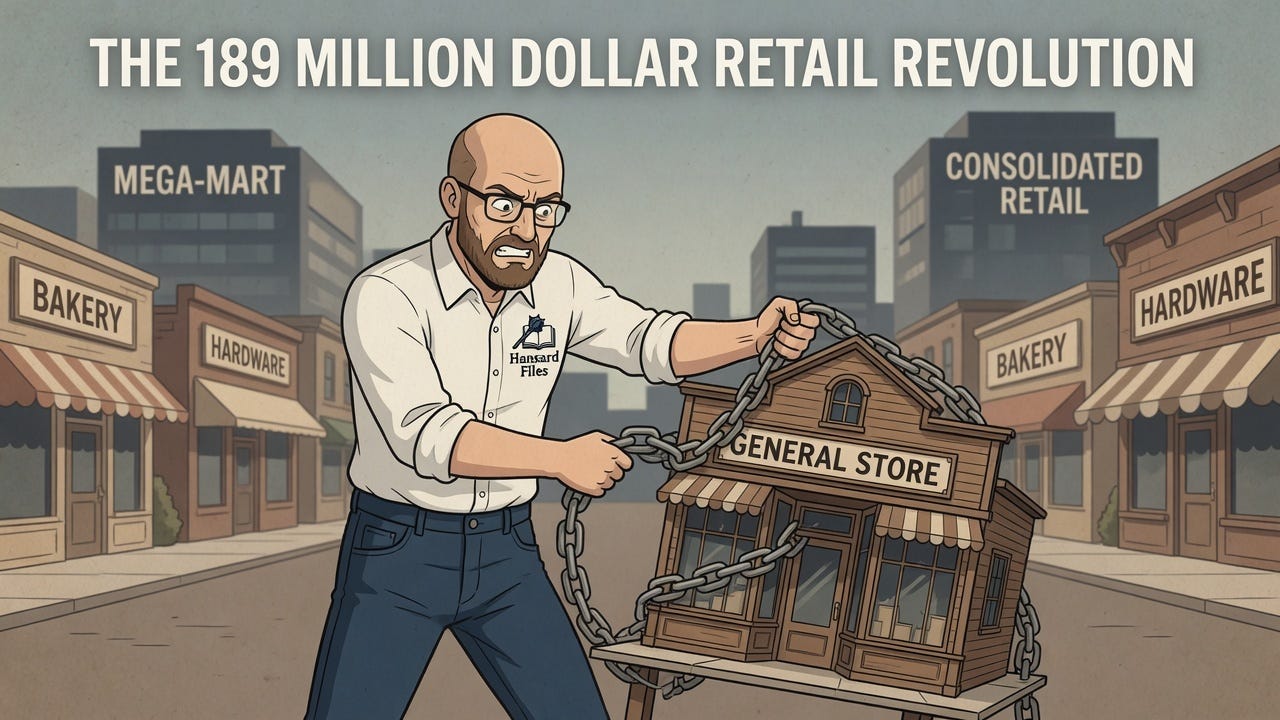
October 1929 remains the most infamous month in economic history. While Wall Street traders watched ticker tape with mounting dread in New York, a different kind of financial assessment was being finalized in Ottawa. On October 26, 1929, exactly three days before Black Tuesday shattered the global economy, the Dominion Bureau of Statistics released a pioneering document. It was not a warning about stocks, but a survey of a retail phenomenon that was quietly reshaping the daily life of the nation. The subject was the rise of chain stores.
The report, titled Survey of Chain Store Systems in Canada, captures a frozen moment of commercial evolution. It depicts a marketplace on the precipice of the Great Depression, where the centuries-old dominance of the independent shopkeeper was facing its first organized industrial threat. For the first time, federal statisticians attempted to measure the scope of corporate consolidation in the retail sector. The data they uncovered reveals a nation in transition, caught between the personalized service of the village general store and the standardized efficiency of the emerging corporate giants.
The Scale of the New Machine
The Bureau’s investigation identified 132 distinct chain store systems operating within the dominion. These were not the ubiquitously branded multinational conglomerates of the twenty-first century, but they were the clear ancestors of modern retail. Together, these organizations controlled 2,970 individual stores. While this number might seem modest by modern standards, the financial throughput was staggering for the era. In 1928, these chains generated total sales of $189,723,797.
To put this figure into perspective, the report notes that with a population of approximately 9.6 million people, the chain store industry was already extracting roughly $20 for every man, woman, and child in the country. This revenue, however, was not distributed evenly across the map. The province of Ontario was the undisputed heartland of this retail revolution, accounting for over $107 million of the total sales. Quebec followed with $43 million, while British Columbia punched above its weight with $13 million. In contrast, the Maritime provinces and the Prairies remained largely the domain of the independent merchant, with chain penetration significantly lower.
The statisticians were careful to contextualize their findings. They estimated that the total retail spend of the Canadian public was approximately $2 billion. This meant that despite their rapid growth and high visibility, chain stores captured less than 10 percent of the total market. The independent store was still the “dominant factor in distribution,” according to the text. Yet the tone of the report suggests that the bureaucrats understood this dominance was fragile. The chain store was not merely a new competitor; it was a new method of distributing goods, one that was “proceeding so rapidly that it is difficult to obtain an up-to-date measurement of its dimensions.”
The Grocery Wars
The primary battlefield for this commercial conflict was the grocery sector. Of the 132 chains surveyed, the grocery category was the most numerous, boasting 24 distinct systems and 1,319 stores. This single sector accounted for nearly half of all chain locations in the country. The grocery chains reported sales of over $64 million, representing roughly 34 percent of all chain store revenue.
The report provides a fascinating glimpse into the specific economics of food distribution. While the independent grocer typically operated on thin margins and relied on personal relationships, the chains were leveraging volume. The document estimates that independent grocery sales nationwide totaled between $250 million and $300 million. This meant that by 1929, the chain systems had already seized approximately 20 to 25 percent of the grocery market. This was a far deeper market penetration than in any other sector, signaling that the commodification of food would be the wedge used to break the independent retailer’s hold on the consumer.
The Bureau noted that this aggressive expansion had already triggered a response. “Important counter movements are developing,” the authors wrote, describing the formation of organizations of independent stores banding together for “large scale buying and advertising.” This was the birth of the cooperative model, a defensive strategy forged in the heat of “intense competition” between the growing corporate entities and the entrenched independent merchants.
The Blurring of Lines
One of the most insightful aspects of the 1929 survey is its analysis of what it termed “Sales Outlets.” The statisticians recognized that a store’s sign did not always indicate what was being sold inside. As chains sought to maximize revenue per square foot, they began to blur the traditional boundaries of trade. A drug store was no longer just a pharmacy; it was becoming a general retailer.
The survey found that the 132 chain systems contained 16,166 distinct “merchandise outlets.” This meant that, on average, every single chain store location was selling products from five different commodity classes. The breakdown of these outlets offers a portrait of 1920s consumer culture. There were 960 outlets for candy and confectionery, 650 for tobacco, and 394 for meals.
The drug store chains were particularly aggressive diversifiers. The report highlights that the modern drug store had become a distribution point for stationery, tobacco, soda-fountain products, and refreshments. This diversification strategy allowed chains to insulate themselves against fluctuations in any single market. If pharmaceutical sales dipped, the soda fountain or the tobacco counter could carry the overhead. This was a level of strategic resilience that the specialized independent cobbler or butcher struggled to match.
The Roaring Twenties Consumption Habits
The sales data categorized by commodity class provides a window into the lifestyle of Canadians just before the economic collapse. While foodstuffs dominated the ledger, with groceries and meats accounting for nearly 40 percent of all sales, the discretionary spending reveals a society that was investing heavily in leisure and appearance.
Chain stores sold over $6 million worth of candy and confectionery, a figure that exceeded the sales of men’s and boys’ clothing ($5.9 million). Perhaps most surprisingly, the sales of “Musical Instruments and Sheet Music” reached $6.6 million. In the era before widespread radio dominance and long before television, Canadians were spending more at chain stores on music than they were on furniture ($5.2 million) or boots and shoes ($4.4 million).
The data also reflects the gender dynamics of the era’s consumerism. Women’s outerwear sales stood at $5.6 million, with hosiery adding another $2.6 million. The report meticulously tracked these sub-categories, recognizing that the female consumer was becoming the primary driver of retail growth. The chain stores had optimized their inventory to capture the disposable income of the Roaring Twenties, stocking their shelves with rayon, silk, and novelties that appealed to a populace enjoying a postwar boom.
Foreign Capital and Domestic Control
In the early twentieth century, Canadian economic nationalism was a potent political force, and the Bureau of Statistics paid close attention to the ownership structures of these new retail giants. There was a pervasive fear that American capital was buying up the Canadian high street. The survey provided hard numbers to address these anxieties.
Of the invested capital in these chain systems, the report found that 82 percent was owned within Canada, amounting to nearly $47 million. The United States held a 15 percent stake, valued at roughly $8.5 million, while British investment was a negligible 2.5 percent. While the sector was still overwhelmingly domestic, the presence of significant American capital in the most modern and aggressive sector of the economy was a harbinger of the integration to come.
The report detailed that of the 132 chains, 106 were incorporated companies. This shift from sole proprietorship to incorporation was a critical legal evolution. It allowed these businesses to raise the millions of dollars in bonds and preferred stock necessary to finance their rapid expansion across provincial lines. The independent shopkeeper, relying on bank loans and personal savings, was fighting a competitor that had unlocked the power of the capital markets.
A Prediction Frozen in Time
The authors of the report concluded their survey with a look toward the future, offering a prediction that is haunting in retrospect. Writing in late 1929, they observed that predicting the ultimate outcome was impossible, but they felt certain about the immediate outlook. They foresaw a period of “intense competition between chains and organized independents and between different chain organizations themselves.”
They viewed the retail landscape as a battlefield where efficiency and scale would war against tradition and locality. They could not know that within days of the report’s publication, the stock market would crash, plunging the world into a decade of poverty that would fundamentally alter consumer behavior. The Great Depression would test the resilience of both the chains and the independents. The chains, with their capital reserves and ability to lower prices through volume, would eventually gain the upper hand, but the “intense competition” the Bureau predicted would rage for the rest of the century.
This 1929 survey stands as a tombstone for an era of commerce. It documents the exact moment when the logic of the assembly line was applied to the corner store. The $189 million in sales recorded by the Bureau was not just a statistic; it was the beachhead of a corporate invasion that would eventually conquer the main streets of the nation.
Hansard Files digs through the archives to resurrect the forgotten data that shaped our world. To support this independent research and ensure these stories are not lost to history, please consider subscribing.
Source Documents
Dominion Bureau of Statistics. (1929, October 26). Survey of chain store systems in Canada. Department of Trade and Commerce.
What an amazing article. I read with great interest that in 1929 there 24 grocery chains, today, there are 5 majors, 2 of which are owned by Americans and did not exist in 1929 (I have knowledge of whether the other 3, Sobeys, Metro and Loblaws did). I is obvious to me that even in 1929 there were fears of consolidation and market dominance. And look where we have arrived, only 97 years later.
Anyone with experience living in remote Canada was affected (eventually) by the growth of chain stores. For that reason, shopping local whenever possible became a lifestyle. Sure, I paid more, but as the old phrase goes: either pay now, or pay later.
Supporting local (or others north of the 49th) became a priority.