


The warning arrived, as it often does in committee rooms, dressed up in academic language. But what Martin Kwan, a legal scholar at the University of North Carolina, was describing on the afternoon of April 20, 2026, was not abstract. Sitting before the Standing Senate Committee on Human Rights, he laid out what the Fourth Industrial Revolution actually looks like at ground level: entry-level jobs vanishing before students graduate, careers replaced by gig work, the speed of machine learning outpacing the speed of human retraining.
“Having a stable career becomes a thing of the past,” he said. “Nobody can be spared from this nightmare, and it will hurt vulnerable groups more.”
The room, occupied by senators from Ontario to Saskatchewan to PEI, heard him out. Then the questions began. And for the next eight days, across four separate Senate committees and dozens of witnesses, the same basic tension surfaced again and again. Canada is running a 2000-vintage privacy law. Its one attempt at AI legislation died on the order paper in January 2025 when Parliament prorogued, and has not been reintroduced. Meanwhile, the technology has not waited.
A Country Without a Framework
Canada signed the Council of Europe Framework Convention on Artificial Intelligence and Human Rights, Democracy and the Rule of Law. It ranked third globally in AI research for years. It produced the foundational work that underpins the transformer models now reshaping the global economy. And it has, right now, zero comprehensive federal AI legislation in force.
Senator Kim Pate acknowledged the signing of the convention and then asked the obvious follow-up: since signing is not legally binding, what concrete steps should the government actually take? David Lie, a professor and Canada Research Chair at the University of Toronto’s Schwartz Reisman Institute for Technology and Society, offered three priorities. Protect children from AI harms. Preserve human agency in automated decisions. Require transparency from companies about what their systems actually do.
On the transparency point, Lie gave a specific and unsettling example. Earlier that same month, he noted, a leading AI company had announced that its latest model had discovered thousands of vulnerabilities in software used by millions of people. The company deemed the model too dangerous for public release and restricted it to a small number of organizations. Responsible, perhaps. But it also meant that the public, regulators, and independent researchers had no visibility into the full scope of what that system could do or had already found.
“If we cannot assess the level of danger,” Lie said, “how can we know whether such advances will make failures like the 2021 ransomware attack more or less frequent?”
The committee chair, Senator Paulette Senior, asked whether Lie’s institution had been consulted in developing the government’s forthcoming AI strategy. The answer was no. Not in any particular way. The same invitation that went to everyone had gone to them.
Entry-Level Jobs Are Already Gone
Professor Kwan did not soften this part of his testimony. He described a labour market where AI replaces not the complicated, senior work first, but the starting-gate roles where young people historically get their footing. The data entry clerk. The junior researcher. The administrative assistant. The tasks that teach you the fundamentals of an industry, the unwritten rules, the workflow. Those are the roles that AI handles cheaply and accurately, and those are the roles now disappearing.
“The speed of replacement is faster than people learning new skills,” he said.
Senator Kristopher Wells raised the question of whether AI could be harnessed for good in education, specifically for students with learning exceptionalities who might benefit from personalized AI tutors in overcrowded classrooms. Both witnesses acknowledged real potential there. But the structural problem Kwan had identified persisted: the fruits of AI will not distribute themselves fairly. Some groups will experience net harm during the transition. They need policy-makers to safeguard their rights. The international right to work, he argued, places a positive obligation on Canada to provide not just retraining but vocational guidance. To help people understand what the market will actually look like, not just teach them a skill that might itself be obsolete in three years.
Teresa Scassa, Canada Research Chair in Information Law and Policy at the University of Ottawa, testified in the same session. She described what AI-mediated employment actually looks like from the inside: algorithmic systems screening job applications before a human ever reads them, decisions made by tools that human rights commissions currently lack the technical capacity to audit.
“Apart from issues of whether laws should be changed,” she noted, “there is a need for adequate resources for human rights commissions to engage in technologically complex algorithm-based human rights investigations.”
Senator Wells made a point that landed quietly but deserved more attention. He had been browsing LinkedIn earlier that same day and noticed a line at the bottom of a job posting: “AI is not used to filter applications.” New language. Language that had never been necessary before, because the practice it was disclosing had never existed before.
The Songs Were Stolen. All of Them.
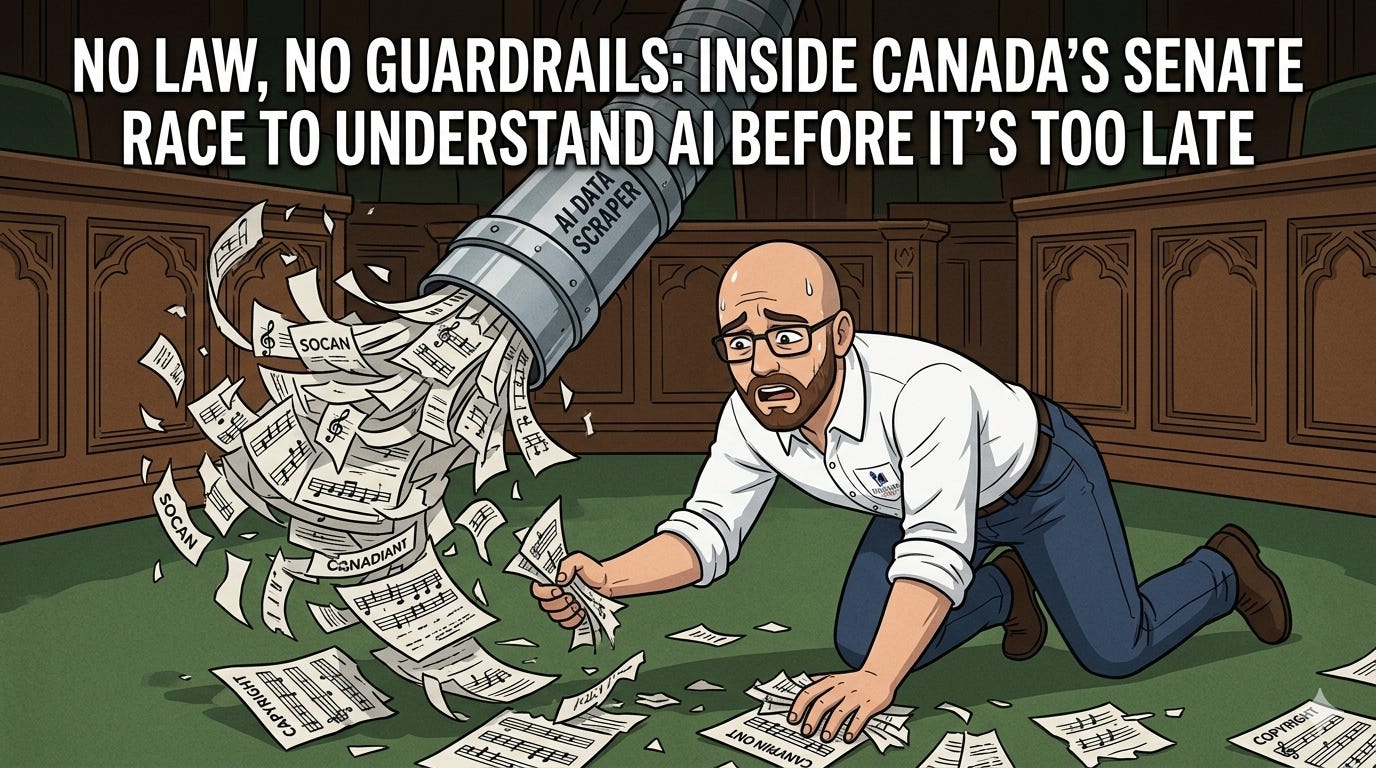
Forty-eight hours after the Human Rights committee, the Standing Senate Committee on Transport and Communications was hearing from a different set of witnesses about a different dimension of the same problem. Julia Werneburg, Legal Counsel and Privacy Officer for the Society of Composers, Authors and Music Publishers of Canada (SOCAN), chose her words with care. A global study by CISAC, she explained, estimated that under current conditions, up to 24 percent of music creators’ revenues are at risk of disappearing because of AI.
Then Margaret McGuffin, CEO of Music Publishers Canada, put it more bluntly.
“Nearly every song ever written by a Canadian songwriter has already been scraped and stolen by these AI companies without consent, credit or compensation.”
Evidence collected by the International Confederation of Music Publishers over three years documented how many of the world’s largest technology companies had taken copyright-protected music and fed it into generative AI systems. No license. No permission. No payment.
John Degen, CEO of The Writers’ Union of Canada and vice-president of the Coalition for the Diversity of Cultural Expressions, reached for a historical analogy that the committee clearly found useful. In the early 2000s, Napster and peer-to-peer file sharing decimated the music industry. But it was not the technology itself that caused the damage; it was the public’s willingness to become pirates, the breakdown in shared understanding that taking without paying was stealing. iTunes and the licensing model that followed eventually rebuilt something workable.
“AI is the same,” Degen said. “AI systems that are trained on music need permission from artists and rights holders. This is done by licensing.”
He also announced something more personal and pointed: his own upcoming novel, Seldom Seen Road, would be among the first books in the world certified under the newly launched Human Authored Certification program, a labelling initiative from the U.S. Authors Guild and the Society of Authors in the U.K. His declaration was legal, not just philosophical. He wrote the book. Without AI.
What Canada Risks by Moving Slowly
Michael Geist , Canada Research Chair in Internet and E-commerce Law at the University of Ottawa, testified the same morning as Degen. He pushed back, carefully and precisely, on the idea that licensing requirements would automatically protect Canadian culture. The risk of over-regulating, he argued, was that AI developers would simply exclude Canadian content from their training sets entirely. They had done something similar with Canadian news after the regulatory environment around Bill C-18 became complicated. Less Canada in the training data means less Canada in the outputs.
He called for an AI transparency act as a starting point: requiring companies to disclose which copyrighted works were ingested into training data, so rights holders could verify when their work was used and negotiate from a position of actual knowledge. The recent situation involving OpenAI and the Tumbler Ridge shooter, he said, illustrated exactly the problem. It should not take a meeting with company executives for a minister to find out what a platform’s policies were on banning users or reporting conduct to police.
Senator Farah Mohamed asked a question that generated visible reaction in the room. Given that ombudspersons already exist for banking, prisons, and privacy, was it not time to consider an AI ombudsperson? She prefaced the suggestion by saying she was prepared to be “guffawed out of the room.” The witnesses did not guffaw. They engaged. The idea sat on the table, not dismissed.
The Two-Tier Society Already Taking Shape
The Human Rights committee reconvened on April 27, and the testimony from David Nolan of Amnesty Tech added a dimension that the earlier sessions had touched on but not fully examined: the human rights implications of AI’s physical and environmental infrastructure, and the concentration of power it enables.
AI data centres, Nolan explained, require enormous quantities of drinking water for cooling, posing threats to local communities, particularly in water-stressed regions. Market power is increasingly concentrated in a handful of technology companies. That concentration is not merely a competition problem. It undermines privacy, access to information, freedom of opinion, workers’ rights, and freedom from discrimination.
The picture drawn by witnesses over multiple sessions was consistent. Voices from Canada’s social sector described a country where AI, rather than reducing inequality, threatened to produce a two-tiered society: one tier equipped with the latest tools and capabilities, another left behind by systems it cannot access, influence, or benefit from. Senator Arnold asked witnesses how the committee should frame this in its report.
The answer from Teresa Scassa was unsparing: “I think it just becomes an overwhelming challenge.”
What was not said in any of these sessions, because nobody could say it with confidence, is that Canada has a plan.
The Sovereign AI Compute Strategy, $2 billion in commitments, was described by Vector Institute’s Glenda Crisp in a different committee session as two years behind schedule. Canada has slipped to eighth overall in the Tortoise Global AI Index. Infrastructure ranks sixteenth. The operating environment, eighteenth.
Four Committees, One Question
By the end of the final week of April 2026, four Senate committees had heard AI testimony in the span of nine days. Human Rights examined job displacement, algorithmic discrimination, vulnerable groups, and children. Transport and Communications heard from music creators, publishers, copyright experts, researchers on algorithmic ageism, and advocates for older adults. The picture assembled across those rooms was not of a government moving decisively. It was of a parliament listening carefully to a problem it has not yet found the political will to address.
Canada signed the Council of Europe convention on AI and human rights. Canada’s only federal AI bill died before it could be voted on. Canada is running privacy legislation drafted in the year 2000.
Professor Lie put the urgency in terms that need no translation: “We simply cannot wait for a tragic, large-scale incident, like the one in 2021, before we act.”
What these committees are building, slowly, through testimony and questions and follow-up letters, is the documentary record of what Canada knew, and when. The question no senator asked aloud, but every transcript implies, is whether the country will act on what it’s learning before the moment the record becomes an indictment.
That part is up to you to watch.
Hansard Files spends weeks in the archives so you don’t have to. If stories like this matter to you, subscribe to keep this work independent.
Related Hansard Files Articles


Source Documents
Standing Senate Committee on Human Rights. (2026, April 20). Evidence: Study on the Impact of Artificial Intelligence on Human Rights and Economic Security in Canada. Senate of Canada.
Standing Senate Committee on Human Rights. (2026, April 27). Evidence: Study on the Impact of Artificial Intelligence on Human Rights and Economic Security in Canada. Senate of Canada.
Standing Senate Committee on Transport and Communications. (2026, April 21). Evidence: Opportunities and Challenges of Artificial Intelligence in the ICT Sector. Senate of Canada.
Standing Senate Committee on Transport and Communications. (2026, April 22). Evidence: Opportunities and Challenges of Artificial Intelligence in the ICT Sector. Senate of Canada.
Mike,
I have been reading this collection of transcripts (along with the House committees, like INDU, that are also engaged with AI), and I noticed that you left out AI safety and existential risk from your summary.
Is that because you are thinking of dealing with it separately or is it not a salient issue for some reason?
Your closing note (“The question no senator asked aloud, but every transcript implies, is whether the country will act on what it’s learning before the moment the record becomes an indictment.”) will be especially poignant if we find ourselves in a situation where humanity is at risk and we spent our time worrying about copyright infringement.
Really enjoying your work and would be very interested to see your thoughts on the risk side of AI.
…r