


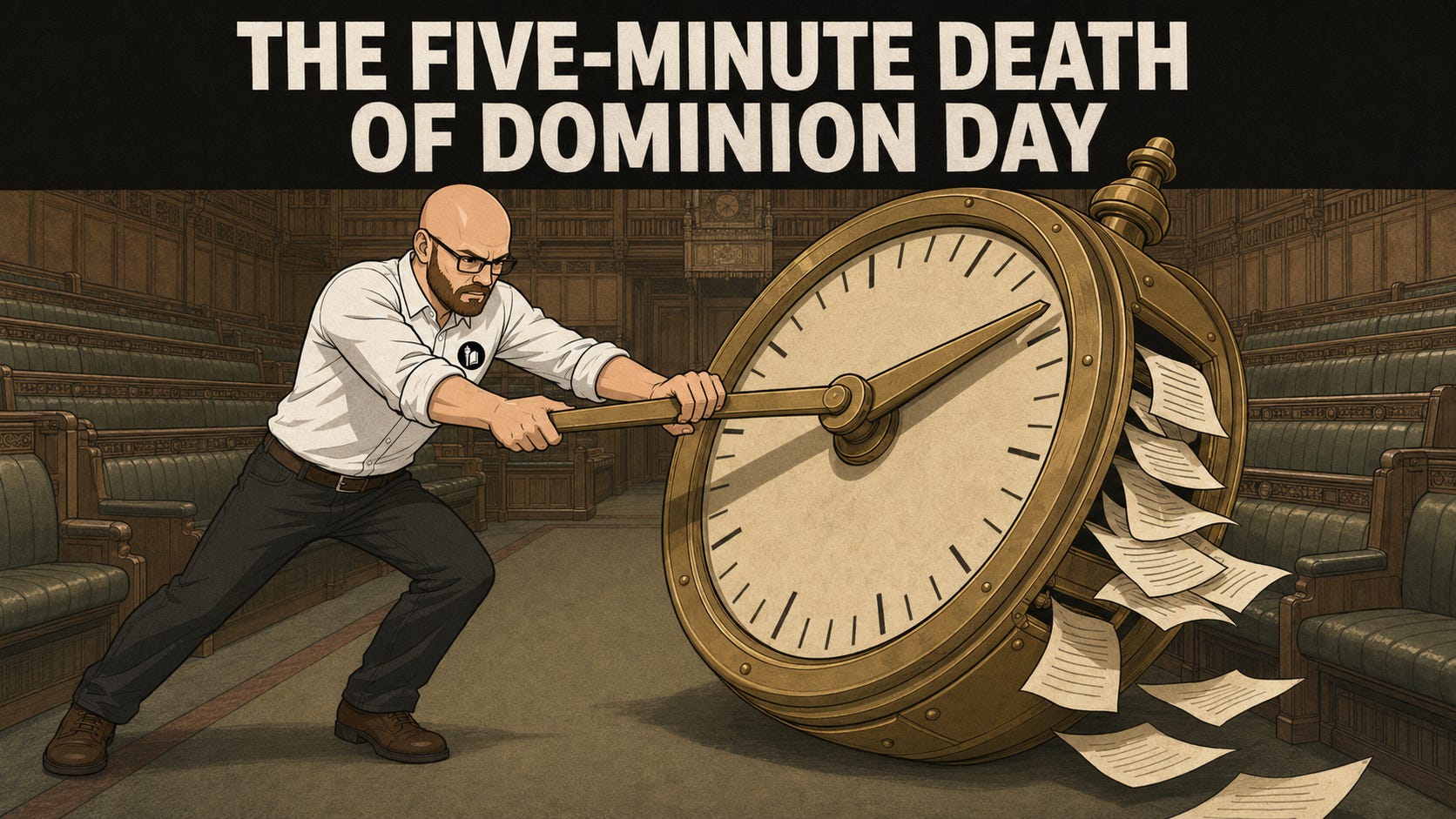
Parliament was nearly empty on the afternoon of Friday, July 9, 1982. Most MPs had already left Ottawa. The ones who stayed were watching the clock. At roughly 4:30 p.m., a private member’s bill called Bill C-201 came up on the order paper. It proposed one change to the Holidays Act: replace the words “Dominion Day” with “Canada Day.” Three words out, two words in. And in less than five minutes, with thirteen members present in a chamber that required twenty for a legal quorum, Canada’s national holiday got a new name.
One MP asked, “What is going on?”
Nobody answered him.
The day the Commons adjourned a country’s identity
The MP who spoke up was David Baker, Conservative member for Nepean-Carleton. His question appears in the Hansard record of that afternoon, a transcript that takes up only one page of the Commons Debates. Baker had barely finished the sentence before the Deputy Speaker, Liberal MP Cyril Lloyd Francis, asked the House for unanimous consent to send the bill to Committee of the Whole. Somehow, the record shows, consent was granted. Francis then chaired that committee himself, moving through the bill with the speed of a man who knew the clock was against him: “Clause 1 agreed to. Preamble agreed to. Title agreed to. Bill reported, read the third time and passed.”
The bill’s sponsor, Liberal MP Hal Herbert of Vaudreuil, Quebec, wasn’t even in the chamber when his own bill passed.
After it cleared, New Democratic MP Mark Rose made a brief speech celebrating the occasion. “I think this is a day on which to develop and to celebrate our new holiday,” Rose said. “It is only appropriate that, in celebrating our new holiday called Canada Day, we should at least take a holiday of 55 minutes for the afternoon.” Then, according to Conservative Senator David Walker’s later account in the Senate, a member asked for unanimous consent that the clock be deemed to read five o’clock, so the House could adjourn immediately and preclude any further objection to the vote that day. The House promptly adjourned.
By that evening, Trudeau was in Kingston, Ontario. “The national Holidays Act was changed,” he told the crowd, “so that the first of July forevermore would be called Canada Day.” A cheer went up. The following Monday, July 12, CBC reported that Conservative MPs who had missed the vote complained loud and long. Deputy Whip Gordon Taylor called it “a sneaky, arrogant way of governing the country.”
What the name meant, and what it cost
The word “Dominion” was not arbitrary. When the Fathers of Confederation gathered in London in 1866 to finalize the country’s name, John A. Macdonald’s preferred choice, “The Kingdom of Canada,” was vetoed by the British Foreign Secretary over concern it would provoke the American republic. The replacement came, according to the Parliamentum account of the record, from Sir Samuel Leonard Tilley of New Brunswick, who looked to Psalm 72:8: “And he shall have dominion also from sea to sea, from the rivers unto the ends of the earth.” The word carried both a monarchical and a geographic meaning, evoking sovereignty over a continent.
Parliament formally recognized July 1 as Dominion Day through the Dominion Day Act of 1879. The preamble of that bill was specific about what the day was meant to commemorate: the entry of the original provinces into Confederation, and the subsequent joining of Rupert’s Land, British Columbia, and Prince Edward Island, all in the month of July, all under the name of Canada. The day existed to mark a precise historical sequence.
By the late 1940s, the Parliament of Canada and the Canada Gazette had both quietly stopped using the term “Dominion” on official letterhead. The phaseout was institutional, not legislative. For decades after, various governments tried and failed to change the holiday’s name through proper channels. A Gallup poll from November 1981 showed 70 per cent of Canadians supported the change to Canada Day. The political will was there. The parliamentary process kept resisting.
‘A horrible little bill’
The Trudeau government had wanted the name change done before July 1, 1982, the first Canada Day after the Constitution was patriated. That didn’t happen. A late-night session in the House on June 22 fell apart when the Progressive Conservatives walked out over a procedural dispute, with NDP House leader Ian Deans telling the Speaker that proceeding without the Official Opposition “would not be an appropriate move this evening.” July 1 came and went with the old name technically still on the books.
Three weeks later, on a hot Friday afternoon with the House nearly empty, it happened anyway.
The Senate received the bill on July 22, 1982. Liberal Senator Florence Bird moved second reading, defending the name change as an overdue break from British colonial nomenclature. She described Dominion Day as a holdover chosen “at the insistence of the British Foreign Office,” and suggested those who preferred the old name suffered from an “inferiority complex” about Canadian identity. Alberta Senator Ernest Manning pushed back hard, according to the record of those July debates. He found it difficult to believe the House had treated a national symbol so casually. “It is the type of thing that creates serious divisions and alienation among Canadians,” he said, and argued the entire rationale for the change rested on a misunderstanding of what “Dominion” actually meant.
Liberal Senator George McIlraith didn’t object to Canada Day as a concept. But he described the bill itself as “a horrible little bill” and pressed the government to proceed in a more “dignified way.” Conservative Senator David Walker, who had clearly read the Hansard carefully, told the Senate chamber exactly what had happened in the Commons: thirteen MPs, a faked clock, an instant adjournment, and a change to the nation’s oldest statutory holiday. He was describing what the constitution said should not have been possible.
Section 48 of the British North America Act, 1867, requires that at least twenty members be present for the House of Commons to exercise its powers. Thirteen is not twenty.
Liberal Senator Ann Bell gave the final speech before the vote. She acknowledged that Dominion Day reflected a tradition that was, in her words, “dying.” She did not celebrate this. “We have a political concept,” she said. “We have a geographical concept. But I am afraid we are losing the spiritual concept of Canada.”
Forty-four senators voted in favour on October 25, 1982. Royal Assent followed two days later, on October 27. The name became official in time to plan the first Canada Day celebrations for July 1, 1983.
The quorum nobody called
There’s a procedural detail buried in this story that hasn’t gone away in forty-three years. The constitutional quorum of 20 members existed precisely to prevent a handful of MPs from making consequential decisions while the rest of the chamber was absent. On July 9, 1982, that protection failed. Not because the rules weren’t there. They were. But because quorum in the House is only enforceable at the start of a sitting or when a member specifically calls attention to it during proceedings. Baker asked what was happening, but he never formally moved that the House lacked quorum. By the time anyone understood what had just occurred, the House had adjourned.
The bill that cleared the Commons that afternoon was, Moscovitz reported for CBC, just three paragraphs long, compared to the three-page government bill that had failed earlier in the year. Three paragraphs, thirteen MPs, five minutes. A name that had been on the statute books for 103 years was gone.
The 1982 Constitution had taken Canada’s founding document home. The patriation was the big story that year. Bill C-201 was the quiet footnote, except it wasn’t entirely quiet. The Senate record of those debates in late July and early August runs much longer than the Commons transcript. Senators from both parties spent hours on the floor parsing a word, a procedure, a concept of nationhood. They knew what they were voting on. They passed it anyway.
Canada Day has now been the country’s official national holiday for longer than Dominion Day was, in its final form, recognized as such. The name nobody voted to change in a full session of Parliament has outlasted the name that 280 elected members might have debated for weeks.
Forty-three years on, what’s in a name is still contested in some corners of the historical record. What’s in the Hansard is not.
Hansard Files goes back to the original record so you don’t have to. If this kind of primary-source accountability journalism matters to you, consider subscribing to keep it going.
Related Hansard Files Articles

Source Documents
House of Commons of Canada. (1982, July 9). Debates (Hansard), 32nd Parliament, 1st Session. [https://parliamentum.org/wp-content/uploads/2014/07/commons-debates-9-july-1982.pdf]
Senate of Canada. (1982, July 22; August 3). Debates (Hansard), 32nd Parliament, 1st Session. [https://dennisryoung.ca/wp-content/uploads/2016/07/The-Death-of-Dominion-Day-by-Robert-Sibley.pdf]
Bowden, J.W.J. (2014, July 2). From Dominion Day to Canada Day: From Historical Significance to Banality. Parliamentum. https://parliamentum.org/2014/07/02/from-dominion-day-to-canada-day-from-historical-significance-to-banality/
CBC Archives. (2022, September 21). Why Canada’s national holiday is no longer Dominion Day. CBC. https://www.cbc.ca/archives/canada-day-1982-1.6496279
Somehow that seems so typical of Trudeau the Elder. I've no doubt it was planned well in advance and executed with a grin.
Being an Ottawan in those days, and within hearing range of downtown gossip, I marvel that the humanity of some of those directly involved could be the means of grace delivering us to Canada Day today. Ever grateful, Hansard Files.