


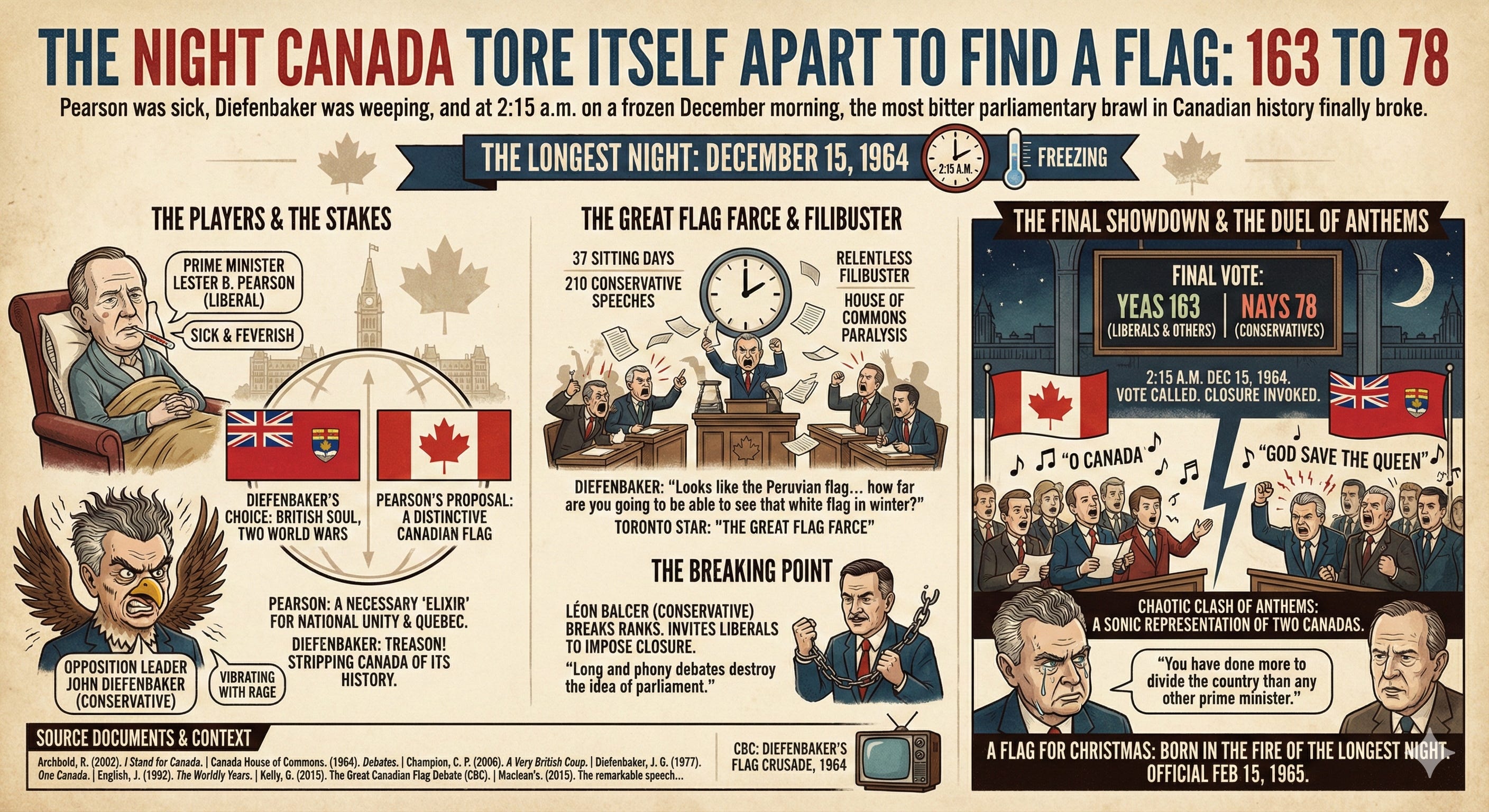
It was 2:00 a.m. on December 15, 1964. Outside the House of Commons, Ottawa was locked in the deep freeze of a pre-Christmas winter. Inside, the air was thick with cigarette smoke, exhaustion, and six months of accumulated venom.
Prime Minister Lester B. Pearson sat slumped on the government benches, fighting a fever. He had dragged himself out of a sickbed to be present for this moment, his face pale, his voice raspy. Across the aisle, Opposition Leader John Diefenbaker stood like a “proud eagle,” vibrating with rage. For 37 sitting days, his Conservatives had launched 210 speeches in a relentless filibuster to stop the new flag, calling the proposed Maple Leaf a “Pearson Pennant” and a betrayal of Canada’s British soul.
But the clock had finally run out. The government had invoked closure—a legislative guillotine used to force a final vote. It was a mechanism Diefenbaker called a “dictatorship,” but for the weary MPs desperate to return home for Christmas, it was the only way out of the deadlock.
The Great Flag Farce
The fight had begun months earlier, not as a debate, but as a brawl. Pearson, leading a minority government, had promised a distinctive Canadian flag within two years of taking office. He saw it as a necessary “elixir” for national unity, a way to appease the rising nationalism in Quebec and distinguish Canada from the fading British Empire.
Diefenbaker saw it as treason.
“Physician, heal thyself,” Diefenbaker had thundered at Pearson earlier in the debate. “You have brought in... this question that cannot have any other effect than to divide this nation as it has not been divided.”
To Diefenbaker, the Red Ensign—with the Union Jack in the corner—was the flag under which Canadians had bled in two world wars. To strip it away was to strip Canada of its history. He mocked the proposed design, dismissing the single red maple leaf as looking like “the Peruvian flag.” He warned that in the snows of a Canadian winter, a largely white flag would be invisible.
“I ask you,” Diefenbaker sneered, “how far are you going to be able to see that white flag in winter?”
The debate descended into what the Toronto Star dubbed “The Great Flag Farce.” MPs challenged each other to duels. Tempers flared so hot that Pearson was booed and hissed by veterans at a Royal Canadian Legion meeting in Winnipeg. The House of Commons became a theatre of paralysis, with the business of the nation halted by a filibuster that seemed to have no end.
The Betrayal
The deadlock was finally broken not by a Liberal, but by a Conservative. Léon Balcer, a prominent Tory MP from Quebec and Diefenbaker’s former lieutenant, could no longer stomach his leader’s obstructionism.
Breaking ranks in a move that stunned the House, Balcer stood up and invited the Liberals to impose closure.
“Long and phony debates destroy the idea of parliament,” Balcer declared. His words shattered the Conservative front. He effectively handed Pearson the weapon he needed to end the war. The Liberals seized the invitation, moving the motion to cut off debate and force a vote.
The Duel of Anthems
On the final night, the atmosphere was electric and poisonous. The galleries were packed, despite the late hour. As the vote was called, the exhausted MPs rose one by one.
The result was decisive: 163 to 78.
The Maple Leaf was official. But the drama wasn’t over. As the Speaker announced the numbers, a spontaneous and discordant choir erupted from the government benches. Liberal MPs began to sing “O Canada” in a flush of victory.
Almost immediately, the Conservatives roared back. They drowned out the national anthem with a defiant, thundering rendition of “God Save the Queen.”
For a few chaotic moments, the two songs clashed in the air—a sonic representation of the two Canadas that had battled for six months. The old guard clinging to the Crown, and the new nationalists singing for a symbol of their own.
Diefenbaker, defeated but unbowed, looked across the floor at Pearson. Tears were reportedly visible in the old Chief’s eyes—tears of rage, not sorrow. He delivered a final, withering curse to the Prime Minister: “You have done more to divide the country than any other prime minister.”
A Flag for Christmas
The vote effectively ended the session. MPs, battered and bruised, scattered for the Christmas holidays. The official proclamation would wait until January, and the flag would not be raised until February 15, 1965, but the deed was done in the dark of that December morning.
Pearson returned to his sickbed, his “unity” flag won through the most divisive tactic in parliamentary procedure. Diefenbaker went home to mourn the death of the Red Ensign. And the nation, waking up on December 15, finally had a symbol that was entirely, exclusively its own—born not in peace, but in the fire of the longest night.
Source Documents
Archbold, R. (2002). I Stand for Canada: The Story of the Maple Leaf Flag. Macfarlane Walter & Ross.
Canada House of Commons. (1964). Debates. 26th Parliament, 2nd Session.
Champion, C. P. (2006). A Very British Coup: Canadianism, Quebec, and Ethnicity in the Flag Debate, 1964-1965. Journal of Canadian Studies, 40(3), 68-99.
Diefenbaker, J. G. (1977). One Canada: Memoirs of the Right Honourable John G. Diefenbaker: The Tumultuous Years 1962–1967. Macmillan of Canada.
English, J. (1992). The Worldly Years: The Life of Lester Pearson, 1949-1972. Knopf Canada.
Kelly, G. (2015, February 11). The Great Canadian Flag Debate. CBC Radio.
Maclean’s. (2015, February 16). The remarkable speech and great debate that gave us our flag.
Thank you for this — it’s a compelling and absorbing piece, and I learned a great deal from it. I had no idea how brutal and emotional the flag battle actually was.
As a young child, my memory is much gentler: February 1965, school classrooms full of construction paper, every one of us making our own Maple Leaf flags. There was excitement, pride, a sense that this was ours. None of us had any idea what it had taken to get there.
Reading the backstory now, in a time that feels so divided, I find it oddly hopeful. The fact that something so widely shared today was born out of such bitter conflict is a reminder that national unity doesn’t come from avoiding disagreement — it comes from surviving it, and eventually choosing to move forward together.
Thank you for telling this story so clearly. It feels especially worth remembering right now.
I recall formal debating among us grade school kids. Even then, we reflected our parent’s views of tradition vs an exciting new vision of Canada. Helpful to remember that we’ve been through pivot points before. And will get through this one too