


In September 1942, the war for the Atlantic had moved west, right into the throat of Canada’s economic engine. For years, the Royal Canadian Navy (RCN) had feared the day German U-boats would stop hunting in the mid-ocean air gap and start picking off the coastal traffic that fed the war effort. That fear materialized in the worst possible way at Wabana, the iron-ore anchorage on Bell Island in Conception Bay, Newfoundland.
On September 5, U-513 slipped into the undefended roadstead. The anchorage was a shooting gallery: no nets, no mines, no patrols. The U-boat commander, seeking a pilot, actually rested his boat on the bottom in 13 fathoms overnight. When he surfaced to fire, he sank the Lord Strathcona and Saganaga. In the chaos, U-513 was even struck by a fleeing steamer, the impact driving the U-boat into the mud, yet it survived to slip away.
The RCN had a crisis. They needed to project power into these remote, undefended bays immediately, but they couldn’t build naval bases overnight. Their solution was a radical improvisation: a 4,670-ton “tanker” that was actually a floating mobile base, designed to nurse a brood of fragile, gas-guzzling wooden launches.
This is the story of HMCS Preserver, the makeshift mother ship sent to hold the line where the land defenses ended.
The Flawed Matriarch
Launched in late 1941, Preserver was, at the time, the largest ship ever built by the RCN. On paper, she was impressive: a 268-foot depot ship capable of carrying half a million gallons of gasoline and 180,000 gallons of diesel. She was designed to support the “Little Ships”—the Fairmile Motor Launches (MLs) that were the RCN’s answer to coastal defense.
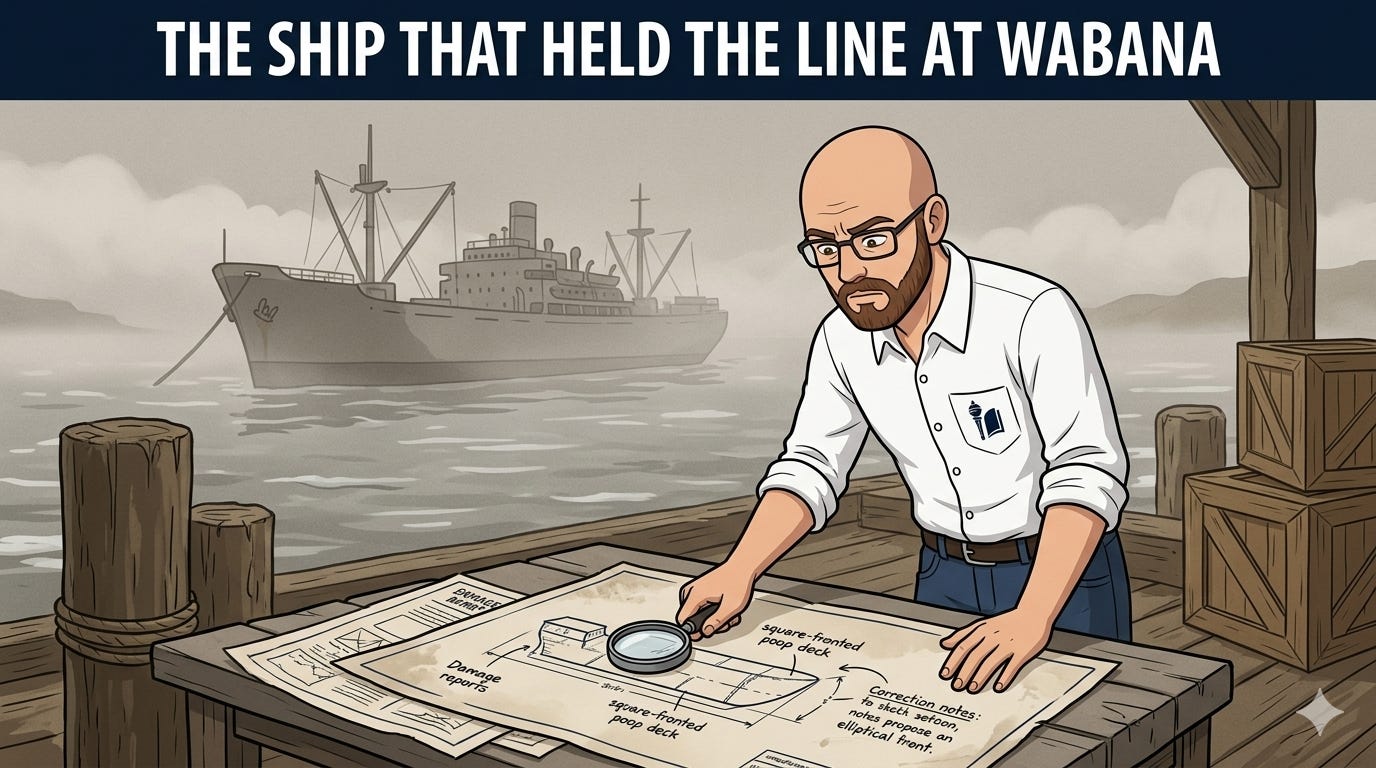
But Preserver was a ship at war with her own design. She was built with a “square-fronted poop” deck—a flat vertical face on her afterhouse that acted like a wall against the Atlantic. In even a moderate 30-knot breeze, seas would smash into the structure, flooding the lower messes and tearing up deck fittings. Her commanding officer, Commander R.L. Johnson, was forced to use his own crew to build a makeshift breakwater on the upper deck to deflect the waves, tersely explaining to his superiors that “in modern tankers the poop front is elliptical”.
Below decks, she was a floating factory. Almost half her crew were specialists: ordinance artificers, radar technicians, blacksmiths, and divers. They lived among their lathes and drills, sleeping in hammocks strung up in the machine shops, waiting to repair the wooden hulls of the Fairmiles that buzzed around them like wasps.
The Paper Patrol
By October 1942, the “Wabana Crisis” had forced the RCN to disperse its assets. Preserver was ordered north to Botwood and Lewisporte, ports vital for the export of paper and wood products.
The deployment revealed the sheer logistical nightmare of fighting a war in Newfoundland’s outports. The Fairmiles were thoroughbreds—fast but fragile. They burned 2.4 gallons of gas per mile and had no endurance. Preserver was their lifeline. Without her, they would be dead in the water within days.
The duty was often surreal. In mid-October, Preserver’s crew found themselves acting as a salvage unit for a crashed plane, NC 41880. The aircraft had gone down in the harbour, and the depot ship’s diving team spent days rigging a lifting sling. In a moment of grim comedy, the wire sling cut through the fuselage “like cheese,” and the owners eventually got their plane back “in two pieces”.
Meanwhile, the “Little Ships” chased ghosts. In the deep quiet of the “middle watch” at Bay Roberts, a shore battery reported a submarine sighting. Two MLs raced to the scene, only to find themselves nearly colliding in the dark. One ML spotted a blue flashing light and veered away; another rolled depth charges that heaved up the bay’s waters but produced nothing but dead fish. The “submarine” was later classified as a non-sub contact—likely a school of fish or a temperature gradient. It was a pattern of “inevitable wastage” that defined the coastal war: hours of high-tension hunting for enemies that were rarely there.
The Red Bay Exile
The true test of Preserver’s endurance came in 1943 and 1944, when she was banished to Red Bay, Labrador. This was the “permanent arrangement”—a forward operating base in the Strait of Belle Isle to protect the convoys supplying the Northeast Staging Route.
Red Bay was a study in isolation. The ship was moored in the basin, her 4-inch gun trained on the entrance to act as a shore battery. The weather was the real enemy. In June 1944, Preserver arrived to find the strait choked with “solid floes and lofty bergs drawing 25 fathoms”—pieces of Baffin Island drifting south to crush anything in their path.
Morale became a logistical objective. Tethered to a hamlet with “mediocre trout fishing” and swarms of flies, the crew had to invent their own world. They organized whaler rowing races and promotion classes. In a testament to the boredom and the surreal nature of their waiting war, the ship’s report from the summer of 1944 noted that a “Language Class in Japanese” was functioning, with the ship’s company showing “keen interest”. They were freezing in Labrador, preparing to fight in the Pacific.
The isolation degraded the ship as much as the men. The refrigerator plant, critical for storing the six months’ worth of food the ship carried, broke down repeatedly. In July 1944, two MLs had to make a long voyage just to fetch 150 pounds of Freon gas to save the ship’s food supply.
“Victory” in the St. Lawrence
The final months of the war saw Preserver acting as a harbour master for the end of the world. In May 1945, she was at Bay Bulls when U-190, a German submarine that had surrendered to the RCN, was escorted in. The once-terrifying predator was described as a dark, low vessel, “barnacle-covered, rusty and salt-spotted”. It was a visual confirmation of the victory Preserver had spent three years chasing.
Historians would later debate the success of the RCN in the St. Lawrence, with some admitting that in 1942, “Canada was defeated” in those waters due to the heavy losses. But Preserver represented the turning of that tide. She was a clumsy, flawed vessel—a tanker trying to be a base, a square-pooped ship in a round-wave ocean—but she allowed the Navy to exist where it otherwise couldn’t. She turned undefended bays into operational sectors.
Her war ended not with a bang, but with a tow. In October 1945, she towed the stores ship Kirkwood from Bermuda to Halifax, pausing periodically in the ocean swell to send a boat crew over to pump out her leaking charge. It was a fitting end for a ship that had spent the war keeping others afloat.
The Hansard Files digs into the archives to find the logistical nightmares and forgotten experiments of Canadian history. Subscribe to support independent investigative journalism.
Source Documents
Directorate of History. (1966, June 30). Report No. 10: HMCS Preserver (Fairmile Depot Ship 1942-1945). National Defence Headquarters.
Very interesting article, Mike! Can I assume Preserver was the namesake for the first post war HMCS Preserver? And it is now the namesake for the new Joint Support Ship under manufacture at Seaspan.