


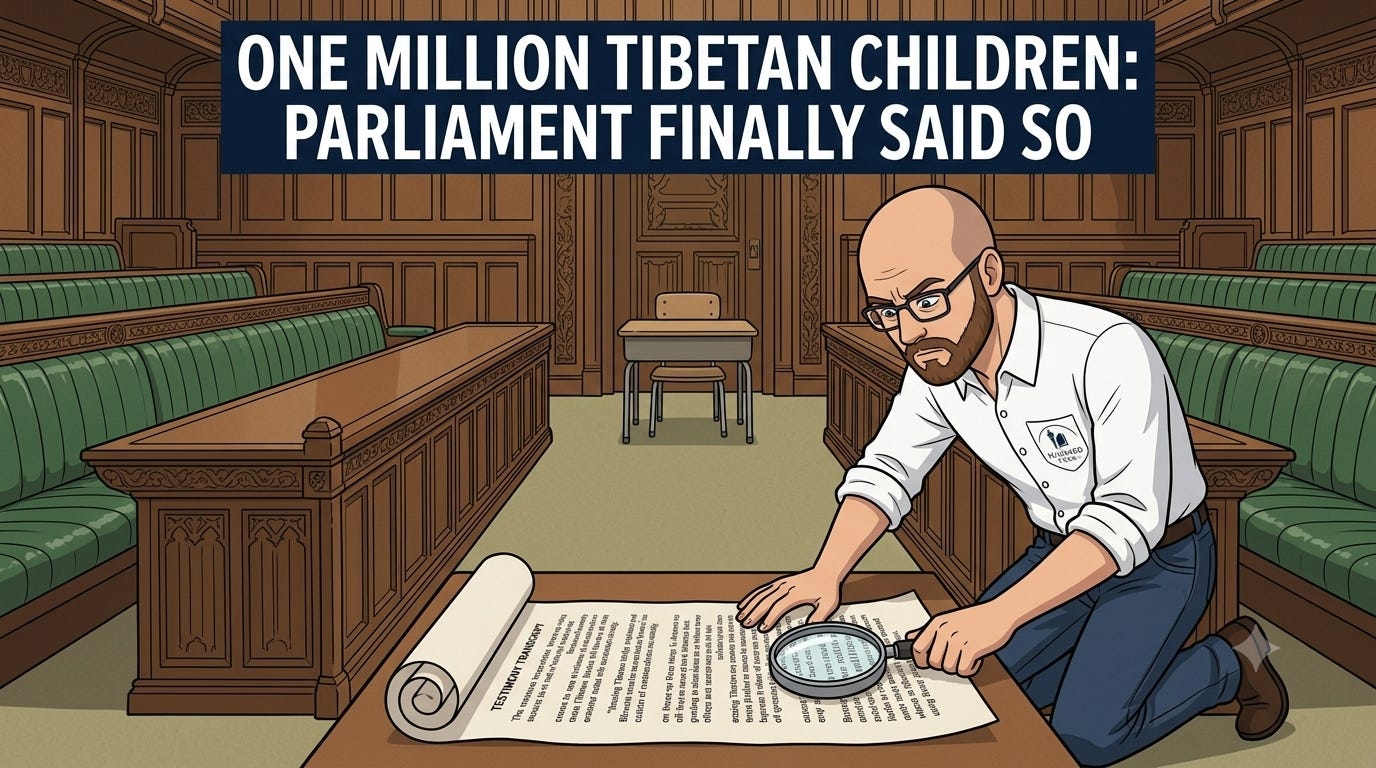
Four years old. That’s how young a Tibetan child can be when the state takes them. Not metaphorically, not gradually. Removed from their family, enrolled in a residential school designed by Beijing, and started on a curriculum whose explicit purpose is to make them forget who they are. A researcher testified before the Subcommittee on International Human Rights that her own grandnieces went through one of those preschools in 2016. She described it not as education but as the opening move in a decades-long erasure.
Tencho Gyatso, speaking before the subcommittee, put it plainly: “For Tibetan children, childhood is spent not in the company of parents and grandparents but in institutions designed to reshape how they speak, what they believe and ultimately who they are.”
Four days from now, on July 1, 2026, China’s new ethnic unity legal framework comes into force. It will legally subordinate Tibetan cultural expression to Communist Party ideology. That deadline was hanging over the testimony in that committee room like a clock.
The numbers behind the system
The system is vast. The brief prepared from the subcommittee evidence puts approximately one million Tibetan children currently separated from their families inside China’s boarding school network. Four out of every five Tibetan children between ages six and eighteen are coerced into state-run schools.
That word, coerced, is doing real work. The testimony before the subcommittee does not characterize these schools as optional institutions that families freely choose. Witnesses described a compulsory architecture with no meaningful exit. Families cannot withdraw their children without consequences. The schooling runs not just through the primary years but into secondary and vocational tracks, meaning a child who enters at four may not return home in any meaningful sense until late adolescence, if then.
The physical structure mirrors the ideological one. These are boarding schools, not day schools. The distance from family is not incidental; it’s the point. The absence of parents and grandparents is not a logistical inconvenience. It is the mechanism. When language acquisition happens inside state walls rather than inside a family home, the language that survives is the one the state teaches.
What gets erased
The testimony was specific about what the schools are designed to remove: Tibetan language, Tibetan religion, and the identity that runs through both. The CCP’s framework treats these not as cultural heritage to be protected but as obstacles to “ethnic unity,” a phrase that, in this context, means conformity with Han Chinese norms and party ideology.
Tibetan Buddhism is not incidental to Tibetan identity. The subcommittee evidence treats them as inseparable. A child raised in a state boarding school, conducted in Mandarin, built around a curriculum that treats Tibetan spiritual practice as a problem to be corrected, does not simply grow up with a different language. They grow up with a different account of who they are and where they come from.
The researcher who described her grandnieces’ preschool enrollment in 2016 was not describing an extreme case. She was describing the system functioning as designed.
The July 1 deadline and what it means
The new ethnic unity legal framework entering force on July 1 is not a minor regulatory update. According to the subcommittee evidence, it represents the formalization of what has been operating informally for years. Practices that have existed as policy directives become statutory obligations. Tibetan cultural expression that has survived in informal spaces becomes explicitly subordinated to party doctrine in law.
The timing is worth sitting with. A parliamentary subcommittee heard testimony about this system in the days before its legal consolidation. The record now exists. Canada’s parliament heard witnesses describe in specific terms what is happening to Tibetan children, and the clock for the framework’s entry into force was visible to everyone in the room.
Why Canada is hearing this
The Subcommittee on International Human Rights holds a specific mandate to examine human rights conditions abroad and report to Parliament. Its hearings create a public record. That record does not compel government action on its own, but it does something more durable: it forecloses the later claim that no one knew.
Canada has relationships with China that are economically and diplomatically significant. The subcommittee does not operate in isolation from those relationships. But the testimony it received does not allow for ambiguity about what the record contains. One million children. A system starting at age four. A legal framework consolidating it all, effective in four days.
The subcommittee evidence also puts Canada’s own history squarely in the frame. The language of colonial boarding schools is not abstract for a Canadian parliament. It carries the specific weight of the residential school system and the still-ongoing reckoning with what that system did. Witnesses before the subcommittee are aware of that resonance. So, presumably, are the MPs who heard them.
The witness who said it out loud
Tencho Gyatso’s testimony before the subcommittee was careful and specific. She did not speak in generalizations. She described the architecture of the schools, the age at which children enter, the structure of the curriculum, and what it produces. Her framing was not rhetorical. It was documentary.
“For Tibetan children, childhood is spent not in the company of parents and grandparents but in institutions designed to reshape how they speak, what they believe and ultimately who they are.”
That sentence is not an allegation. It describes a system whose design intent is documented in Chinese state policy documents. The subcommittee record now contains it. So does this article.
Parliament went on to other business. The clock kept running.
Hansard Files reads the committee transcripts and subcommittee evidence so you don’t have to. If accountability journalism from the primary record matters to you, subscribe to keep this work independent.
Related Hansard Files Articles

Source Documents
House of Commons Canada. (2026). Evidence from the Subcommittee on International Human Rights of the Standing Committee on Foreign Affairs and International Development (SDIREV21-E). 45th Parliament, 1st Session.
Gotta wonder if the Chinese took lessons from Canada. Except of course, being China, why would they take lessons from us? Also, our residential schools were not very successful at making indigenous people not indigenous.
Ah, yes, China... just the kind of folks Canada should form a strategic partnership with while spitting in the face of our closest ally, best customer which whom we share the world's longest undefended border. Elbows up!!