


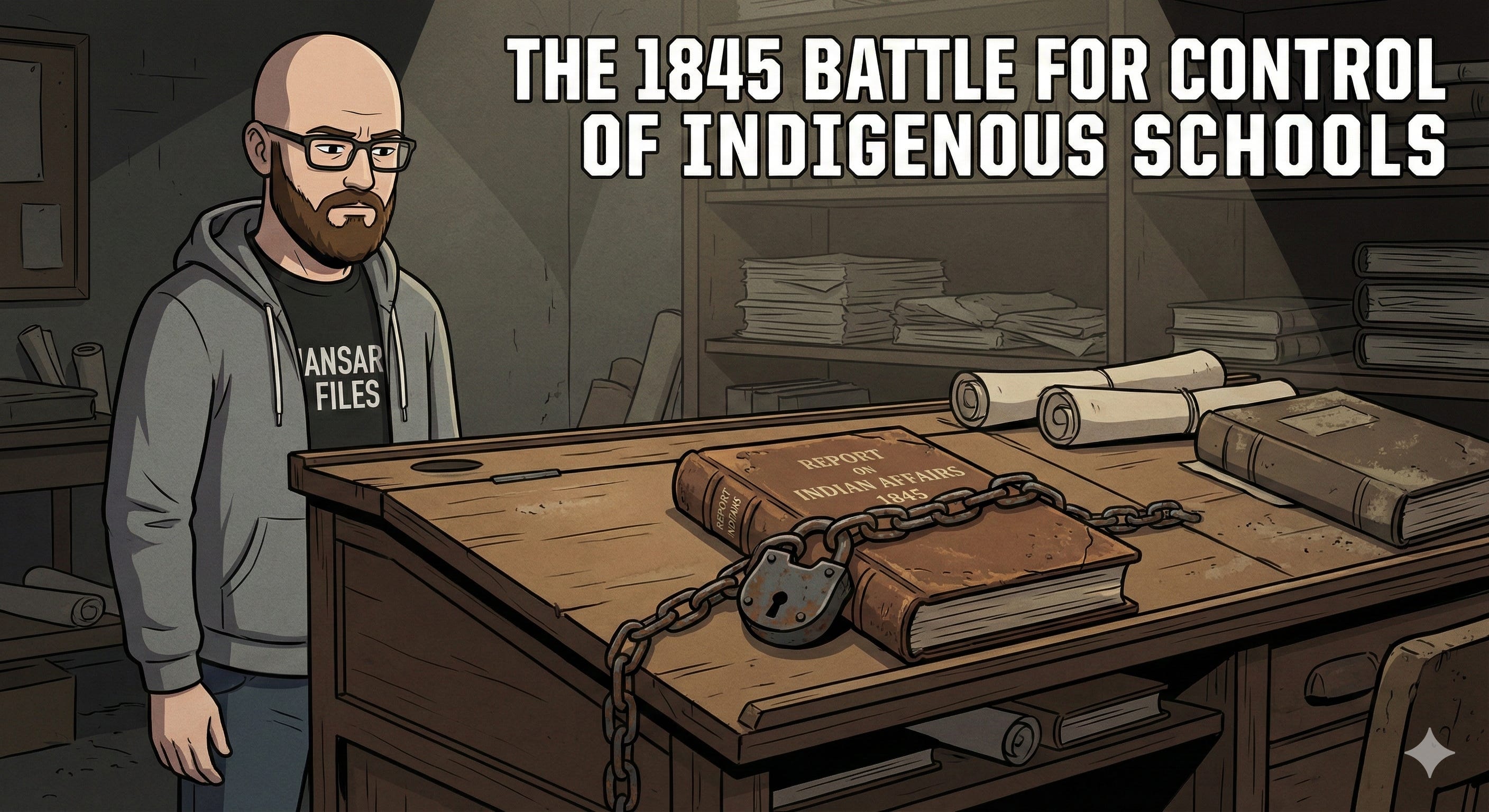
On March 20, 1845, a heavy document was laid before the Legislative Assembly of Canada. It was a report on the affairs of the Indians in Canada, a sweeping bureaucratic assessment intended to measure the “civilization” and progress of Indigenous tribes across the fracturing colonies of Canada East and Canada West. While the text is couched in the dry, administrative language of the Victorian era, the story it tells is one of profound conflict. It reveals a chaotic, disjointed landscape where education was not merely a tool for instruction but a battleground for religious dominance, language suppression, and cultural survival.
This 1845 Indigenous education report exposes a critical moment in history. It captures the period just before the centralized, industrial-scale residential school system was fully realized. In these pages, we see the raw machinery of assimilation sputtering. We see government agents expressing frustration not with the students, whom they consistently describe as having equal or superior aptitude to white children, but with the “jealousy of the missionaries” and the fierce sectarian turf wars that frequently padlocked schoolhouse doors.
The Stagnation of the East
The report paints a bleak picture of the educational landscape in Canada East, the region that is now Quebec. The government officials who compiled the data described the situation as “stationary.” While settlements existed and populations were stable, the mechanisms of Western education had ground to a halt. The report identifies a primary culprit for this stagnation, and it was not a lack of funding or Indigenous disinterest. It was a deliberate blockade by the clergy.
In Caughnawaga, a significant settlement, the report notes that there was “not at present a school of any description.” This was not for lack of trying. Ten years prior, in 1835, Lord Aylmer had appointed an English teacher of the Roman Catholic persuasion to establish a school in the village. It seemed like a compromise designed to succeed: a Catholic teacher for a Catholic community. Yet, the report states bluntly that the attempt failed. It was frustrated by the prejudices of the local missionary, who remained deeply opposed to the introduction of the English language among the tribes.
This pattern of clerical resistance was repeated with even higher stakes at St. Regis. For eighty years, from the earliest settlement of the tribe, no attempt had been made by the resident clergy to establish a school. When the government or private individuals proposed one, the church resisted. The tension finally snapped in July 1835. Through the exertions of a resident agent and local Anglican clergy, a school was finally opened. It was led by the Reverend E. Williams, a native Indian of Caughnawaga who had been educated in Connecticut.
The opening of the St. Regis school was a momentary triumph of Indigenous agency and educational demand. Seventeen children attended on the first day. As word spread, the number swelled to forty. The school secured funding from a society in England and books from New York. The government contributed a salary from the Parliamentary Grant. For two months, the schoolhouse hummed with activity.
Then came the crackdown. The report details how the resident Missionary issued a command to the parents of the scholars. They were to withdraw their children immediately. The penalty for disobedience was severe: the parents would face the “displeasure and the anathema of the church.” The threat worked. The classroom emptied, the number of students plummeting from forty to seven. Reverend Williams tried to persevere with the handful of remaining students, but the political pressure was relentless. The Roman Catholic Bishop of Montreal lodged a formal complaint against Williams for “interference with his flock.” The Earl of Gosford, bowing to religious pressure, withdrew the government salary. The school at St. Regis was closed and, as of the 1845 reporting date, had never reopened.
The Aptitude of the Students
One of the most striking aspects of the 1845 document is the consistent assessment of Indigenous intelligence. In an era often characterized by racist pseudo-science and dismissive attitudes toward non-European peoples, the field agents reporting to the Legislative Assembly offered a different view.
Regarding the students in Canada East, the report states that the “aptitude of the Indians for the acquisition of knowledge is as great as that of the whites, or may even in some respects be said to surpass it.” At St. Regis, during the short-lived tenure of Reverend Williams, the children were found to exceed white children in their ability to learn. This was noted as particularly remarkable given that the instruction was entirely in English, a language of which the students knew nothing prior to entering the classroom.
This acknowledgement of intellectual capability appears repeatedly throughout the text. In the Huron settlement of La Jeune Lorette, the twenty-five children attending school were described as “apt scholars,” while the adults were characterized as skilful artisans. Among the Algonquins and Nipissings at the Lake of Two Mountains, observers noted that even those who lived a “wandering life” during the majority of the year could read and write tolerably well in their own language. The report explicitly mentions that these mobile groups were often “more intelligent and civilized” than those who remained sedentary near the towns.
This data contradicts the narrative that Indigenous peoples were resistant to learning. Instead, it suggests they were resistant to the specific methods and terms of the education being forced upon them. In the Oneida settlement in Canada West, for example, children were taught using books in the Oneida language alongside English texts. The report notes that while they made “slow progress in the English,” they learned “very fast” when taught in their own tongue. The barrier was not the capacity of the student, but the language of the instruction and the qualifications of the masters.
The Industrial Experiment in the West
While the East was paralyzed by religious infighting, Canada West (Ontario) was becoming the laboratory for a different kind of experiment: the industrial boarding school. The report highlights the “very perceptible” changes among the Six Nations Indians of the Grand River. Here, the government saw what it wanted to see: a shift away from traditional ceremonies and an eagerness for Western education.
The centerpiece of this effort was the boarding school of the New England Company at the Mohawk Village. The demand for places in this institution had skyrocketed. A few years prior, the school struggled to find fourteen students. By 1845, there were fifty students enrolled and another fifty applications pending. This facility represented the model the government hoped to replicate. It was not merely about literacy; it was about labor.
In addition to the standard curriculum of the Bible, Mavor’s Spelling Book, and Murray’s Grammar, the boarding school functioned as a factory for tradesmen. Fifteen boys were under instruction in heavy manual trades: wagon-making, blacksmithing, carpentry, and shoe-making. Twelve girls were being trained in housekeeping, needlework, spinning, and knitting. The goal was to produce a self-sufficient class of artisans who could build and maintain the infrastructure of a settled, agrarian community.
The report notes that many adults in the Six Nations were already skilled mechanics without formal instruction. There were blacksmiths capable of shoeing horses and repairing farming implements, and carpenters capable of erecting and finishing frame houses. The educational policy in the West was designed to harness this mechanical aptitude and channel it into the colonial economy.
The Curriculum of Conversion
A close reading of the school supplies listed in the report reveals the narrow intellectual corridor through which these students were forced to walk. There were no history books about their own lands, no geography texts that mapped their traditional territories. The curriculum was a mirror of the British common school, heavily weighted toward religious indoctrination.
In the schools along the River Thames, serving the Delawares, Chippewas, and Munsees, the “Union Primer” and “Webster’s Spelling Book” sat on desks alongside the New Testament. At the Wesleyan Methodist schools, students used the “New London Primer” and “Richardson’s Reading Made Easy.”
However, the shadow of sectarianism loomed over the curriculum as well. On Manitoulin Island, where Catholic and Protestant communities lived in proximity, the school books became contraband. The report details a Protestant school using Mavor’s Spelling Book and the Bible. Meanwhile, in the Roman Catholic school, the priest strictly forbade the use of both the Bible and Mavor’s Spelling Book. The report notes that in the Protestant school, children were taught partly in Indian and partly in English. In the Catholic school, English was the sole medium of instruction, yet the Bible—the primary text for literacy in that era—was banned from the classroom.
The Seasonal Conflict
Beyond the religious battles, the 1845 report identifies a fundamental clash between the rigid, stationary structure of the European school and the seasonal economic cycle of the Indigenous families. In the section concerning the Munsees and Oneidas, the report explicitly states that “one of the greatest impediments to the education of the Indian children is their practice of leaving school to accompany their parents on their hunting, fishing, and sugar making excursions.”
This observation highlights the disconnect between the colonial administration and the reality of Indigenous life. The government viewed the school as a place of constant, uninterrupted attendance. For the families, education had to coexist with the imperative of survival and the seasonal rhythms of the land. When the sap began to run or the fish began to spawn, the classroom emptied.
The administrators viewed this as “irregularity,” a moral or disciplined failing. They failed to recognize it as a persistent adherence to a traditional economy that the school system was explicitly designed to eradicate. The “wandering life” of the Algonquins, which the report grudgingly admitted produced intelligent and literate adults, was seen as a problem to be solved rather than a valid way of being.
A Legacy of Lost Potential
The 1845 report concludes as a testament to lost potential. It documents a generation of children who were acknowledged to be bright, capable, and eager to learn. It records parents who were willing to send their children to school, provided those schools did not violate their conscience or destroy their language.
Yet, the system failed them. It failed because a missionary at St. Regis feared the English language more than he valued literacy. It failed because the government withdrew funding at the first sign of ecclesiastical displeasure. It failed because the curriculum was designed to erase Indigenous identity rather than build upon it.
The “school wars” of 1845 were a prelude to the darker chapters that would follow. The boarding schools mentioned with such bureaucratic approval at the Mohawk Village would eventually mutate into the mandatory residential school system, where the “impediment” of parental influence would be removed by force. But in 1845, the struggle was still open, the resistance was visible, and the tragedy was that the government knew exactly how capable these students were, even as it allowed their future to be held hostage by religious jealousy.
If you value deep dives into the forgotten archives of history, subscribe to Hansard Files. We read the dense reports so you don’t have to.
Source Documents
Legislative Assembly of Canada. (1845, March 20). Report on the affairs of the Indians in Canada, laid before the Legislative Assembly.