


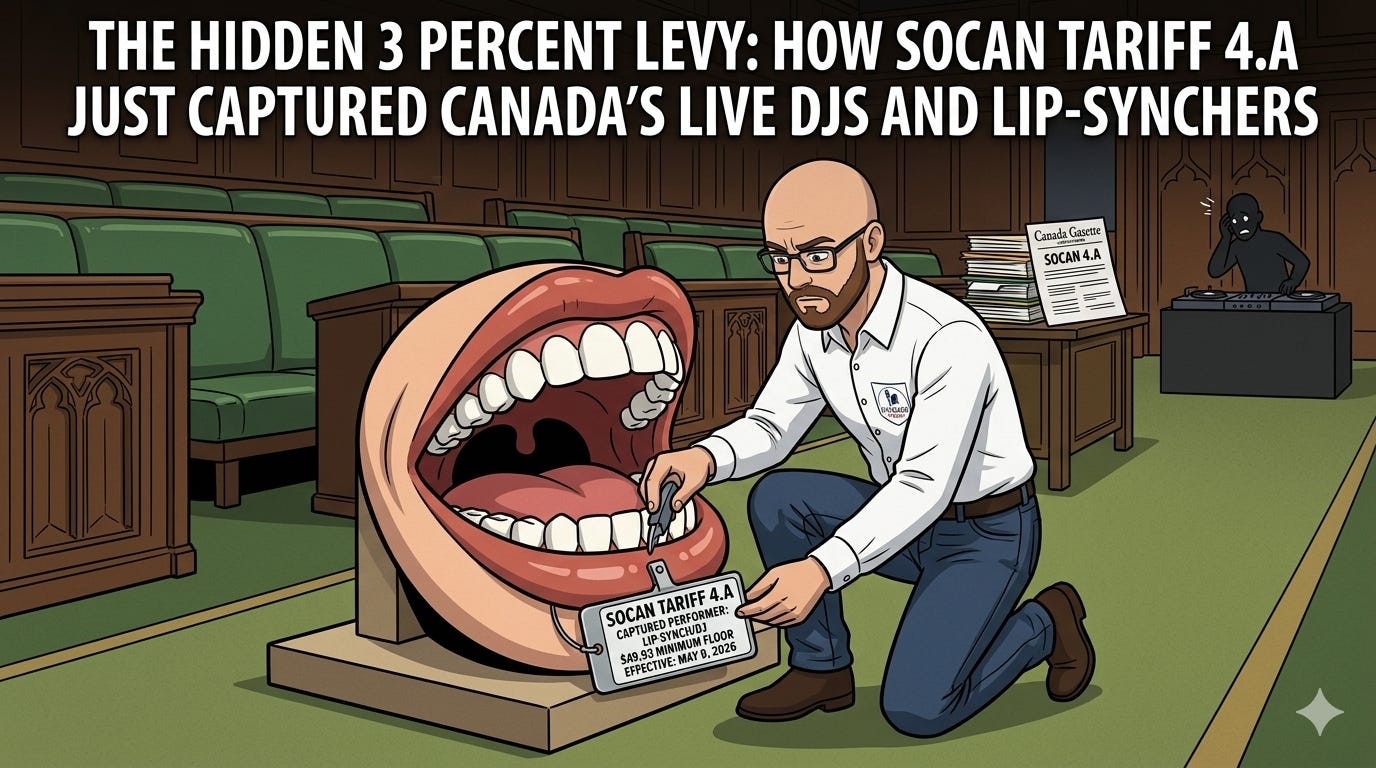
The house lights come up, the featured DJ cuts the audio, and the local promoter begins the quiet, unglamorous work of counting the register. For years, the federal royalty dragnet struggled to categorize modern electronic acts and non-traditional performers. But as of this morning, May 9, 2026, the administrative state has officially closed the loop. Published at the very back of the Canada Gazette is a standalone regulatory supplement enforcing SOCAN Tariff 4.A across the country. It is a highly specific statutory update that places an inescapable financial floor on live entertainment. If you promote a summer festival, operate a club stage, or book an act that relies entirely on lip-synching, the federal government has a brand new mandate for your accounting.
The $49.93 Minimum and the Captured DJ
Federal copyright rulings usually conjure images of sheet music and traditional concert halls. The Copyright Board’s text for the 2025 through 2027 cycle, however, explicitly targets the modern gig economy. Under the newly finalized definitions, the term “performers” now legally captures live DJs. The rule applies whenever the DJ is the featured performer and their identity forms part of the promotional material used to sell the event.
The board also added a fascinating clarification designed for the realities of modern pop performance. Section 3 explicitly states that the tariff applies to the performance of musical works by lip-synching or miming. Invisible performances just don’t exist on the ledger anymore.
The cost of doing business is set at a flat 3 percent of gross ticket receipts, excluding taxes. But the board has built an unyielding floor into the math. Even if a paid concert suffers a massive loss at the door, the promoter owes a minimum royalty fee of $49.93 per event. If a municipality or organizer hosts a free community concert, the levy simply shifts. Promoters must pay 3 percent of the total fees distributed to the singers, musicians, dancers, and conductors, while maintaining that exact same $49.93 baseline. Alternatively, venues can opt for an annual license, which carries a minimum baseline fee of $85.59.
The 30-Day Clock and the Audit Trail
What happens after the stage lights go down matters just as much. Venues and promoters now face a strict 30-day compliance clock. Within a month of an event, organizers must submit the legal names, addresses, and telephone numbers of both the concert promoters and the physical venue owners. They must also hand over an itemized reporting of gross ticket receipts or total artist payouts.
To ensure compliance, the federal government has armed the Society of Composers, Authors and Music Publishers of Canada with robust enforcement mechanisms. Section 9 grants explicit rights to audit a user’s books and records during normal business hours upon reasonable notice. Ignoring the invoice carries an immediate penalty. Late payments automatically accrue daily interest set at exactly 1 percent above the Bank of Canada’s prevailing rate. Demonstrating typical bureaucratic precision, the board noted one small mercy. The interest won’t compound.
Meanwhile, Quiet Rulings on Military Procurement and Political Ridings
While the live music sector digests its new baseline, the rest of today’s Gazette offers a stark reminder of how much high-stakes business bypasses the evening news clips. Take a quiet notice from the Canadian International Trade Tribunal embedded on page 988. Following a formal complaint by Delaware-based NACRIS Inc., federal investigators determined that the Department of National Defence failed to properly evaluate the winning bid for a recent military contract.
The contract in question wasn’t for armored vehicles or artillery. It was a solicitation to provide hotel amenities and accommodation services in Ridgecrest, California. The tribunal officially ruled the complaint valid, exposing an administrative flaw in how foreign support operations are vetted by the military.
A few pages earlier, the national political landscape shifted just as quietly. Elections Canada formally announced the deregistration of sixteen separate People’s Party of Canada electoral district associations, stretching from Vancouver Island to Nova Scotia East, effective May 31. Concurrently, the Trade Tribunal dropped a massive final determination on international steel imports. Investigators concluded that the dumping of oil country tubular goods from Mexico, Turkey, South Korea, and the United States has actively caused injury to domestic industry.
The real machinery of governance doesn’t operate in the performative shouting of Question Period. It runs on statutory notices, strict compliance clocks, and auditing clauses written in small print. Whether it is a local club owner calculating ticket sales to cover a $49.93 royalty floor, or a military procurement officer answering for California hotel bookings, the rules of reality are drafted while the rest of the country looks away. The ledger is always balancing. The only question is whether you are reading the fine print before the bill arrives.
Hansard Files spends weeks in the archives so you don’t have to. If stories like this matter to you, subscribe to keep this work independent.
Related Hansard Files Articles
Source Documents
Canada Gazette. (2026, May 9). Canada Gazette, Part I, Volume 160, Number 19.
Copyright Board. (2026, May 9). SOCAN Tariff 4.A - Popular Music Concerts (2025-2027), Supplement to the Canada Gazette.
It's like the bureaucrats lay in bed at night, dreaming up more ways to tax & control the population.