


Every Saturday, the federal government publishes the Canada Gazette. On its face, the document is a dry record of official notices and proposed regulations. A deeper look reveals something more. The Gazette is a public ledger of governance in motion. A proposal published on September 27, 2025, offers a perfect case study. The Department of the Environment plans to amend the Wildlife Area Regulations for the Cap Tourmente National Wildlife Area in Quebec. The changes would eliminate a 50-year-old migratory bird hunt and abolish a 40-year-old entrance fee.
The core problem for many citizens is a sense of confusion when a long-standing rule changes. The decision feels abrupt, the reasons opaque. You are left to wonder about the political calculations or hidden agendas driving the shift. The government’s own analysis of the Cap Tourmente decision provides the clarity needed to see past the noise. The story behind this regulatory change is not about politics. The story is about a system working as intended. A system where evidence, not inertia, guides decisions.
The Problem of Policy Fossils
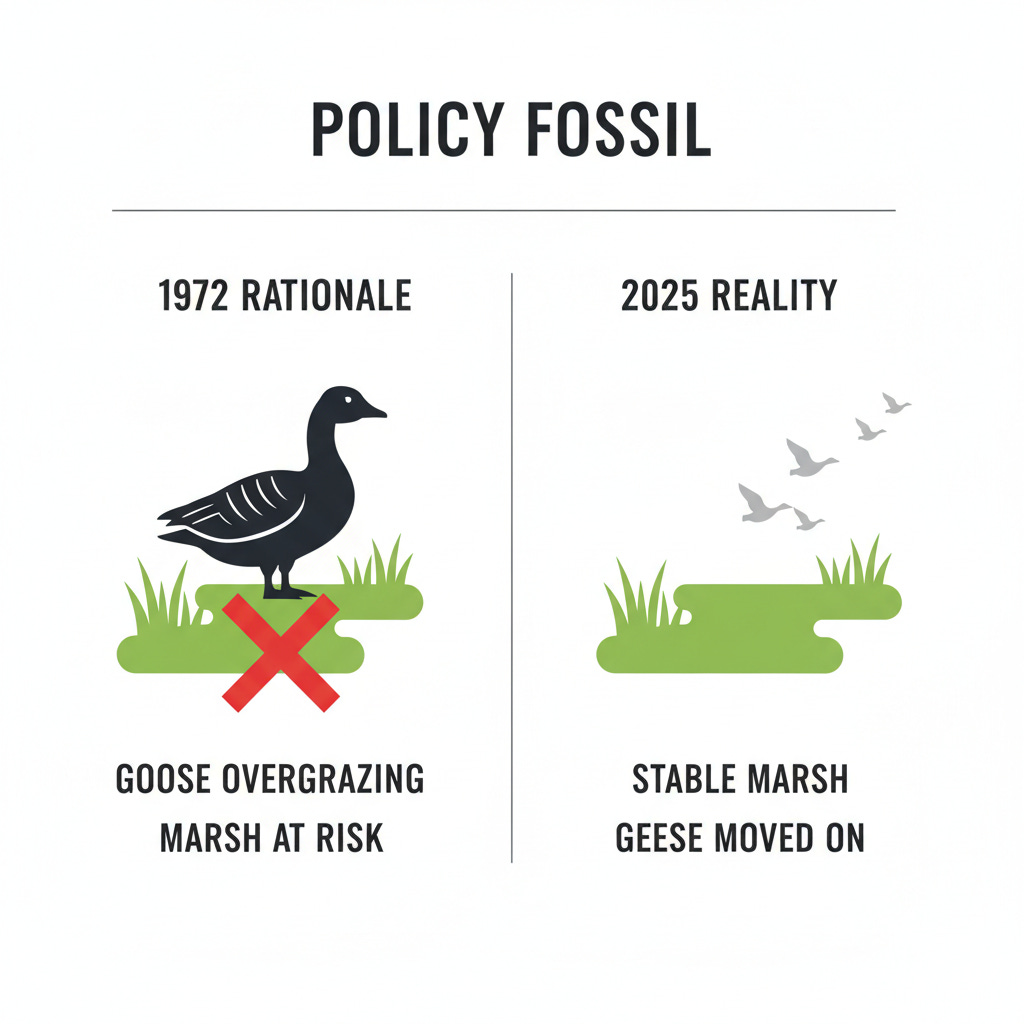
To understand this situation, we need a better analogy than “red tape.” Think instead of a Policy Fossil. A fossil is the imprint of a once-living thing, preserved in stone long after its environment has changed. A Policy Fossil is a rule or program which has outlived its original purpose. The rule remains on the books, a relic of a past reality, shaping present-day actions for reasons which are no longer valid. The controlled hunt and entrance fees at Cap Tourmente are perfect examples of Policy Fossils. They were created to solve specific problems of their time. The evidence now shows those problems no longer exist. The work of good governance is to recognize these fossils and thoughtfully remove them.
A Conservation Measure Without a Conservation Need
The controlled fall hunt program at Cap Tourmente began in 1972. The Regulatory Impact Analysis Statement explains the program was not for sport. The program was a conservation measure designed to protect the area’s American Bulrush marsh from intensive grazing by the Greater Snow Goose. For years, the growing goose population posed a genuine threat to this vital migratory stopover habitat. A controlled hunt was a logical tool to manage the pressure.
Here is the detail I find most revealing. The ecological conditions have changed completely. The Department of the Environment’s recent biological monitoring shows two things have happened. First, the Greater Snow Goose population stabilized in the 2000s. Second, the geese changed their behaviour and now mainly use migratory stopover sites outside the National Wildlife Area. The immediate threat to the marsh is gone.
The monitoring results indicate that the Cap Tourmente NWA hunt program is no longer required as a conservation measure for the bulrush marsh.
The original justification for the hunt has vanished. Continuing the program would be an act of path dependence, not a response to a current ecological need. During consultations, hunting organizations expressed a desire for the tradition to continue. The Department’s position is clear. The program exists to protect the marsh. Since the marsh is no longer threatened, the program’s purpose is complete. A program for sport or public service is a different matter, and not the purpose of this specific regulation.
The Last Toll Booth in the Network
The second Policy Fossil is the entrance fee. Cap Tourmente is the only one of Canada’s 64 National Wildlife Areas which charges the public for access. The fees were introduced in 1985 to help fund the higher level of visitor services offered at the site. This practice is now in direct conflict with broader government objectives. Initiatives like Canada’s Nature Legacy and the “Connecting Canadians to Nature” program aim to increase opportunities for you to experience the natural world. A fee at one specific location creates a barrier.
The data show what happens when this barrier is removed. When fees were waived for Canada’s 150th anniversary in 2017, the number of visitors jumped 41 percent above the average. When fees were waived again in 2021 during the pandemic, visitor numbers rose 53 percent. Removing the fee permanently aligns Cap Tourmente with the entire national network. The move also makes the site accessible to more Canadians.
The consultations revealed a local non-profit organization running a nature park with an entrance fee was opposed to the change. The organization worried free access to the NWA would create competition for customers. The Department’s analysis acknowledges this possibility but frames its objective as aligning the NWA with the rest of the network and connecting more people to nature.
First Nations Assert a Deeper History
The consultation process also surfaced a more fundamental issue. The Department consulted with four First Nations. One Nation supported ending the hunt for non-First Nations hunters, agreeing the original conservation goal had been achieved. The same First Nation also made an important distinction. The group considers Cap Tourmente a place for its members to conduct traditional migratory bird hunting. The group requested its access be maintained.
This points to a critical question of rights and historical treaties which predates the 1972 hunt program. The Department’s response was to affirm its commitment to continue discussions with the First Nation regarding hunting by its members. This part of the story shows how removing one layer of modern regulation often reveals a deeper, more complex layer of law and obligation beneath.
Concluding Insight
The principle at work here is the superiority of evidence-based governance over institutional inertia. The Cap Tourmente hunt and fees were not bad policies. They were good policies whose time has passed. They became fossils. The decision to remove them is an example of a system functioning correctly, adapting its rules to match new scientific evidence and new public priorities. This is the difficult, unglamorous work of maintaining a healthy regulatory environment. The hardest work of governance is not creating new rules, but tending the garden of old ones.
In Other News...
Beyond this deep dive, you can find more analysis and commentary on the On Hansard site.


Sources:
Regulations Amending the Wildlife Area Regulations and the Environmental Violations Administrative Monetary Penalties Regulations. (2025, September 27). Canada Gazette, Part I, 159(39), 1912–1925.