


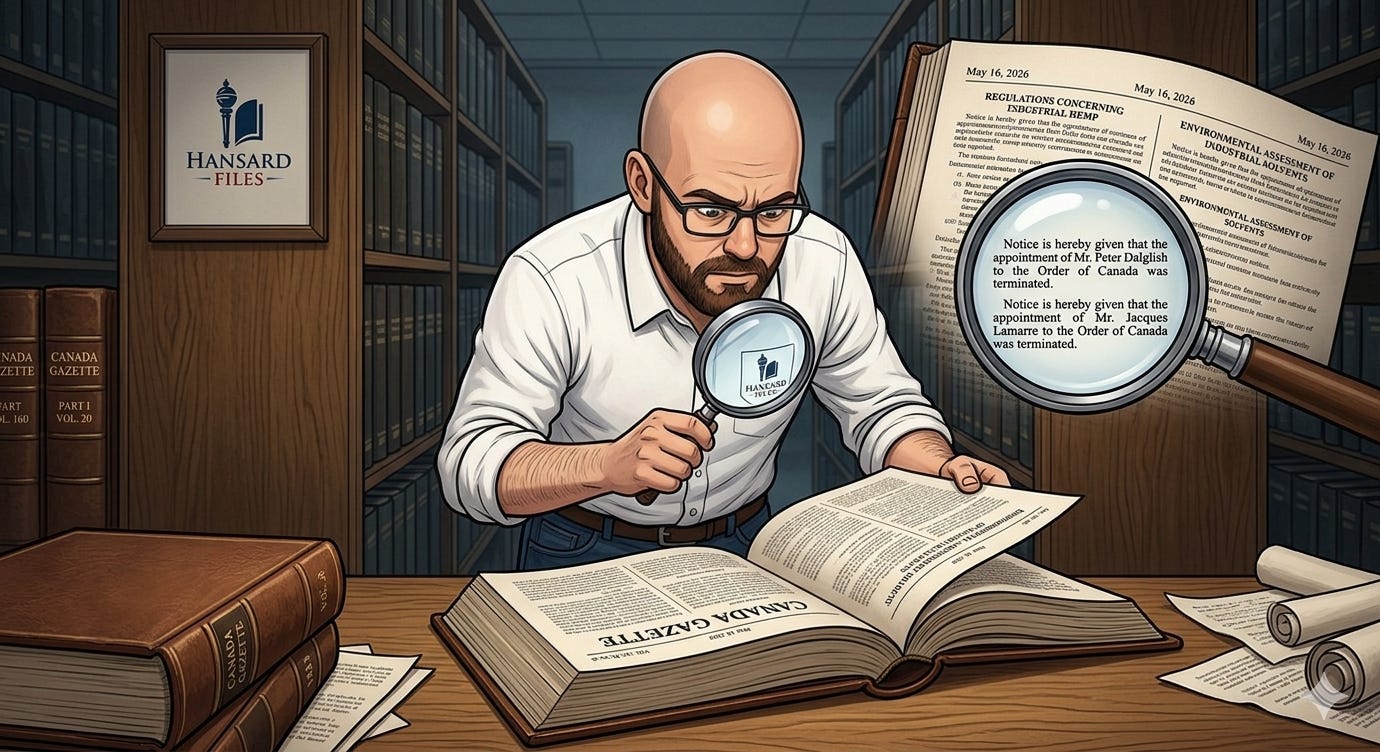
It arrived, as these things always do in official Ottawa, without fanfare. Tucked inside Canada Gazette Part I, Vol. 160, No. 20, published May 16, 2026, between routine appointment notices and an environmental assessment of industrial solvents, was a pair of notices that Canada had been waiting years to see. Two men. Two revocations. Both signed by Governor General Mary Simon on April 15.
“Notice is hereby given that the appointment of Mr. Peter Dalglish to the Order of Canada was terminated.”
And then, one notice below: “Notice is hereby given that the appointment of Mr. Jacques Lamarre to the Order of Canada was terminated.”
Thirty-three words each. Bureaucratically bloodless. Carrying enormous weight.
The Humanitarian Who Became a Convicted Predator
Peter Dalglish arrived in the Order of Canada in December 2016, invested as a Member for a career that genuinely looked, from a distance, like one of the more extraordinary lives in modern Canadian public service. He had devoted his life to helping children escape poverty. Trained as a lawyer, he became involved in humanitarian projects after witnessing the Ethiopian famine of 1984, founded Street Kids International to teach homeless children work and life skills, and pioneered approaches to preventing child labour and assisting war-affected children in Afghanistan.
The distance, it turned out, was everything.
In April 2018, Dalglish was arrested in Nepal after police raided his home and found two young boys there. A Nepalese law enforcement official accused Dalglish of luring boys away from their poor families with offers of education, jobs, or trips, and then sexually abusing them. He was subsequently sentenced to 16 years in prison by a Nepalese court.
The conviction came in June 2019. The Order of Canada revocation came in April 2026. Nearly seven years passed between them.
That gap is not a footnote. It is the story. As early as 2020, a public petition was circulating calling on the Advisory Council of the Order of Canada to remove Dalglish’s membership, noting that he still appeared as a member in good standing more than a year after his conviction, and calling the oversight an offense to all other members of the Order. He was, in those years between conviction and revocation, still technically wearing one of Canada’s highest civilian distinctions, at least on paper.
The Order of Canada’s Advisory Council process moves slowly and deliberately by design. The Council is meant to deliberate carefully before removing a distinction. Those are reasonable institutional instincts. But the Dalglish case tested them hard, and the delay left a visible stain.
The Engineer, the Dictator’s Son, and $2 Million
The second name in the notice, Jacques Lamarre, arrives with different but equally damning context.
Lamarre, chief executive officer of Canadian engineering giant SNC-Lavalin until 2009, was originally invested as a member of the Order of Canada in 2005. For years he was seen as one of the figures who had helped build SNC-Lavalin into a global infrastructure powerhouse, a source of considerable national pride in Quebec and beyond.
Then came the unravelling.
The penalties against Lamarre stem from breaches during his tenure at the Montreal-based firm, now known as AtkinsRéalis Group Inc., between 2001 and 2009, including payment of financial benefits to obtain contracts in Libya, with approximately $2 million going to the ruling family, largely for expenses racked up in Canada in 2008 by Saadi Gadhafi, son of former Libyan dictator Moammar Gadhafi.
The disciplinary tribunal also found Lamarre guilty of “collusion and corruption” in relation to SNC’s political financing activities in Montreal, where the firm sought to win contracts in exchange for party payoffs.
On January 7, 2026, Quebec’s engineering order revoked Lamarre’s professional licence and imposed a $75,000 fine. Licence revocation is the most serious sanction the professional order can impose. The Order of Canada revocation followed in April.
The case ties into wider prosecutions: SNC-Lavalin faced charges in 2015, its construction division pleaded guilty, paying a $280 million fine and receiving three-year probation, while a senior executive admitted to kickbacks worth at least $47.7 million and another was convicted in Canada.
The Gazette as Final Record
There is something particular about the Canada Gazette as a vessel for these notices. It is not a court. It does not prosecute. It does not editorialize. The Gazette simply records, with quiet authority, that something has changed in the official record of the country. A Governor General signed an ordinance. The Secretary General of the Order certified it. It ran on a Saturday morning between notices about industrial hemp regulations and rare earth environmental guidelines.
That compression, the human catastrophe of the Dalglish case and the institutional rot of the SNC-Lavalin saga reduced to administrative paragraph form, is both the limitation and the power of the document. The Gazette does not tell you how it feels. It tells you what is now true.
What is now true: Peter Dalglish and Jacques Lamarre are no longer members of the Order of Canada. Their names remain in the historical record of who was once admitted. The revocations are also recorded. Both columns exist. Neither disappears.
What It Takes, and What It Means
Canada has now revoked Order of Canada appointments from a relatively small number of people in the institution’s history. The previous removals included names like Conrad Black, Alan Eagleson, David Ahenakew, Steve Fonyo, and Garth Drabinsky. Each case was different. Each raised questions about how the honour should work, how long the process should take, and what standard of conduct the Order is actually enforcing.
Both Dalglish and Lamarre were found guilty of wrongdoing, the country’s highest civilian honour now formally withdrawn from both.
The Order of Canada exists, at its founding premise, to recognize Canadians who have made extraordinary contributions to their country. The revocation power exists because the institution understands that a person’s record does not end when the Governor General pins the insignia. What they do afterward, or what is later revealed about what they did before, counts.
The Gazette notice does not say any of that out loud. It offers thirty-three words and a date. But if you know what you’re reading, and why it took this long for one of those notices to appear, the weight of it sits with you.
The record is now updated. For anyone who cares about what the Order of Canada is actually supposed to mean, that is both a relief and a reason to keep watching how carefully the institution guards its own name.
Hansard Files spends weeks in the archives so you don’t have to. If stories like this matter to you, subscribe to keep this work independent.
Source Documents
King’s Printer for Canada. (2026, May 16). Canada Gazette, Part I, Vol. 160, No. 20. Government of Canada.
I care. The Order of Canada is our highest civilian honour. These honours need to be revoked if that highest standard is not maintained. My father was awarded the Order of Military Merit at the Member level. It is the second highest honour after the Order of Canada, and he earned it, as did so many others.
Holy crap ... an incredible report, as usual sir! ...