


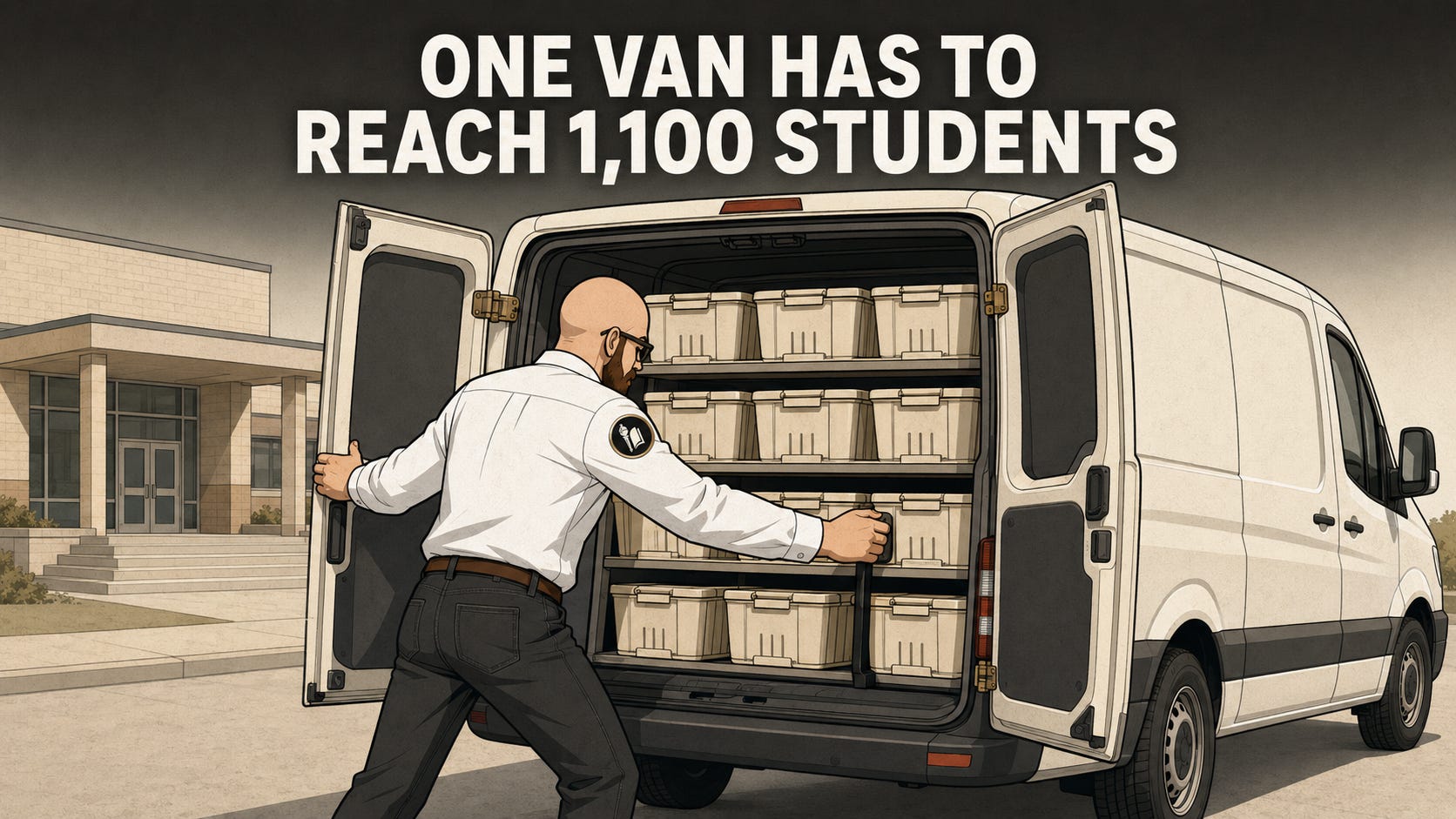
The federal contribution toward one purpose-built van was $170,646.
Its assignment was larger. The vehicle would support daily meal deliveries to 1,100 Indigenous students at nine schools in Whitehorse, part of an expansion of the Yukon First Nation Education Directorate Society’s Urban Nutrition Program.
That is how the project appears in the Canadian Northern Economic Development Agency’s 2024-25 Departmental Results Report. The agency, known as CanNor, lists the van among the results achieved through a fund for northern food and agriculture businesses.
Then the grammar changes.
The program “will deliver” the meals. The project “will” produce a high return on investment, support local employment and diversify the society’s revenue. The report gives no number for meals delivered during the year, no measure for that return and no employment count attached to the van.
The money was delivered. The results were still written in the future tense.
The Van in CanNor’s Results Column
CanNor reported providing approximately $2.5 million to 13 projects through Northern Isolated Community Initiatives in 2024-25. The fund invests in northern food and agriculture businesses. Its stated purpose joins two problems that Ottawa often places in separate files: economic activity and food security in northern and Indigenous communities.
The Whitehorse van puts both inside one vehicle.
Its immediate job is logistical. A nutrition program serving nine schools needs to move meals to the students. CanNor’s account gives the number of students, the number of schools, the recipient and the federal contribution. It does not describe the van’s design, its route or the date on which deliveries began.
The agency also gives the project a wider economic case. It says the investment will support local employment and diversify revenue for the non-profit operating the program. Those claims matter because CanNor does not report food projects as social spending alone. They sit inside its sole core responsibility, economic development in the territories.
That responsibility consumed $72.2 million in 2024-25. Another $8.7 million went to internal services, bringing actual agency spending to just under $81 million. Within that ledger, the van is a small line. On the ground, it is the physical link between a meal program and 1,100 students.
The report records the purchase. It does not yet record the delivery.
Northern Food Security Runs on Equipment
The other projects CanNor chose to feature follow the same practical logic. Northern food security, as presented in the report, depends on freezers, trucks, farm capacity and the ability to keep more production inside the territories.
In the Northwest Territories, CanNor issued $800,000 to Knutsford Ventures Inc. for a major expansion of the Polar Eggs farm. The stated aim was to increase production and capacity enough to bring the territory’s entire egg quota back within its borders. The agency said the project would create jobs, strengthen food security and reduce the cost of eggs.
Again, the promised outcomes are prospective. The report does not provide an updated production figure, a retail egg price or a completed job count. It establishes the investment and the intended result.
Elsewhere in the same report, a larger transport package appears under a different CanNor program. The agency committed $650,000 to the Naha Dene Development Corporation for a refrigerated truck, a delivery truck and two pickup trucks in the Dehcho Region. Of that amount, $46,000 was allocated for 2025-26.
The equipment is supposed to improve food-supply logistics, establish a delivery service and supply fresh produce to local workers. The trucks are also expected to generate rental revenue and help hospitality businesses expand during potential economic and population growth.
CanNor’s examples share a practical logic. One van moves school meals. One farm expansion tries to keep an egg quota at home. Four trucks create a delivery system where the existing system is not enough.
None of these is described as a temporary food shipment. CanNor’s chosen projects are attempts to build the machinery that moves, stores or produces food after the funding announcement is over.
The Funding Clock Beneath the Projects
The report pairs those investments with a warning about the larger operating environment. CanNor identifies fragile supply chains, narrow construction seasons and missing infrastructure as risks to northern economic development. It describes housing shortages in parts of the North as severe and says major infrastructure is inadequate or absent across the territories.
The agency’s current spending plan also has an expiry problem.
CanNor lists total planned spending of $66.3 million for 2025-26, $61.8 million for 2026-27 and $44.8 million for 2027-28. Planned full-time staffing falls from 124 positions in 2025-26 to 107 in 2027-28.
The agency attributes the decline to temporary programs reaching their scheduled end. The Tourism Growth Program expires first. Larger reductions are anticipated in 2027-28 with the scheduled expiry of Regional Economic Growth Through Innovation funding and an IDEANorth funding top-up. CanNor says 16 positions are attached to the IDEANorth money scheduled to end.
Those figures are not a final decision to remove every dollar. The report states that expiring funds may be renewed, increased or cancelled at the government’s discretion. It also notes that future spending figures include only Main Estimates, not later supplementary estimates or future Treasury Board submissions.
Still, this is the plan the department reported. The projects are expected to build durable capacity. Some of the programs supporting the agency are not yet durable themselves.
What the Report Can Prove
Departmental results reports sit between an appropriation and an outcome. They show where money went, which projects departments chose to feature and how the department describes its own performance. They can also expose the distance between an approved contribution and a finished result.
For the Whitehorse project, CanNor can report that $170,646 was delivered to procure a purpose-built van. It can report the intended reach: 1,100 Indigenous students at nine schools. It can state that daily meals will be delivered.
The document cannot yet tell the reader how many meals travelled in that van during 2024-25. It does not say whether the vehicle entered service before the fiscal year ended. It offers no baseline against which to test the promised expansion.
The same boundary runs through the egg-farm entry. The federal contribution is specific. The anticipated jobs, lower prices and food-security gains are not measured in the report.
This does not erase the investments. It defines what the public record can support.
For now, the cleanest result is also the most modest one. Ottawa funded a van. Its intended passengers are meals, and 1,100 students are waiting at the other end of the route.
Hansard Files reads the departmental record so you don’t have to. If stories like this matter to you, subscribe to keep this work independent.
Related Hansard Files Articles


Source Documents
Canadian Northern Economic Development Agency. (2025). Canadian Northern Economic Development Agency 2024-25 Departmental Results Report.
So if I read your article correctly, tax payer money was allocated for a well intentioned purpose. A document was published to demonstrate transparency but was really more an activity of obfuscation. And we have no results. We haven’t heard back from the schools where these students were to receive their meals? I am completely flummoxed after reading this. Is the information real or accurate? Im not trying to cast shade but all I can come up with is WTF? In a world of awakened treachery and deceit to read that it is being perpetrated in my own backyard and to our northern communities where life is rough enough. One truck one egg farm. Sounds like we messed up the omelette. Help me to understand.
I wish we lived in a country where we didn't have to pretend governments funding food programs for students was a good idea... where citizens weren't taxed into poverty and/or dependency so they could afford to feed their children... And where anyone pointing this out isn't accused of being heartless.