


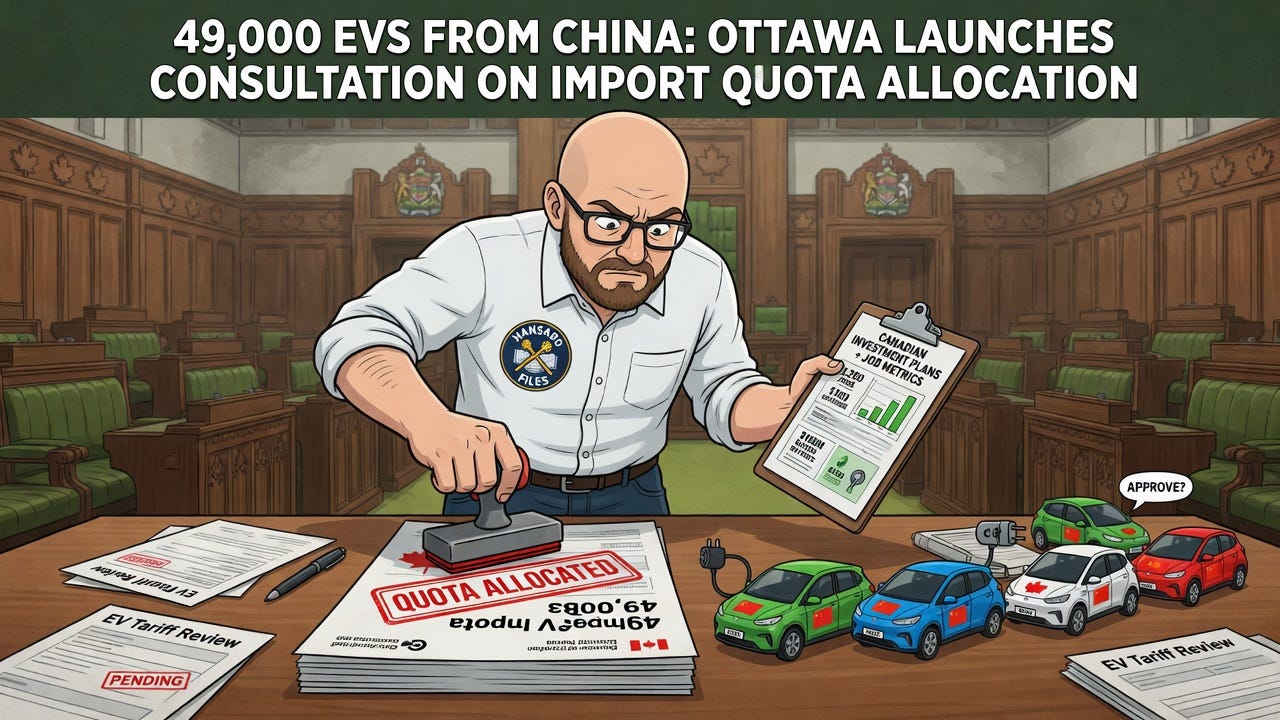
On April 18, 2026, the Canada Gazette published a notice that quietly signals one of the most concrete trade-policy decisions facing Canadian auto makers, consumers, and supply-chain workers this year. Global Affairs Canada is now seeking views on the allocation and administration of the 49,000-vehicle annual import quota for electric vehicles originating from China.
The quota itself stems from the preliminary joint arrangement between Canada and the People’s Republic of China announced January 16, 2026. It took effect March 1, 2026, on a first-come, first-served basis for an initial six-month period. Volume grows 6.5 percent each year. The share reserved for lower-priced EVs (FOB $35,000 or less) rises from 10 percent in year two to 50 percent in year five. The consultation, open until May 1, 2026, will shape the permanent system that begins September 1, 2026.
From First-Come, First-Served to Targeted Allocation
The current interim system lets eligible original equipment manufacturers (OEMs) that manufacture or assemble new motor vehicles in Canada compete on speed alone. Once the six-month window closes, Ottawa must decide whether to keep that simplicity or shift to a deliberate allocation model. The notice poses precise questions that reveal the government’s priorities: eligibility criteria, investment incentives, multi-year certainty, price considerations, and mechanisms to reward or penalize actual use of quota.
Global Affairs Canada asks whether the existing rule (OEMs resident in Canada under the Export and Import Permits Act) should remain or expand. It probes how to design allocations that catalyse new investment in Canadian plants, research facilities, or battery supply chains. Metrics under consideration include planned investment value, production capacity, domestic supply-chain depth, and new Canadian jobs. The notice also floats multi-year allocations to match long vehicle-development and shipping lead times, potential under-utilization penalties, and rules for transferring or returning unused quota.
Investment, Jobs, and Consumer Prices on the Line
A second set of questions targets practical administration. Should quota volumes favour OEMs that demonstrate concrete Canadian investment plans? How should existing joint ventures with Canadian firms factor in? What types of facilities deliver the greatest benefit (new assembly plants, R&D centres, battery technologies)? Should the final Canadian retail price of imported EVs influence allocation? And should permit validity (currently 60 days) change?
The notice makes clear that any allocation system must still respect exclusions: substances regulated under the Pest Control Products Act, Fertilizers Act, or Feeds Act, research-and-development uses, site-limited intermediates, and export-only products remain outside the quota.
What the Decision Means for Canadian Drivers and Industry
The outcome will affect more than importers. It will influence where future EV assembly and component plants locate, how quickly lower-priced models reach Canadian dealerships, and whether domestic supply-chain jobs grow or remain offshore. Feedback is invited from OEMs, small and medium-sized enterprises, industry associations, provincial governments, labour unions, academics, and the general public. Submissions go to the Trade Controls Division at evs.quota-contingent.ve@international.gc.ca.
The longer-term policy is scheduled for release in June 2026. Until then, the quota continues on first-come, first-served rules while stakeholders shape the rules that will govern it for years ahead.
Hansard Files digs through every page of the Canada Gazette so you don’t have to. Subscribe to support independent reporting on the federal rules that shape daily life in Canada.
Related Hansard Files Articles


Source Documents
Government of Canada. (2026, April 18). *Canada Gazette*, Part I, Vol. 160, No. 16.
Given how most vehicles manufactured for the Canadian market are required to meet rigorous safety standards, is there any indication the CCP's spymobiles are being tested or is it one of those "Trust me, brah!" situations?