


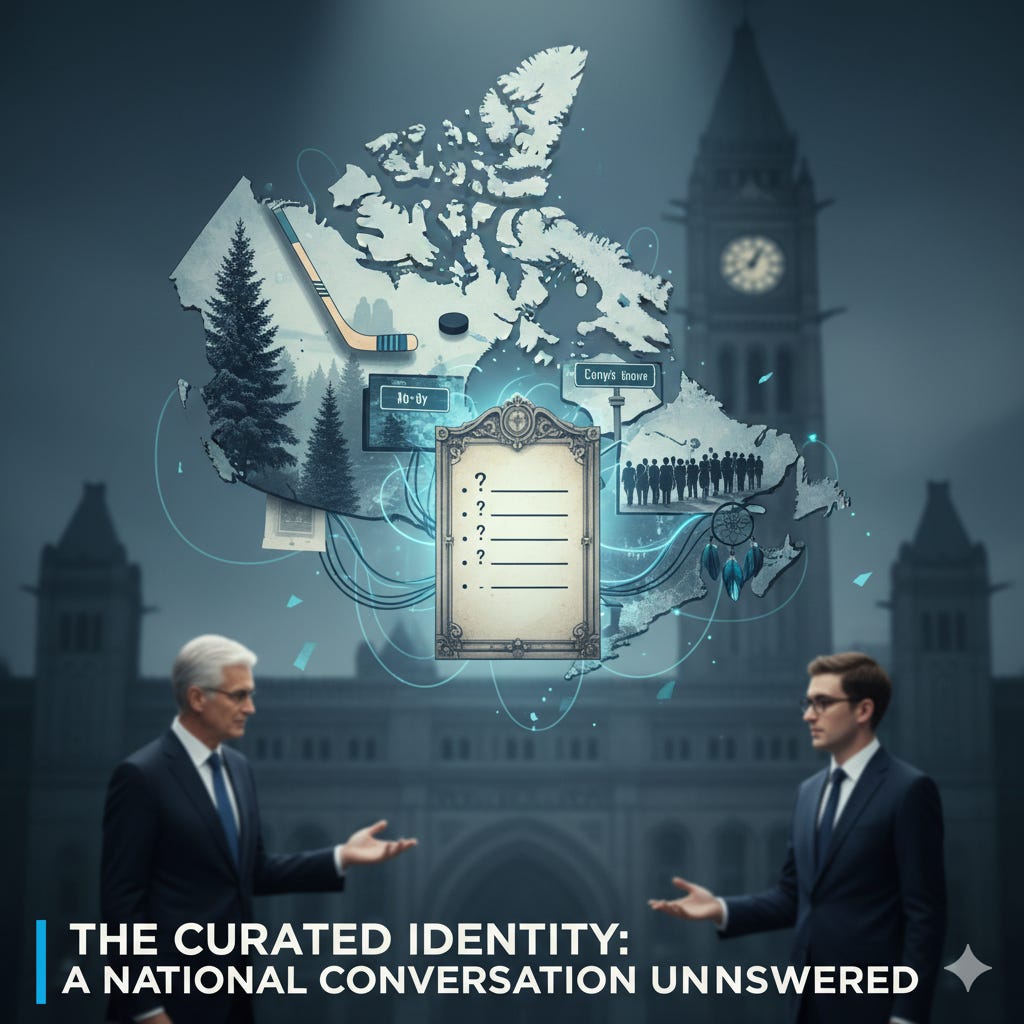
On September 25, 2025, senators questioned the Honourable Steven Guilbeault, a minister whose lengthy title includes the responsibility for “Canadian Identity.” The session covered a wide range of topics, from sports betting to budget cuts. One exchange, however, between the minister and Senator Leo Housakos exposed a profound challenge at the heart of our national conversation. When asked a direct question about the nature of Canadian identity, the minister’s response, or lack thereof, pointed to a significant shift in how our leaders approach the concept of nationhood.
This is not a minor point of political debate. Your frustration with a government that seems to speak in circles on fundamental issues is not misplaced. It reflects a deeper problem. The exchange in the Senate reveals a government that views national identity not as a coherent story to be told or a principle to be upheld, but as a series of files to be managed. This administrative approach creates a vacuum where a clear, unifying vision ought to be. Understanding this shift is the first step toward demanding something more substantive.
The Question That Went Unanswered
The core of the issue surfaced when Senator Housakos posed a simple, direct question to the minister responsible for Canadian identity: “How do you define and what is Canadian identity to you?” The problem begins with the answer. The minister’s response was a masterclass in deflection. He began by stating it was not his role to define the national identity for others.
My role is to work to ensure that the diversity of Canadian identities whether they are francophone, anglophone or Indigenous are well represented and put forward as part of the fabric of our society.
Here is the detail I find most revealing. The minister reframed his job from one of leadership to one of administration. Instead of articulating a vision, he described a process of ensuring representation for various identity groups. This response sidesteps the fundamental question. It assumes a “fabric of our society” exists without explaining what threads hold it together. The problem is not the recognition of diversity. The problem is the apparent belief that a national identity is nothing more than the sum of its diverse parts, with no overarching narrative required from its leaders.
This points to a critical question. If the minister for Canadian Identity believes his role is not to define it, then whose role is it? The answer seems to be no one’s. The government has positioned itself as a neutral facilitator, a manager of a complex portfolio of identities, rather than the champion of a specific, shared one.
The “Curated Identity”
To make sense of this approach, I propose an analogy: The Curated Identity. Think of the government as a museum curator. The curator’s job is to collect and display various artifacts, in this case, the multitude of identities present in Canada. The curator arranges them, ensures each is properly lit and labeled, and presents them to the public. Minister Guilbeault confirmed this view when he later described his role as a list of his portfolios. He mentioned being responsible for Official Languages, Nature, Parks Canada, Sport, and Diversity and Inclusion, suggesting these items are, in themselves, the pillars of our identity.
This is the essence of The Curated Identity. It is an identity defined by a bureaucratic checklist. The government’s role is simply to present the collection. But a collection of items is not a story. A museum filled with un-contextualized artifacts leaves the visitor confused, forced to invent a narrative on their own. The curator who refuses to explain what the exhibition is about fails at their most important task. Similarly, a government that only presents a curated collection of identities without articulating a unifying story abdicates its responsibility.
This became even clearer when Senator Housakos pressed the minister further. He asked the minister to at least acknowledge a historical foundation.
...will you at least acknowledge that the two founding people, the French and the English, along with the special status and the recognition of our Indigenous Peoples, are at the core of our heritage?
The minister again refused to engage with the substance of the question. He sidestepped the query about a historical core and instead pivoted to budget lines and program funding, mentioning the “$750 million that we pay each year to the Government of Quebec for French-language training programs.” This is the ultimate expression of the administrative mindset. When asked for a definition of our national soul, the answer is a reference to a spreadsheet. The government is more comfortable discussing the budget for the museum than the meaning of its contents.
What We Lose When We Don’t Define
The Curated Identity is not a benign, inclusive philosophy. It is an intellectual retreat that carries a significant cost. By refusing to articulate a core narrative, the government creates a vacuum. It assumes social cohesion will spontaneously emerge from a collection of managed diversity files. This approach leaves citizens, and especially newcomers, without a clear answer to the question, “What does it mean to be Canadian?”
The proceedings of September 25th were not just another day of political theatre. They were a clear demonstration of a government that prefers the safety of administrative language over the difficult work of articulating a national vision. The minister’s inability or unwillingness to define Canadian identity reveals a systemic failure to lead on one of the most fundamental issues facing our country. A country that outsources the definition of its own identity soon finds it defined by the loudest and most extreme voices.
In Other News...
Beyond this deep dive, you can find more analysis and commentary on the On Hansard site.


Source:
Senate of Canada. (2025, September 25). Debates, Issue 19. 1st Session, 45th Parliament.
I'd hate to have a federal politician defining me. I'm glad he's sticking in his lane.