


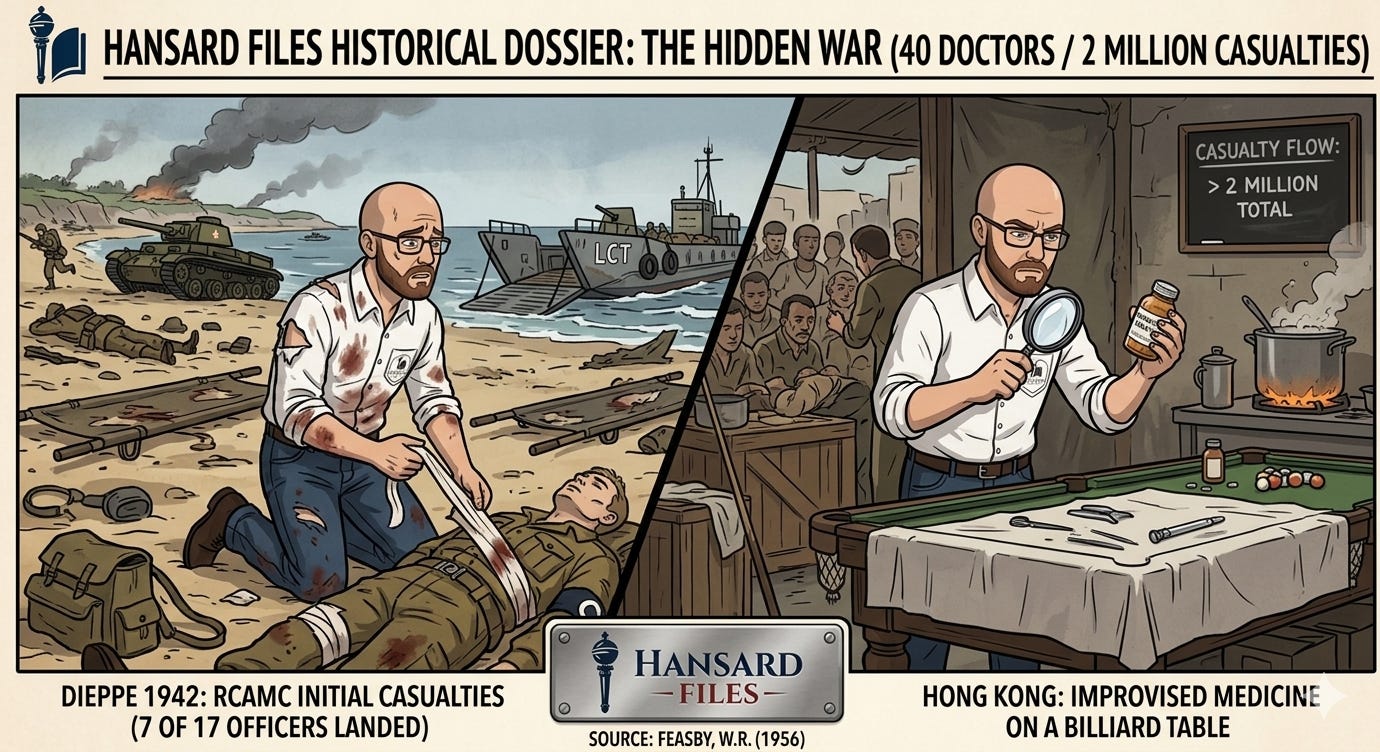
The medical officer of Les Fusiliers Mont-Royal was killed almost as soon as he landed.
It was August 19, 1942. Dieppe. Of the 17 officers and 117 other ranks of the Royal Canadian Army Medical Corps who had sailed toward the French coast that morning, only seven officers and 21 other ranks ever made it to the beaches. The rest were pinned offshore, watching from craft carrying tank reserves that never committed to the battle, two to three miles out, listening to what was happening on shore. Of those who did land, 24 became casualties. Only one officer and three other ranks returned to England unscathed.
This is not the Dieppe most Canadians know. It is the one buried in the Official History of the Canadian Medical Services, 1939–1945, Volume One, compiled by Lieutenant-Colonel W.R. Feasby and published by the Queen’s Printer in 1956. Six hundred and thirty-four pages. Decades of war diaries, official files, and clinical records. A cloudburst in Ottawa in July 1947 destroyed many of the original army medical files before anyone had finished reading them. What survived is remarkable enough.
The story it tells is of a medical corps that entered the war with 40 permanent medical officers, no field-ready equipment beyond obsolete First World War stocks, and a formal assessment from its own directorate stating that Canada could not medically support any force larger than a brigade. It left the war having passed more than two million casualties through its institutions, pioneering battlefield blood transfusion, managing penicillin therapy in the Italian theatre when the drug was barely known, and holding broken men together on billiard tables in Japanese prison camps with chloroform and pots borrowed from the cookhouse.
The Corps That Nearly Wasn’t Ready
Canada entered the Second World War with a military medical service that existed largely on paper. The Royal Canadian Army Medical Corps, despite its title, had a permanent establishment of just 43 officers and nursing sisters and 123 other ranks as of March 31, 1939. The non-permanent reserve units were worse. A General Staff report from 1931 rated 61 of the existing 81 medical units as “moderate to poor” for organization and training. Not moderate. Not developing. Moderate to poor.
The equipment situation was genuinely alarming. A report prepared in the Directorate of Medical Services in early 1938 stated plainly that with the stocks on hand, no more than a dozen regimental medical officers and a single field ambulance could be placed in the field. There was insufficient equipment to provide hospital facilities inside or outside Canada. The conclusion, written by people whose job it was to know, was that it would “not be possible to meet the medical requirements of any force in the field larger than a brigade in Canada or abroad.”
The Director General of Medical Services spent years trying to redirect defence funds toward medical stores. His requests were answered with polite deferral. The increased appropriations that arrived after 1936 went to weapons, vehicles, and ammunition. By the fiscal year 1939–40, the entire estimate for medical stores was $13,000, just $2,000 more than the year before. As late as August 25, 1939, a week before the war began, an emergency defence expenditure was authorized. The Militia’s medical allocation from that warrant: $10,000.
Then Germany invaded Poland.
40 Permanent Officers, 628,000 Soldiers
What followed is one of the most consequential institutional expansions in Canadian history, told almost entirely in the language of committees, war diaries, and casualty tables.
Mobilization began in September 1939 with a corps scrambling to examine recruits, establish camp medical facilities, and organize field units simultaneously. A practical test conducted in the D.G.M.S. office in May 1939 had concluded that the minimum time required for medical examination and attestation of recruits, if boards functioned at full speed from day one, was 16 days. Since that condition was unlikely to be met, the time allowed for units to reach war strength was extended to 21 days. The planning was both meticulous and, in places, optimistic to the point of absurdity.
But the Corps held. It improvised. Within months, field ambulances, casualty clearing stations, and general hospitals were forming across Canada and shipping to Britain. The small permanent cadre became a skeleton around which tens of thousands of civilian physicians, nurses, dentists, and orderlies assembled themselves into a functioning military medical system.
By the end of the war, that system comprised 5,219 medical officers, 4,172 nursing sisters, and 40,112 other ranks and ratings serving across three armed forces. A corps that had entered the war with barely the personnel to staff a mid-sized hospital had become the largest medical organization in Canadian history.
Dieppe: The First Real Test
The Dieppe raid of August 19, 1942 was supposed to be a controlled operation with a detailed medical plan. Regimental medical officers were to land with the assault waves, establish aid posts near the beaches, and progressively move inland. Four tank landing craft, each equipped for 100 stretcher cases and 60 walking wounded, were to ground on the main beaches an hour before withdrawal to evacuate the collected casualties. No. 11 Field Ambulance had trained intensively on the Isle of Wight for months. Opposed and unopposed landings were practised on the Dorset coast. The plan was sound.
The beaches were not.
At Puys, the Royal Regiment of Canada met what the official history calls “almost instantaneous disaster.” The first two assault waves were received with murderous fire. By the time the third wave landed, the unit was so decimated there was no prospect of reaching the objective. The regimental medical officer, who had landed with the second wave, was wounded almost immediately. His stretcher bearers followed. The No. 11 Field Ambulance section attached to the Royal Regiment managed to get a handful of men ashore onto an exposed beach under merciless fire. A proper regimental aid post was impossible to establish. Emergency first aid to whoever could be reached was all that was possible before the survivors surrendered at approximately 8:30 in the morning. Both medical officers were taken prisoner. Of the 18 other ranks in that section, only six returned to England, three of them wounded.
At Pourville, the story was different. The South Saskatchewan Regiment landed with less opposition and pushed inland. The regimental medical officer found a small grassy plot with embankments on three sides and a house on the fourth, roughly 200 yards from the shore, and established his aid post there. Casualties poured in from both the South Saskatchewans and the Queen’s Own Cameron Highlanders. When the order to close came, the accumulated wounded had been successfully transferred to the seawall. It was dangerous work, crossing ground under almost continuous mortar and machine-gun fire. It happened.
At Dieppe itself, the medical officers of the Royal Hamilton Light Infantry and the Essex Scottish got ashore and did, in the words of the official history, “very fine work among the wounded under most hazardous conditions.” The R.H.L.I.’s medical officer was wounded early and eventually taken prisoner alongside his counterpart from the Essex Scottish. The medical officer of Les Fusiliers Mont-Royal was killed on landing.
Over 600 wounded were eventually carried back to England. The reception of those casualties, organized in hours rather than days on 1,375 hastily cleared hospital beds across southern England, was largely successful, a fact the official history acknowledges with measured admiration given the chaos involved.
A Billiard Table in Hong Kong
If Dieppe was a crisis managed, Hong Kong was a catastrophe endured.
When Canadian forces left Vancouver on October 27, 1941, four medical officers, two nursing sisters, two dental officers, and a small number of other ranks accompanied them. The garrison surrendered on Christmas Day. What followed, the official history records with controlled precision, was nearly four years during which the Japanese were “largely indifferent to the requirements of the sick among their prisoners” and medical facilities provided of Japanese volition were “hopelessly inadequate.”
At Sham Shui Po Camp, the Japanese jammed almost 6,000 troops, Canadian, British, Indian, and Hong Kong volunteers, into a space built for two battalions. A dysentery epidemic arrived almost immediately. Surgical work was performed on a billiard table. Instruments were boiled in cooking pots. Chloroform was the only available anaesthetic. Sulpha drugs served as the principal antiseptic for wounds. The temperature dropped to 40 and 50 degrees Fahrenheit at night. Men slept without blankets, windows stopped with rags.
In August 1942, a diphtheria epidemic struck approximately 500 troops and killed 46. The official history notes, without editorial commentary, that this epidemic was believed to have the long-term result of saving lives, because the resulting immunity protected the camp population during subsequent outbreaks.
The Canadian medical officers kept working. Through strategems the history does not fully enumerate, they obtained the wherewithal to carry on an active practice. The official assessment is direct: it is questionable whether many Canadians would have survived this experience without the care of their own doctors.
Sicily, Italy, and the Innovation Imperative
The Mediterranean campaigns, beginning with the Sicilian landings in July 1943, forced a different kind of adaptation. Here, the challenge was not inadequate equipment or improvised facilities but the sheer complexity of coordinating medical care across dispersed forces, unfamiliar terrain, and diseases the Canadian military medical system had never systematically confronted.
Malaria nearly broke the planning before it began. Information about anti-malarial protocols trickled in to the 1st Canadian Infantry Division slowly and arrived incomplete. Documentary material on a range of medical subjects arrived too late for effective action. The specially trained malaria officer flown from the Middle East managed only three days of instruction with medical officers before embarkation. One routine mepacrine supply, an essential antimalarial tablet distributed daily, was scheduled to arrive on D plus 3 and be unloaded on an indefinite number of days thereafter.
The lesson was learned, sometimes painfully, but learned. By the Liri Valley operations in the spring of 1944, penicillin was making its first appearance in the Italian theatre and the supervision of penicillin therapy had been assigned as a formal responsibility. Field transfusion units, mobile bacteriological laboratories, and resuscitation officers were functioning as integrated parts of the casualty chain. The ambulance control post at Capua served as a distributing centre for all Eighth Army casualties, with a distributing officer maintaining live bed states for every hospital so that no facility was asked to receive more patients than it could handle. On one day in late May 1944, after the assault on the Hitler Line and the fighting along the Melfa River, No. 14 General Hospital received roughly 900 battle casualties and No. 15 received slightly more than 1,000, bringing total patients in each hospital to approximately 1,600.
They kept operating.
What 2 Million Cases Look Like on Paper
The final accounting in the preface of Feasby’s history is almost incomprehensible in its scale. More than two million casualties passed through medical institutions numbering well over one hundred in Canada and many scores in theatres abroad. The return of fit personnel to duty, the official history notes carefully, made a contribution to solving the problem of manpower for Canada “the significance of which is difficult to estimate.”
That understated sentence carries considerable weight. The Canadian Army, fighting across five years on multiple continents, never had enough men. The medical system that recovered the sick and wounded and returned them to units was, in an operational sense, a force multiplier. Heroic surgery and remarkable feats of therapy, Feasby writes, “became almost commonplace.”
What made that possible, the history makes plain, was not government investment or peacetime planning. The R.C.A.M.C. in 1939 had a medical stores budget of $13,000. It received $10,000 in emergency funds the week the war started. By any rational pre-war measure, it was not ready. The system that emerged, the one that held blood-soaked beaches and prison camp billiard tables together, was built in real time by physicians and nurses who had been civilians months or years before.
The Record That Almost Didn’t Survive
One detail in Feasby’s preface sits quietly, easy to miss in the institutional prose. In July 1947, a cloudburst in Ottawa destroyed many of the files of the Army Medical Service. The official historian had been appointed only a year earlier. The documents he needed to reconstruct what happened were gone before he had finished gathering them.
What remained was enough to fill 634 pages. What was lost is not quantifiable. Canada’s defence spending debate today, as senators debate a path to $159 billion in defence commitments by 2035, tends to focus on hardware: aircraft, ships, missiles, vehicles. This record, published 70 years ago by the Queen’s Printer and quietly digitized by the Department of National Defence, is a reminder of what underfunded military readiness actually costs. Not in procurement delays or equipment gaps. In billiard tables used as operating theatres. In medical officers who were killed as soon as they landed.
The men and women in those records did not have the benefit of adequate preparation. They had training, determination, improvisation, and each other. That proved to be enough. Barely, and sometimes not even that.
The question this history implicitly asks, and never answers, is whether we would ask them to do it again from the same starting point.
Hansard Files spends weeks in the archives so you don’t have to. If stories like this matter to you, subscribe to keep this work independent.
Related Hansard Files Articles

Source Documents
Feasby, W.R. (Ed.). (1956, January 1). Official History of the Canadian Medical Services 1939–1945, Volume One: Organization and Campaigns. Department of National Defence / Queen’s Printer, Ottawa.
Great essay Mike, one quibble though "Royal" Canadian Army Medical Corps? I thought that, like the UK, we have the Royal Canadian Air Force and the Royal Canadian Navy, but just the Canadian Army.
On a somewhat related note, one of my neighbours growing up was a veteran, a small quiet bachelor who survived Dieppe. If he had family, I never saw them. When I was young, my parents asked me to help him shovel snow and stack wood for his stove. He lived out his years self-medicating with liquor.