


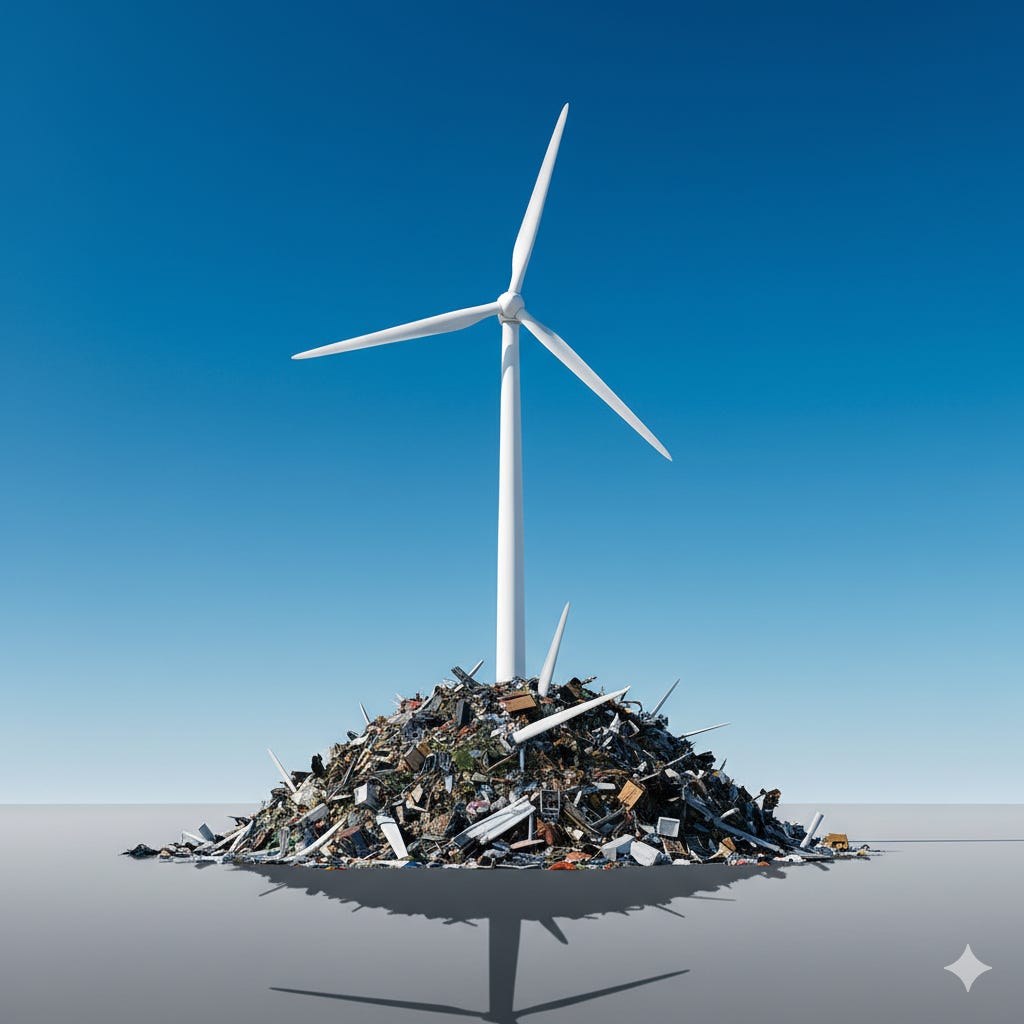
Wind power is a symbol of Canada’s clean energy future. We see the giant, graceful turbines spinning on the horizon and feel a sense of progress, a step toward a sustainable world. It’s an easy story to believe, one where our environmental challenges can be solved with smart technology and good intentions. This narrative feels right, but it’s dangerously incomplete.
The problem isn’t the energy the turbines produce, it's the turbines themselves. Specifically, the blades. By 2050, Canada is projected to produce over 275,000 tonnes of wind turbine blade waste. To put that in perspective, that’s more than eight times the total municipal solid waste the entire country generated in 2016. We are building a literal mountain of garbage in the name of going green.
But here's what everyone misses: this isn’t an accidental oversight. It’s a foreseeable crisis that our current policies are actively ignoring. Provincial regulations, designed to look responsible, are little more than a paper-thin veil over a massive landfilling operation. The coming wave of waste isn’t just an environmental issue, it’s a failure of governance happening in plain sight.
From Sky to Soil: The Un-recyclable Truth
A wind turbine blade isn't like a plastic bottle or an aluminum can. It’s a marvel of engineering, built from a complex composite of glass or carbon fibres bonded with resin. This makes them incredibly strong and light, but also a nightmare to break down at the end of their 20-25 year lifespan.
Think of it like a cake baked with superglue. You can’t just un-bake it to get the flour and eggs back.
Because of this complexity, the overwhelming majority of decommissioned blades worldwide are not recycled. They are cut up and buried in landfills. This is the dirty secret behind the clean image. While 80-90% of a turbine (the steel tower, the concrete base) is recyclable, the blades represent a massive exception.
And Canada is about to face a tidal wave of this waste.
A surge in wind farm installations between 2011-2015 means a massive number of blades will be retired between 2036-2040.
The annual waste is projected to spike to nearly 29,000 kilotonnes per year during that period.
An estimated 70% of all this waste will originate from just two provinces: Quebec and Ontario.
We are hurtling towards a predictable waste crisis with the simplest, and crudest, solution as our default: digging a very large hole.
The Recycling Mirage
So, why not just recycle them? The technology technically exists, but it’s far from a silver bullet. Each method comes with its own set of serious trade-offs, making the "green" solution look a lot murkier up close.
The options read less like a menu for sustainability and more like a list of compromises:
Mechanical Grinding: This is the brute-force approach. Blades are chopped, shredded, and crushed into a powder. The problem? It destroys the structural properties of the fibres, turning high-tech material into low-grade filler for things like concrete. It's less recycling, more down-cycling.
Cement Kiln Co-Processing: In this method, shredded blades are burned in cement kilns. The organic resin provides fuel, reducing the need for coal, and the glass fibres become an ingredient in the cement. While it avoids the landfill, it releases pollutants like dioxins and furans and permanently destroys the high-value fibres.
Thermal & Chemical Recycling (Pyrolysis & Solvolysis): These are more advanced options that use high heat or chemicals to dissolve the resin and recover the fibres. While they can recover fibres with up to 98% of their original strength, these processes are extremely energy-intensive, require harsh chemicals, and are not yet commercially mature.
Did You Know? Even when fibres are successfully recovered through recycling, they are often downgraded. Recycled carbon fibres, for example, might be suitable for the automotive industry, but they lose the high-grade quality required for aeronautics, creating a perpetual cascade of lower-quality material.
Each path has a cost, not just in dollars, but in energy, secondary pollution, and compromised materials. There is no easy, clean fix.
Canada's Policy Black Hole: We Have No Plan
This is where the story turns from a technological challenge into a failure of Canadian governance. Despite the coming 275,000-tonne wave of waste, Canada has no dedicated wind turbine recycling facilities.
Worse, our provincial regulations are structured to make this problem invisible.
In provinces like Ontario, Alberta, and Nova Scotia, wind farm operators are required to submit a "Decommissioning Plan Report" (DPR). It sounds responsible. These reports detail how a site will be dismantled and the land restored. But they contain a fatal flaw.
The plans only require that waste, including the massive blades, be transported off-site. Where do they go? The reports don't need to specify a recycling facility. Simply stating that the blades "will require disposal in landfill" is considered an acceptable and complete plan.
Our policy framework is like telling a teenager to clean their room by shoving everything under the bed. The room looks clean for the official report, but the mess is just hidden, pushed into a landfill for someone else to deal with later. This isn't just a lack of infrastructure, it's a policy choice that makes landfilling the path of least resistance. It’s a regulatory blind spot you could drive a transport truck full of turbine blades through.
From Passive Observer to Informed Watchdog
The reality of Canada's wind energy waste is unsettling. A technology we champion for its environmental benefits comes with a hidden cost that our own governments are helping to obscure. The promise of clean energy is being undermined by a dirty, and very large, garbage problem.
But now you know.
You're no longer just someone who sees wind turbines as symbols of a green future. You're now one of the few Canadians who understands the hidden cost and the policy gaps that allow it to grow. You see the 275,000-tonne challenge on the horizon and recognize that vague "decommissioning plans" are not a solution. This knowledge changes your role.
You're not just a passive citizen, you're an informed watchdog. And that is the first, most critical step to demanding accountability and forcing a real plan. Don't let this story stay buried. Share it. The conversation about Canada's energy future needs to include the one about its garbage.
For more deep dives into the policies shaping Canada, follow OnHansard on Substack.
Sources:
LaFreniere, K. (2025). Wind turbine blade circularity: an overview of composite recycling methods, global markets and policies, and opportunities for Canadian development. Natural Resources Canada, CanmetENERGY.