


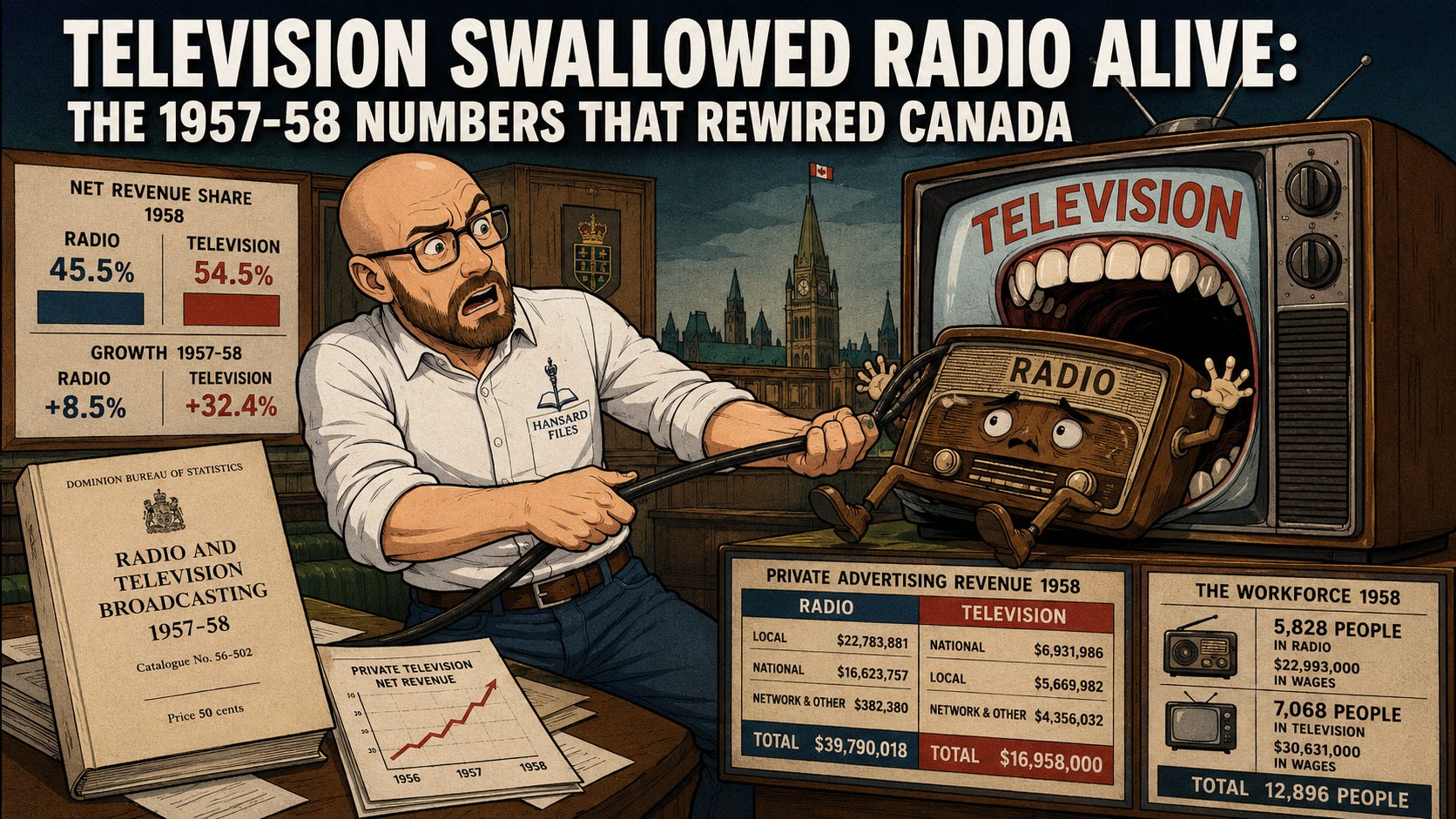
The document arrived in January 1961, bearing the crown seal of the Dominion Bureau of Statistics and a cover price of fifty cents. It was called Radio and Television Broadcasting, 1957-58, Catalogue No. 56-502, and it was the first time the federal government had ever attempted a full financial census of the private broadcasting industry. Nineteen pages of tables and charts. No photographs. No named voices. Just the cold arithmetic of an industry being remade in real time.
The numbers told a story that no one in a radio studio could have wanted to read.
The Year Television Won
In 1956, radio and television were roughly equal rivals. Private radio stations earned $48.6 million in net revenue. Private television stations earned $46.2 million. A gap of just $2.4 million separated the old medium from the new one. Two years later, that gap had collapsed entirely, and then reversed direction at startling speed.
By 1958, the total net revenue of the entire Canadian radio and television broadcasting industry had reached $127,945,330. Radio’s share: 45.5 per cent. Television’s share: 54.5 per cent.
Television had not simply caught up. It had surged past radio in the span of a single fiscal year.
The growth rates told the same story from a different angle. Radio’s total net revenue grew by a respectable 8.5 per cent between 1957 and 1958. Television’s grew by 32.4 per cent. The two industries were not running the same race. Television was in a different one entirely.
A System Built on Contradictions
What made the picture complicated was the asymmetry between the publicly owned Canadian Broadcasting Corporation and the expanding private sector. In radio, the CBC was effectively a minor commercial player. Private stations collected $39,790,000 in net advertising revenue in 1958. The CBC collected $1,098,000. Private radio owned 97.3 per cent of the advertising pie.
Television was different. The CBC had built the national television network from scratch, beginning with its first stations in Montreal and Toronto in 1952. By 1958, the Corporation held a meaningful share of the television advertising market: $10,438,000 compared to $16,958,000 for private stations. That split, roughly 38 to 62 per cent, reflected a system where private entrepreneurs profited from programming delivered over infrastructure the public broadcaster had largely constructed.
The expense picture deepened that contradiction further. In 1957, the CBC accounted for 76.3 per cent of total television expenses in Canada. Its private affiliate partners spent only 23.7 per cent. A year later, the ratio had barely shifted: CBC carried 76 per cent of costs while generating just over 38 per cent of the advertising revenue. The publicly funded broadcaster was absorbing most of the infrastructure cost so that private stations could harvest an expanding national audience.
Ontario’s Stranglehold
Within the private sector, geography determined destiny. The survey’s regional breakdowns showed Ontario as the dominant market for both radio and television, by a margin that left other regions far behind.
In private radio, Ontario’s 59 stations earned total net revenue of $14,345,341 in 1958. Quebec’s 35 stations earned $9,199,440. The Prairie provinces, despite spanning three provinces and 35 stations, earned $9,334,179. British Columbia’s 20 stations earned $5,230,014.
But the Prairie story held one quiet surprise. Private radio stations in the Prairie region earned the highest average net revenue per station in Canada: $267,000. Ontario’s per-station average was lower. The Prairies, despite their smaller absolute totals, were running lean and profitable operations. Not every battle in Canadian broadcasting was won in Toronto.
Television concentrated wealth more aggressively. Ontario’s 13 private television stations generated $9,041,124 in total net revenue in 1958, against only $3,196,085 for Quebec’s 8 stations. The Prairies and British Columbia combined for $5,194,539. The survey recorded the highest average net revenue for private television stations in Ontario at $691,000 per station. The gap between Ontario and everyone else was not merely large. It was structural.
The Station That Survived on Local Ads
Strip away the network figures and the CBC grants, and what emerges is a portrait of an industry far more local than its national ambitions suggested.
For private radio stations, local advertising was the financial foundation. In 1958, local advertising generated $22,783,881 of the industry’s $39,790,018 in total private radio advertising revenue. National advertising added $16,623,757. Network and other revenues combined for a comparatively modest $382,380. The model was, at its core, a local business selling airtime to local businesses.
Private television told a different story. National advertising was the dominant revenue source for private television stations, generating $6,931,986 in 1958. Local advertising contributed $5,669,982. The structure of television, with its higher production costs and its dependence on national brands with large budgets, pushed the medium toward national advertisers in a way that radio, with its lower cost of entry, never had to.
Two-thirds of all 171 private radio stations operating in 1958 earned average net revenues of $200,000 or less. Half of the 40 private television stations earned $400,000 or less. The industry’s headline figures were driven by a small number of large-market stations. Behind them, dozens of small operations were running on thin margins in secondary cities and rural regions, serving audiences that the national networks often did not reach.
12,896 People Making It Work
Beyond the revenue columns, the survey captured something harder to quantify: the workforce that held the whole enterprise together.
In 1958, 5,828 people were employed in radio broadcasting across Canada, earning a combined $22,993,000 in wages and salaries. That represented a 6.8 per cent increase over 1957 payrolls. Television employed 7,068 people earning $30,631,000, an 8.9 per cent increase over the prior year.
Nearly 13,000 Canadians went to work every day to keep the country’s broadcast signal alive. Announcers, engineers, salespeople, production staff, technicians running transmitters in towns whose names rarely appeared on national newscasts. The survey did not name them. It counted them. And the count revealed an industry that had already moved beyond its experimental phase and become a significant employer of professional labour.
The commissions data added a layer of commercial complexity. Private radio stations paid $2,237,153 to representative agencies in 1958 and $3,178,466 to advertising agencies. For television, advertising agency commissions alone reached $1,159,422 for private stations. An entire ecosystem of intermediaries had grown up around the business of selling time on air.
What Ottawa Could Not See
The survey’s introduction was candid about its own limits. Before 1957, there had been almost no systematic financial data on privately owned broadcasting stations. The CBC published annual reports. The Canada Year Book captured some aggregate numbers. But the private sector, which by 1958 owned 97 per cent of the radio advertising market, had operated largely outside the federal statistical gaze.
The pilot survey in 1956 had published figures on a gross basis. The 1957-58 report shifted to a net basis, deducting agency commissions and production charges billed to sponsors. The methodological change made direct year-over-year comparison difficult and required careful estimation. About 3 per cent of radio stations had failed to report in 1957, and 2.3 per cent in 1958. The survey prepared estimates for the non-reporters, concluding that the missing stations were small enough that they represented only 0.6 per cent of total revenues in 1958.
Television stations achieved 100 per cent response. Every privately owned television broadcaster in Canada reported.
That difference in compliance rates is itself a small window into the industries’ divergent self-awareness. Television operators knew they were building something consequential. They showed up.
The Shape of What Came Next
In January 1961, when the Dominion Bureau of Statistics published this report, the Broadcasting Act had already been rewritten. The Board of Broadcast Governors, created in 1958, had separated the regulatory and broadcasting functions that the CBC had previously held simultaneously. The first private television network, CTV, was forming. The industry these nineteen pages described was already giving way to something larger and more fractured.
But the document preserves a moment of particular clarity: the precise year in which Canada’s broadcast economy tipped from one medium to another, captured in tables printed on government paper and sent to libraries and policy offices across the country for fifty cents a copy.
The numbers in those tables shaped decisions about licences, networks, and public funding that echoed forward for decades. They shaped the industry that shaped the culture. And the culture shaped the country you live in now.
Hansard Files spends weeks in the archives so you don’t have to. If stories like this matter to you, subscribe to keep this work independent.
Related Hansard Files Articles

Source Documents
Dominion Bureau of Statistics, Public Finance and Transportation Division, Public Utilities Section. (1961, January). Radio and Television Broadcasting, 1957-58 (Catalogue No. 56-502). Published by authority of the Honourable George Hees, Minister of Trade and Commerce. Roger Duhamel, Queen’s Printer, Ottawa.
The switch between television and the internet hasn't been as abrupt but I suspect will be even more substantial in impact than the switch between radio and tv.