


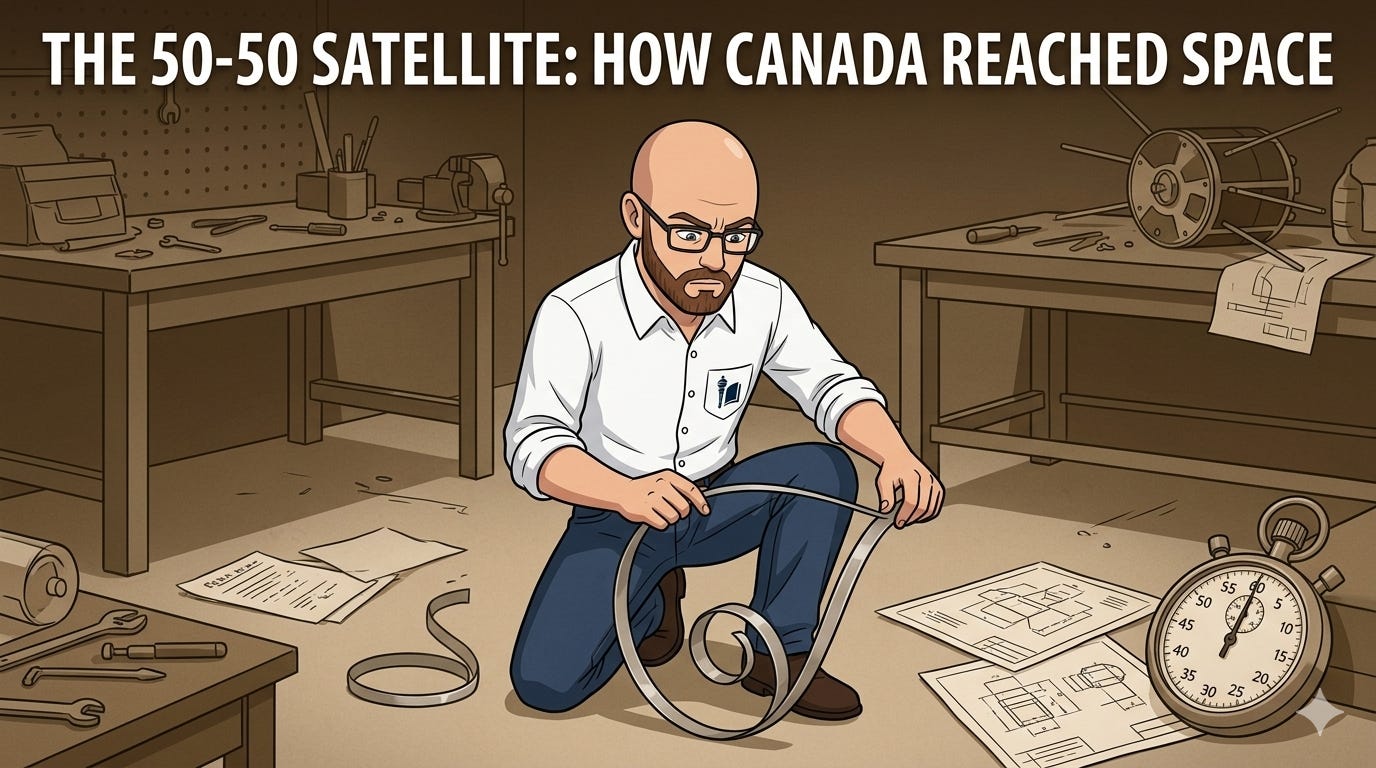
It was late September 1962. At Shirley Bay, on the outskirts of Ottawa, Canadian engineers and scientists waited for a satellite that the government’s later account said had only a fifty per cent chance of surviving orbit. The machine weighed 325 pounds. They had spent three years in “hectic activity.”
At 11:06 p.m. Pacific time on September 28, the Alouette I satellite was launched from the Western Test Range. As the rocket ascended, the tired crews waited for the signal. When ground stations in South Africa and Alaska confirmed that Alouette was operating, the control rooms had their answer.
Canada had become the third nation in space, designing and building its own satellite at a time when most spacecraft were expected to burn out in months. The launch of Alouette I was the “big bang” moment for the Canadian space program, initiating a decade of innovation that would see a country with a fraction of NASA’s budget achieve a reputation for “more successful space research per dollar than any other country”.
The Carpenter’s Tape Dilemma
The origins of the Alouette project lay in a specific Canadian curiosity: the ionosphere. Because of the country’s northern geography, the upper atmosphere above Canada is particularly disturbed, creating the aurora borealis and disrupting radio communications. In late 1958, the Defence Research Telecommunications Establishment (DRTE) presented a paper at a U.S. conference proposing a “topside sounder” satellite, a device that would bounce radio waves off the ionosphere from above, creating a radar-like map to complement ground-based studies.
The conference treated it as the most advanced proposal there. The engineering problem was the antennas. To effectively “sound” the ionosphere, the satellite required antennas 150 feet from tip to tip for one, and 75 feet for the other. Putting a structure that large into a compact 325-pound package seemed physically impossible.
The solution came from an unlikely source: the tank warfare of the 1940s. Two decades earlier, the National Research Council had developed a concept for an antenna that could be stored flat, rolled up like a carpenter’s steel tape, and then formed into a rigid tube as it unrolled. The Canadian engineers adapted this “STEM” (Storable Tubular Extendable Member) technology for the vacuum of space.
This innovation would become one of Canada’s most enduring contributions to aerospace engineering. The concept was eventually commercialized by SPAR Aerospace Ltd. of Toronto, which sold more than $12 million worth of these extendable antennas to foreign space programs in the years following.
Longer Than Anyone Budgeted
Reliability was the primary obsession of the Shirley Bay team. They knew that once it was in orbit, no one could go fix it. The engineering process involved ordering hundreds of samples of a single part to test them under extreme conditions of radiation, direct sunlight, and vibration, simply to choose the single best component. They designed fail-safes to ensure equipment could not accidentally drain the batteries beyond their ability to recharge.
The industry standard for satellite longevity in the early 1960s was measured in months. The Alouette builders hoped for a year. Their most optimistic, “shoot-for-the-moon” prediction was five years of declining usefulness.
Ten years after its launch, as the Department of Communications compiled its 1972 report, Alouette I was still sending back useful data. It held the record for the longest run of any satellite in history at that time. The four experiments on board, measuring cosmic noise, listening to VLF signals, and counting charged particles, operated perfectly, resulting in some 400 scientific papers, more than any other satellite of its era.
Because of this unexpected longevity, scientists had comparable measurements of the ionosphere over almost an entire 11-year solar cycle. They could observe how the “solar wind” of plasma and radiation interacted with the Earth’s magnetic field over the long term, including what the report calls “inner space.”
From Science to Industry: The ISIS Transition
With Alouette I still transmitting, the Canadian team faced a new question: “What next?” They had a backup model of Alouette sitting in the lab, a carbon copy built in case the first launch failed.
The government saw an opportunity to pivot. While Alouette I had been an “in-house” government project, the next phase was designed to kickstart a domestic space industry. Canada entered into a joint program with the United States called International Satellites for Ionospheric Studies (ISIS). The mandate changed. Now, the government would provide management and specifications, but Canadian private industry would build the spacecraft.
The backup model was retrofitted and launched as Alouette II in November 1965. Unlike its predecessor’s circular orbit, Alouette II was thrown into an elliptical orbit ranging from 320 to 1,800 miles, allowing scientists to slice through different altitudes of the atmosphere.
This was followed by ISIS I (1969) and ISIS II (1971). These were no longer simple sounders; they were complex orbiting laboratories. ISIS I weighed 580 pounds and carried ten experiments with antennas extending a massive 240 feet. ISIS II carried photometers capable of imaging the aurora borealis from above, allowing humanity to see the Northern Lights as a complete phenomenon for the first time.
Through these projects, companies like RCA Ltd. in Montreal (electronics) and SPAR Aerospace in Toronto (structure) cut their teeth on advanced space flight hardware. The strategy worked. Canada was building an industrial base, not only flying instruments.
The Anik Revolution: Connecting the Disconnected
By 1968, the focus of the Canadian space program shifted from pure science to urgent pragmatism. The country faced a communication crisis: vast distances, sparse population, and a severe climate made traditional cabling economically impossible for the North.
Only the Soviet Union had attempted a domestic satellite system, but their solution required multiple satellites and complex tracking stations. Canada decided to leapfrog the technology. Parliament created Telesat Canada to manage the world’s first domestic geostationary communications satellite system.
The result was Anik (Inuktitut for “brother”).
Scheduled for launch in November 1972, Anik was designed to park in a geostationary orbit 22,000 miles above the equator. From this vantage point, it acted as a stationary relay tower in the sky. It promised to bring east-west television, telephone, and data transmission to nearly every Canadian, regardless of location.
For the first time, isolated northern communities of under 500 people could receive reliable telephone and radio service through “thin route” ground stations. Network television could reach the remote corners of the Arctic. It was a technological unification of the country, driven by the realization that “looking to the stars” helped keep “feet on the ground”.
The High-Power Gamble of the 1970s
As the first decade of Canadian spaceflight closed, the engineers at the newly formed Communications Research Centre (CRC) were already looking toward the 1980s. They were designing the Communications Technology Satellite (CTS), a project that would push the boundaries of power transmission.
The CTS was experimental, designed to test a “Travelling Wave Tube” provided by NASA that could broadcast a signal of 200 watts. To put that in perspective, the previous generation of satellites broadcast at roughly six watts. That increase in power meant that ground stations could be smaller, cheaper, and simpler, eventually leading to the community antennas and direct-to-home satellite dishes we recognize today.
This new spacecraft also required a radical redesign. Instead of spinning for stability like Alouette and Anik, the CTS would be stabilized on three axes, keeping it permanently locked facing the Earth. It utilized experimental “sails” (concertina-type solar arrays) and an ion engine for station-keeping.
A Decade of Quiet Excellence
The tone of the 1972 report is one of quiet, methodical pride. There is little bombast. The text notes that while the program was “sometimes short on glamor,” it was “long on knowledge”.
The commitment to space was bipartisan, initiated by Prime Minister John Diefenbaker and continued by Lester Pearson immediately following the Sputnik shock of 1957. In a polarized world, Canada carved out a niche that was neither militaristic nor vanity-driven. It was utilitarian.
From the 325-pound Alouette that was still working, to the geostationary orbit of Anik, the first ten years of Canada in space proved that a middle power could lead the world, provided it was willing to innovate its way around the constraints of budget and geography.
Hansard Files works from the government booklet, not the commemorative version. The archive stays free. A paid membership funds the hours to read the next file.
Source Documents
Department of Communications. (1972). 10 Years in Space. Information Services, Department of Communications.
Excellent background summary. Thank-you.
True story: I first learned about Anik, Alouette I and II from my Scouts Canada Handbook. There was a blurb called Canada in Space or something related to the astronomy badge.
So proud of Canada's leadership in space. And now we are developing our own launch sites and our own network relay system. Thank you for sharing this Mike.