


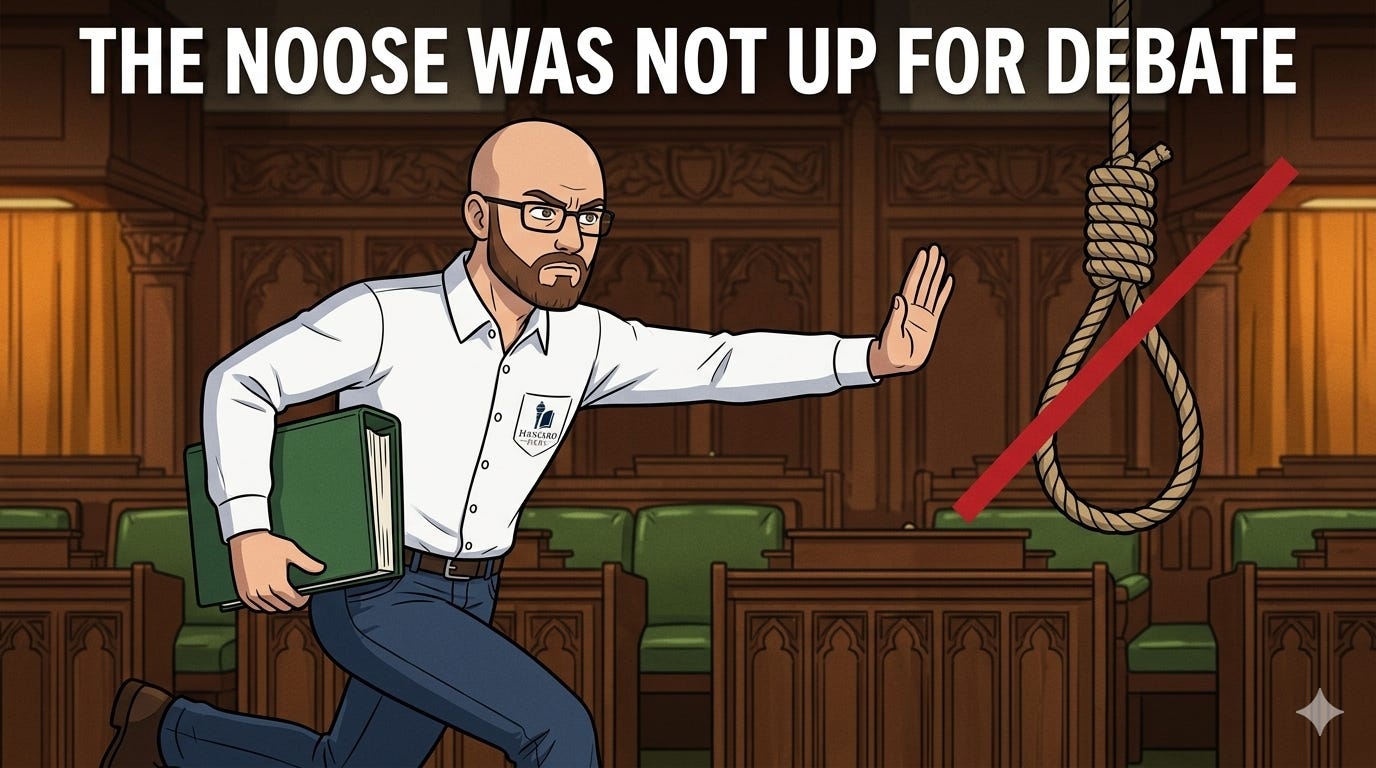
Craig Wellington had thought carefully about what a noose means.
The CEO of the Black Opportunity Fund, speaking into the Senate record on the question of whether Canada should formally ban the display of the noose as a hate symbol, did not reach for euphemism.
“The noose is not a position in a debate,” he said. “It is not an argument. It is a promise of violence. It is a threat. It is a tool that is being used to commit violence and acts of racial terror.”
The Senate chamber that received those words in early June 2026 was in the middle of one of its more contested legislative weeks in recent memory. Bill C-9, the federal government’s Combatting Hate Act, had arrived from the House of Commons already cracked along fault lines. Four new Criminal Code offences. A ban on displaying hate and terrorism symbols in public. A standalone hate crime designation for offences motivated by hatred. And, fatally contentious for some senators, the removal of a longstanding “good faith” religious opinion defence that had existed in Canadian hate crime law for decades.
Three days of debate would produce two adopted amendments, one rejected amendment, one tabled amendment that did not receive the support it needed, and a final vote sending the bill to Royal Assent. Whether the law that emerged was stronger or weaker than what arrived is, depending on the senator you ask, entirely a matter of perspective.
Four a Day, Every Day
The numbers in the Senate record do not invite ambiguity.
From 2018 to 2024, police-reported hate crimes in Canada rose 169%, reaching 4,882 incidents in the most recent year on record. That is an average of more than 13 incidents every single day. The clearance rate for non-violent hate crimes sits at 13.8%.
Black Canadians bear a disproportionate share of those incidents. They represent 4.3% of the Canadian population. They account for 37% of race-motivated hate crimes.
Senator Wanda Thomas Bernard, in proposing the amendment to add the noose to the bill’s list of banned hate symbols, did not present those numbers as background. She presented them as the reason the amendment was not optional. The noose, she told the chamber, is a weapon of domestic terror and white supremacy with a documented history of deployment against Black communities. Its appearance at a worksite, outside a home, or on a campus is not symbolic ambiguity. It communicates a specific threat to a specific population.
The amendment passed.
The SS bolts, the twin lightning runes worn by members of the Nazi Schutzstaffel and adopted by contemporary white supremacist movements, had already been added during clause-by-clause review on June 3, through an amendment proposed by Senator Scott Arnot. The noose followed the next day.
Two symbols. Two amendments. Both adopted without the kind of pitched floor confrontation that would consume the chamber for the rest of Bill C-9’s final days.
The Fight Over Faith
The sharpest debate centred on something the bill removed, rather than something it added.
Under the previous version of Canada’s Criminal Code, a person charged with wilfully promoting hatred could invoke a “good faith” defence if their statements arose from sincere religious opinion or an expression of views on religious texts. Bill C-9 repeals that defence.
Senator Yonah Martin brought an amendment to restore it. Her argument was direct: faith communities across Canada had contacted her offices in significant numbers, anxious about whether their religious teachings, particularly on matters of sexuality, gender, and interfaith relations, could now expose them to criminal liability. The removal of the “good faith” clause, she argued, created a chilling effect. Congregants and clergy were worried about what they could say from a pulpit, in a religious school, or at a community gathering. Her amendment proposed reinstating a clear protection for sincere religious expression.
Senator Pierre Dalphond opposed the amendment on legal grounds that were equally direct. The mens rea required to commit the offence of wilfully promoting hatred, he told the chamber, is incompatible with the mental state of a person acting in genuine good faith. You cannot simultaneously intend to promote hatred and act in good faith. The defence, in his reading, was not only redundant but logically incoherent.
“I cannot kill my neighbour in good faith,” he said, “and I cannot promote hatred in good faith.”
Government Representative Senator Marc Moreau offered a similar position. “Good faith” is not a defined term in Canadian criminal law. Inserting it without definition creates interpretive problems that could be exploited by defendants whose conduct the legislation was specifically designed to address.
Senator Martin’s amendment was negatived.
Whether that outcome reassures or alarms depends on whether you find Senator Dalphond’s legal logic persuasive or whether you believe the practical anxiety in faith communities reflects a real gap in protection. The Senate record contains both positions, argued at length and without resolution between them.
The Amendment That Didn’t Proceed
Senator Annie Karetak-Lindell arrived at third reading with an amendment of a different register.
She proposed to add Indian residential school denialism to the bill’s hate propaganda provisions. The denial, minimization, or justification of the documented harms of the residential school system, she argued, is not a matter of academic interpretation. It causes direct harm to survivors and their families. It contributes to the erasure of documented atrocities. It should, in her view, be treated as hate propaganda.
The government did not support the amendment. The stated reason was procedural and substantive at once: no prior consultation with Indigenous Peoples had occurred regarding this specific change, and amendments to hate propaganda provisions require comprehensive engagement before they can be responsibly enacted. The government’s position was that this was not the right vehicle, at this time, without that process.
Senator Karetak-Lindell’s amendment did not pass.
The exchange did not produce a resolution. Senator Dawn Anderson, speaking separately on a different matter before the chamber during the same session, offered a sentence that the record preserves without editorial commentary:
“At some point, reconciliation must stop being Indigenous homework and start becoming government responsibility.”
She was speaking about a different policy failure. The line applies more broadly.
What Passed and What It Does
The bill that received final approval on June 4, 2026, amends the Criminal Code in four principal ways.
It creates a new standalone hate crime offence, applicable when an individual commits any offence under the Criminal Code or another federal statute and that offence is motivated by hatred based on specified grounds, including race, religion, national or ethnic origin, sexual orientation, and gender identity. It adds new offences for intimidating, obstructing, or interfering with a person’s access to places of worship or places primarily used by an identifiable group. It bans the public display of specific hate and terrorism symbols. And it creates a definition of “hatred” in the Criminal Code itself, codifying Supreme Court language specifying that hatred involves detestation or vilification, not mere disdain or disagreement.
The attorney general consent requirement for laying charges under three existing hate propaganda offences is retained, and extended to the new symbol-display offence. This was an amendment made in the House before the bill arrived in the Senate, adopted in response to concerns that removing the requirement would invite vexatious prosecutions.
The noose and the SS bolts now join the list of banned symbols.
The “good faith” religious defence does not return.
Four Incidents Per Day, 13.8 Percent Cleared
The bill passed. The 4,882 incidents do not disappear with it.
What the Senate record makes clear, across three days of debate, is that the legislation was designed to respond to a specific documented trend, that reasonable senators held fundamentally different views about where the law’s protections and limitations should fall, and that at least two communities, faith communities and Indigenous survivors, left the process with concerns that were heard but not, in their view, fully answered.
Senator Dalphond’s legal logic may be sound. Senator Martin’s constituents may still be worried. Both things are available in the record simultaneously.
What is not available for debate, at least not in the Senate chamber on June 4, 2026, is Craig Wellington’s sentence. The noose is a promise of violence. The Senate agreed on that much, added it to the list, and moved on to the next item.
Hansard Files reads the parliamentary record so you don’t have to. If this kind of coverage matters to you, subscribe to keep it independent.
Related Hansard Files Articles

Source Documents
Senate of Canada. (2026, June 2). Debates of the Senate (Hansard), 1st Session, 45th Parliament, Issue 077. Ottawa: Parliament of Canada.
Senate of Canada. (2026, June 3). Debates of the Senate (Hansard), 1st Session, 45th Parliament, Issue 078. Ottawa: Parliament of Canada.
Senate of Canada. (2026, June 4). Debates of the Senate (Hansard), 1st Session, 45th Parliament, Issue 079. Ottawa: Parliament of Canada.
The issue of IRS denialism will need to be dealt with at some point. It is not okay to deny the harms done by hate, genocide and oppression.
These efforts to criminalize free speech are guaranteed to end up causing more problems than they solve. At no point in history has a government pushing censorship ended up being "the good guys" so to speak.
If the "hate symbols" legislation goes through, I'm going to encourage mass reporting of hateful symbols like the ISIS and other Islamic war flags, a pro-Hamas signs, AntiFa symbols, the communist "Hammer & Sickle" flag, the "clenched fist" flag and any other ideological symbols dedicated to the destruction of western society.