


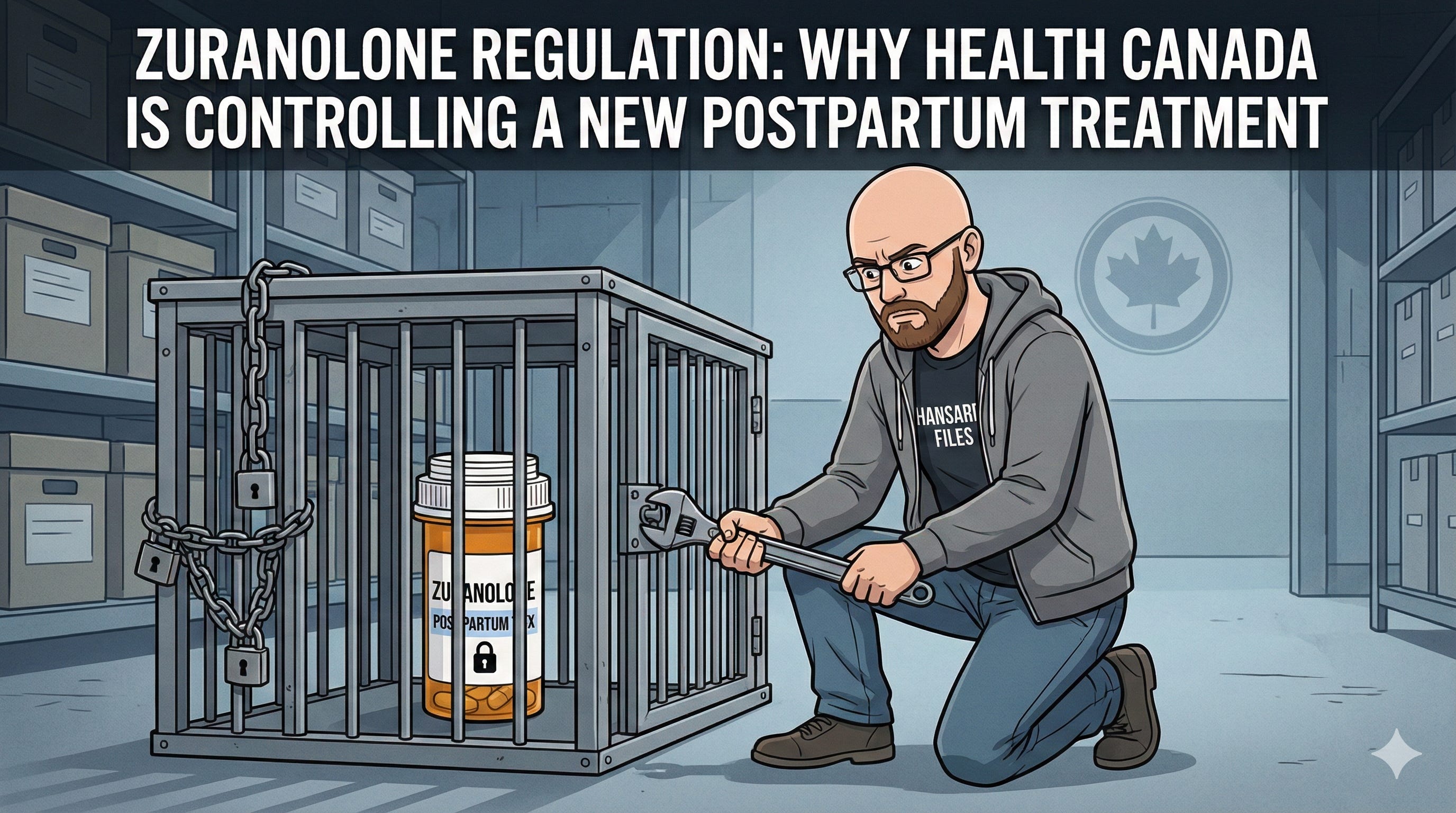
The machinery of the Canadian state often moves in silence, buried beneath the quiet columns of the Canada Gazette. But on the morning of Saturday, February 7, 2026, the federal government signaled a pivotal shift in how the country manages the intersection of mental health innovation and public safety. At the center of this regulatory pivot is zuranolone, a newly authorized synthetic neuroactive steroid designed to treat moderate to severe postpartum depression. While the drug offers a lifeline to new mothers navigating the darkness of postpartum mental health, Health Canada has simultaneously identified a shadow risk: the potential for addiction and diversion into the illicit market.
This Saturday morning publication outlines a proposal to place strict federal controls on the drug, locking it behind the same legislative walls that guard against the misuse of Valium and Xanax. The government is not merely approving a medicine. They are constructing a high-security regulatory cage around it.
The Chemistry of Control
To understand the government’s hesitation, one must look at the pharmacology detailed in the regulatory notice. Zuranolone is not a typical antidepressant. It functions as a positive allosteric modulator of the gamma-aminobutyric acid type A ($GABA_A$) receptor.
This mechanism of action is effective, but it mimics the chemical pathways triggered by benzodiazepines. Health Canada’s scientific assessment has flagged that, like the sedatives currently gripping comers of the addiction crisis, zuranolone shows “potential for both misuse and physical dependence”.
The proposal unveiled by the Department of Health is blunt. They intend to add zuranolone to Schedule IV of the Controlled Drugs and Substances Act (CDSA). This is not a minor bureaucratic filing. It effectively categorizes the treatment as a substance that, while medically valid, poses a risk to “the health of an individual or to society” if diverted.
The implications of this scheduling are immediate and physical. The drug will be regulated as a “targeted substance” under the Benzodiazepines and Other Targeted Substances Regulations. This regulatory classification is a temporary bridge, however. The government notes that these specific regulations are slated for repeal, to be replaced by the new Controlled Substances Regulations coming into force later this year on October 1, 2026.
The Supply Chain Lockdown
The listing of zuranolone under Schedule IV triggers a cascade of security protocols that will ripple through the Canadian pharmaceutical supply chain. The Gazette notice explicitly details the increased oversight that manufacturers and distributors must now prepare for.
If the proposal is ratified following the consultation period, the free movement of zuranolone ends. Any entity wishing to touch the substance—whether to produce, assemble, sell, provide, transport, send, or deliver it—will require a controlled substances licence. The days of standard logistical handling for this postpartum treatment are over.
The border becomes a harder line to cross. The notice mandates that an import or export permit will be required for each individual shipment of zuranolone entering or leaving Canada. This granular level of control is designed to give law enforcement and border agencies “additional tools” to intercept illegal importation or distribution.
Furthermore, the chill extends to the scientific community. Researchers hoping to conduct clinical trials or further studies on zuranolone’s efficacy or side effects will no longer have automatic access. They must apply to Health Canada for a specific exemption to handle the drug.
Health Canada acknowledges that this regulatory heavy-handedness could disrupt the availability of the drug. In a concession to the pharmaceutical industry, they are proposing a “transitional period” specifically regarding labelling requirements. Under the Food and Drug Regulations, prescription drugs carry different labelling mandates than targeted substances. The transition period is an attempt to prevent a logjam in the supply chain where perfectly good medicine sits in warehouses because the sticker on the box does not yet match its new legal status as a controlled substance.
The public consultation on this control measure is now open. The government has set a deadline of April 18, 2026, for interested parties to submit their views on whether this postpartum depression treatment should indeed be handled with the same severity as established addictive sedatives.
Ministerial Condition 22407: The Silent Toxic
While Health Canada focuses on the chemistry of the brain, the Department of the Environment has simultaneously issued a clampdown on a complex industrial chemical. In the same edition of the Gazette, Ministerial Condition No. 22407 outlines the government’s suspicion regarding a substance with a sprawling chemical name: siloxanes and silicones, di-Me, Me 3-(2-oxiranylmethoxy)propyl, Me 3,3,3-trifluoropropyl.
This specific siloxane (CAS Registry Number 3086114-77-1) has triggered a “suspect” classification under section 64 of the Canadian Environmental Protection Act, 1999. The Ministers of Environment and Health suspect the substance is “toxic or capable of becoming toxic”.
Rather than a total ban, the government has opted for a “permitted but leashed” approach. The Ministerial Condition allows for the manufacture or import of the substance, but only under a strict regime of surveillance that places the burden of safety squarely on the “notifier” (the company that introduced the chemical).
The operational requirements imposed on this chemical are severe.
Release Protocols: If the substance—or any waste containing it—is released into the environment, the notifier cannot simply clean it up. They must “immediately take all measures necessary” to prevent further release and limit dispersion.
Mandatory Reporting: The notifier must contact an enforcement officer or the 24-hour emergency service immediately upon release.
Downstream Accountability: Perhaps the most onerous condition is the requirement for “written confirmation” from downstream users. Before transferring the substance to any new person, the notifier must inform them of the ministerial conditions in writing and obtain a written agreement that the recipient will also comply.
This creates a legal chain of custody. The government is effectively deputizing the importer to act as a regulator for their own clients, ensuring that knowledge of the toxicity risk travels with the physical chemical.
The Paper Trail Mandate
The environmental order reveals the government’s increasing reliance on forensic accounting to manage ecological risk. The notifier is required to maintain exhaustively detailed records at their principal place of business in Canada for at least five years.
These records must track:
The specific use of the substance.
Exact quantities manufactured, imported, purchased, distributed, sold, and used.
The names and addresses of every person who takes possession of the chemical.
Crucially, the government has modernized its expectations for data integrity. The order specifies that if these records are electronic, they must be in an “electronically readable format,” ensuring that if an audit occurs, Environment Canada can ingest the data directly into their own systems for analysis. This ministerial condition entered into force retroactively on January 27, 2026.
Institutional Changes: Audits and Vacancies
Beyond the regulation of chemicals and drugs, this edition of the Gazette documents the administrative turnover of the federal apparatus.
The Canada Revenue Agency (CRA) has executed the “capital punishment” of the non-profit world: the revocation of charitable status. The Ron W. Cameron Charitable Foundation, based in Edmonton, Alberta, has been issued a notice of intent to revoke its registration. The CRA’s notice cites a failure to meet the requirements of the Income Tax Act, specifically referencing an audit (Audit case 822342093RR0001). Upon publication of this notice, the revocation becomes effective, stripping the foundation of its ability to issue tax receipts.
Simultaneously, the Privy Council Office has posted a significant vacancy in the machinery of fiscal oversight. The position of Parliamentary Budget Officer is open for applications. This role is critical for the transparency of government spending, serving as the independent check on the financial projections of the sitting government. The posting emphasizes the government’s search for candidates who reflect “fiscal prudence” and “generosity of spirit,” a rhetorical pairing that suggests the dual pressures of the role.
The Convergence of Care and Control
The February 7, 2026, issue of the Canada Gazette paints a picture of a government grappling with the double-edged sword of innovation. In the case of zuranolone, the state is attempting to grant mothers access to a breakthrough depression treatment while simultaneously fearing the creation of a new avenue for addiction. In the case of the new siloxane compound, they are permitting industrial use while fearing toxic ecological fallout.
The common thread is the expansion of the “surveillance state” regarding dangerous substances. Whether it is a pill for postpartum depression or a chemical in a factory vat, the federal government is demanding higher walls, stricter lists, and a paper trail that documents every milligram that moves across the border.
For the pharmaceutical industry and mental health advocates, the clock is now ticking. The consultation regarding zuranolone’s status as a Schedule IV substance closes on April 18, 2026. Until then, the drug exists in a regulatory limbo—approved for medical use, yet flagged as a threat to public safety.
We dig through the archives so you don’t have to. Support independent investigative journalism by subscribing to Hansard Files.
Source Documents
Government of Canada. (2026, February 7). Canada Gazette, Part I, Vol. 160, No. 6.