

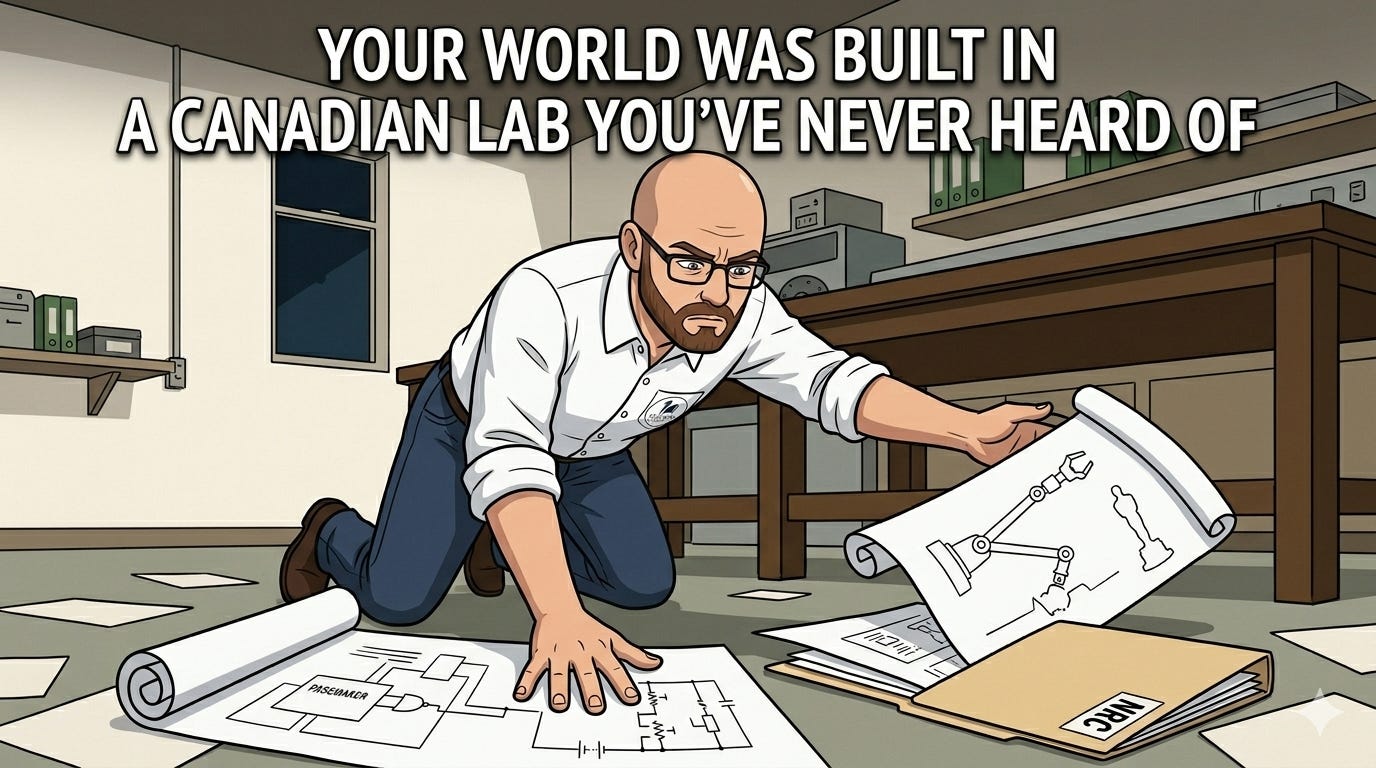
When you watch a movie like The Lord of the Rings, you’re seeing a world brought to life by groundbreaking visual effects. We instinctively credit the magic to Hollywood studios or New Zealand visual artists. When we think of a life-saving medical device like the cardiac pacemaker, our minds might jump to a high-tech lab in California or a German engineering firm.
We tend to see innovation as the product of famous companies, renowned universities, or secretive corporate R&D wings. It’s a simple, clean narrative. But it’s often wrong.
The truth is that many of the foundational technologies that define our modern world of safety, entertainment, and health trace their origins back to a single, surprisingly low-profile organization: the National Research Council of Canada (NRC). For a century, this government-funded body has operated as a hidden engine of innovation, quietly building the architecture of the 21st century while remaining almost completely out of the spotlight.
For the next few minutes, we're going to pull back the curtain on this hidden system. By the end, you'll not only see its invisible fingerprints all over your daily life, but you'll also understand a deeper truth about how progress actually happens.
The Invisible Architecture of Your Safety
Before a technology can be exciting, it often has to be life-saving. The NRC’s history is dense with innovations born from the urgent need to protect human life, often in ways we now take for granted.
Consider the cardiac pacemaker. It wasn't invented in a flash of genius. It was created to solve a very specific and terrifying problem in the 1940s: surgeons had learned to slow a patient's heart by using extreme cold during open-heart surgery, but they couldn't figure out how to reliably restart it. An NRC engineer named John A. Hopps was assigned the task. The result was the world's first pacemaker—a metal cabinet the size of a "thick cereal box" that used vacuum tubes to deliver a gentle, controlled electrical pulse to the heart, forging the new field of biomedical engineering in the process.
Or take the "black box" found in every commercial aircraft. After a plane goes down in a remote area like Canada's vast north, finding it is a monumental task. NRC engineer Harry Stevinson developed the solution: a crash position indicator with no moving parts, containing a transmitter, antenna, and delivery system in one compact package. It was designed to release on impact, float, resist fire, and transmit a signal no matter how it landed—a brilliant piece of engineering that has been instrumental in air crash investigations for decades.
Even the way we secure our airports has an NRC origin story. In the 1970s, as hijackings and bomb threats multiplied, the Royal Canadian Mounted Police (RCMP) needed a way to detect explosives.
An NRC scientist named Lorne Elias had been using technology to find and analyze vapours from pesticides. The RCMP asked a simple question: why not use it to trace explosives?
Elias adapted the technology and created a portable explosives vapour detector, nicknamed the "Blue Box". Before it was ever used to screen travelers, it was used to protect the Pope and a U.S. president. After the 1985 Air India bombing, the device was deployed to airports nationwide, becoming a foundational tool in modern security.
From Outer Space to the Silver Screen
While the NRC was quietly building the scaffolding of modern safety, it was also laying the groundwork for some of our most iconic cultural and technological achievements.
The Canadarm is perhaps its most famous creation. In the 1970s, NASA needed a crane for its new space shuttle program, and Canada chose to build it. The NRC oversaw the project, resulting in a 15-meter robotic arm that could lift over 30 tonnes with incredible precision. Initially designed to retrieve satellites, it became a "workhorse for spacewalks," a mobile camera mount, and an indispensable tool for building the International Space Station. It cemented Canada's global reputation in robotics.
But the NRC’s influence extends from the vacuum of space to the fantasy worlds of Hollywood.
The stunning visual effects in Peter Jackson's Lord of the Rings and King Kong were brought to life with the help of an NRC invention: a high-resolution 3D laser scanner.
Originally developed for mundane tasks like manufacturing inspections and later honed for space engineering and preserving priceless artworks like the
Mona Lisa, the technology was licensed to the private sector. A company that incubated at the NRC used it to create hyper-realistic digital scans of actors and sculptures, which VFX artists then animated into the creatures that dazzled audiences and won Academy Awards.
Long before Pixar became a household name, the NRC was pioneering computer animation. In the 1960s, animators had to manually draw every single frame of movement—a painstaking and expensive process. NRC researchers Nestor Burtnyk and Marcelli Wien developed "key-frame" animation, a technique where artists would draw the major action poses, and a computer would mathematically generate all the frames in between. Their 1973 film,
Hunger, became the first computer-animated movie ever nominated for an Oscar, and Burtnyk and Wien later won Academy Awards for their foundational contribution to the art form.
What This Hidden System Teaches Us
The story of the NRC isn't just a list of fascinating inventions. It reveals a more profound truth about how innovation works. Three key lessons stand out:
Public Investment is a Quiet Catalyst. None of these world-changing inventions were created with a quarterly profit report in mind. They were the result of sustained, long-term public funding that gave brilliant people the freedom to solve hard problems. The private sector then, in many cases, licensed, commercialized, and scaled these foundational technologies.
Innovation is Cross-Disciplinary. A recurring pattern in the NRC’s history is a technology developed for one purpose finding its greatest success in a completely different field. A pesticide detector becomes a bomb sniffer. A manufacturing scanner becomes a tool for Hollywood magic. This is a powerful reminder that breakthroughs often happen at the intersection of seemingly unrelated domains.
Solving a Specific Problem is the Parent of Invention. The pacemaker wasn't an abstract goal; it was a direct answer to the problem of restarting a cooled heart. The black box was born from the need to find downed planes in the vast Canadian wilderness. These were not market-driven pursuits but need-driven ones, which often produce the most robust and impactful solutions.
The world we inhabit is layered with a century of these solutions. They are the product of a hidden system of inquiry, experimentation, and collaboration. By making the invisible visible, we not only give credit where it's due, but we gain a clearer, more accurate understanding of the deep, patient, and often public-spirited work required to build the future.
Full disclosure: I used to work at the NRC. Its innovations include biotech, photonics, nanotechnology and automated translation. But government after government ignored it, chopped it, etc. it should be recognized and celebrated.
And so is your identity here in Canada, they literally invented the identity most Canadians are currently adopting in a BIT lab as a social experiment that now is part of nearly every dynamic of Canadian politics.