


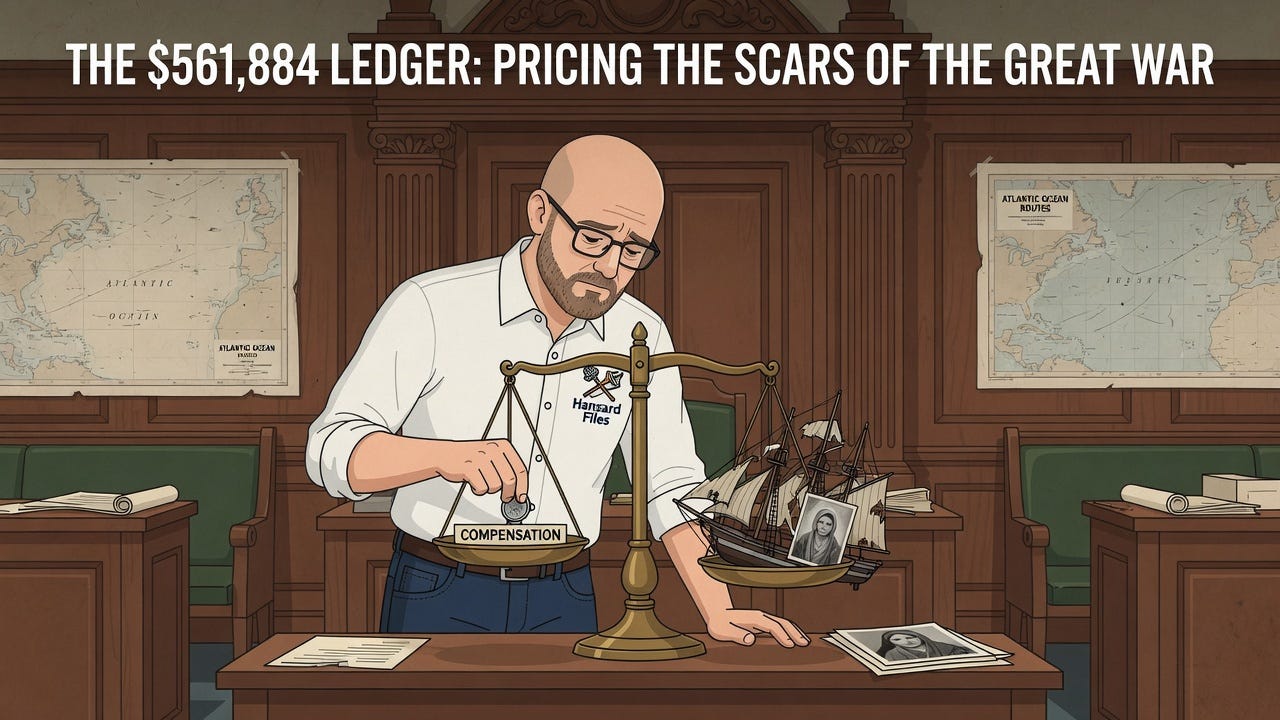
March 6, 1931. The Great Depression had already seized Canada, shuttering factories and breadlines were growing in Montreal and Toronto. But in a quiet office in Ottawa, a lawyer named Errol M. McDougall was looking backward, not forward. He was staring into the cold, salt-stained records of a war that had ended twelve years earlier.
McDougall had been appointed Commissioner to finalize the “outstanding” claims for World War I reparations. While the rest of the country worried about the price of wheat, McDougall’s job was to calculate the price of a human life lost to a German U-boat in 1915, or the value of a schooner that vanished into the Atlantic mist without a trace.
His mandate came from the Treaty of Versailles, specifically the “illegal warfare” clauses that forced Germany to accept financial responsibility for civilian damages. But by 1931, the grand geopolitics of the Hall of Mirrors had dissolved into a gritty, bureaucratic audit of misery. McDougall was left with 729 ragged files—claims that had been missed, delayed, or disputed by previous commissioners. His task was to distribute a specific, calculated sum: $561,884.50.
To get that money to the victims, McDougall had to answer a question that haunts every post-war society: When does the war actually end for the people who survived it?
The Ghost Ships of the Atlantic
McDougall’s files were not filled with stories of soldiers in trenches, but of civilians—fishermen, merchant mariners, and passengers—who found themselves on the front lines of the naval war. His Interim Report reads less like a legal docket and more like a catalogue of maritime ghost stories.
Take the case of the Bessie A. Crooks (Case 1695). On January 26, 1917, this Canadian sailing schooner departed Pernambuco, Brazil, bound for Barbados. She carried a full crew and a routine cargo. She sailed out of the harbor and was never heard from again. No wreckage washed up. No lifeboats were spotted. The ocean simply swallowed her.
Fourteen years later, her owner’s widow, Mrs. Jessie A. Crooks, stood before the commission asking for compensation. McDougall had to play detective. Was the ship lost to a storm? Or was it an act of war? In a courtroom, the burden of proof would have crushed Mrs. Crooks. But McDougall, operating under the “equity and good faith” clause of the inquiry, looked at the map. He noted that the route from Brazil to Barbados in 1917 was a known “seat of operations of enemy raiders.”
He ruled that the silence of the Bessie A. Crooks was proof enough of her fate. The absence of a storm report and the presence of German raiders allowed him to classify the disappearance as “illegal warfare.” The widow was granted her claim.
Then there was the violent spectacle of the Gypsum Queen (Case 1684). Unlike the silent disappearance of the Crooks, the Gypsum Queen went down in chaos. Captain Freeman Hatfield testified that on the morning of July 31, 1915, sixty miles off the coast of Ireland, a torpedo struck his three-masted schooner. The explosion was catastrophic. The report details the terrifying physics of the sinking: the impact threw the vessel on her side; the foremast snapped and went overboard, taking the main topmast with it. The mizzenmast broke and dangled dangerously from the rigging.
Hatfield described how the crew frantically jettisoned the deck load of lumber to keep the ship from capsizing before they abandoned her. McDougall listened to the testimony of the masts snapping and the wood splintering, and he checked the boxes. The violence was confirmed. The check was written.
The Calculus of “Solatium”
The destruction of property was easy to price; a ship has a market value. The destruction of a family was harder. McDougall frequently wrestled with the concept of “solatium”—a legal term for compensation for emotional suffering and grief, distinct from pure financial loss.
In the case of the SS Lusitania, the most infamous sinking of the war, the claims were still trickling in sixteen years later. Case 1678 involved Mrs. M. A. Matthews, who lost her son on the Lusitania in 1915. She claimed $1,000. McDougall awarded her $2,500. It was an arbitrary figure, standardized across claims to ensure fairness—the government’s attempt to place a flat rate on a mother’s loss.
But the ledger was cold. In Case 1703, the children of Arthur Ernest Langridge, the chief steward of the SS Skaraas, applied for help. Their father had died when his ship was torpedoed in 1918. Their mother, struggling to raise three children alone in England, had died of a broken spirit and health in 1923. Now, the orphans were asking for what was owed to their parents. McDougall processed the claim, awarding $4,100 to be held in trust.
The report reveals the grim meticulousness of the payouts. For a lost husband or father, the standard “solatium” often hovered around $2,000 to $2,500. For personal effects—the clothes on a sailor’s back, his sea chest, his tools—the commission had a fixed rate of $250 for a seaman, slightly more for a captain.
The Long Shadow of Exposure
The most difficult cases for McDougall were not the ones who died in the water, but the ones who died in their beds years later. These were the “Death and Personal Injury” claims (Opinion No. 2), where the commissioner had to determine if a death in 1921 was caused by a torpedo in 1917.
Case 1676 tells the story of John Mason, a cook on the SS Annapolis. When the ship was destroyed by enemy action on April 19, 1917, Mason didn’t die immediately. He spent four days and three nights drifting in an open boat, exposed to the freezing North Atlantic weather before being rescued. He returned to Canada, but he was never the same. He suffered from internal injuries and a “general toxic condition.” He died in Montreal’s Royal Victoria Hospital on April 29, 1921—four years after the sinking.
McDougall had to play medical examiner. Was the “toxic condition” a result of the exposure in the open boat? The widow, Mary Mason, argued that her husband’s health had been shattered by that ordeal. McDougall agreed. He found the “chain of connection” unbroken. The exposure in 1917 had weakened Mason’s constitution, leading directly to his death in 1921. Mary Mason was awarded $2,500.
Not everyone was so lucky. In Case 1698, Mrs. H. C. Gravey claimed $2,500 for injuries sustained while she was a passenger on the SS Olympic. She wasn’t torpedoed; she was injured by the concussion of a “depth bomb” deployed by the ship’s own defenders. McDougall disallowed the claim. The injury was an accident of war, not a direct result of “illegal warfare” by the enemy. In the strict binary of the reparations commission, if the Germans didn’t directly cause the bruise, the Canadian government wouldn’t pay for it.
The American Complication
The report also highlights a peculiar bureaucratic cruelty regarding nationality. The Treaty of Versailles was intended to compensate the nationals of the Allied powers. But the border between Canada and the United States was porous, especially for mariners who moved between Nova Scotia and New England.
McDougall established a strict rule in “Opinion No. 4” regarding interest payments. The commission generally paid 5% interest on claims dating back to January 10, 1920 (the treaty ratification date). But what about Canadians who moved south?
In Case 1825, George Edgar Hubbard, a survivor of the Robert & Richard (sunk by a submarine in 1918), claimed his share. Hubbard was Canadian when the torpedo hit. But on December 28, 1921, he had naturalized as a U.S. citizen. McDougall ruled that Hubbard was entitled to his money, but the interest train stopped the moment he swore allegiance to the Stars and Stripes. He would receive interest only up to the date of his naturalization. It was a final, petty accounting measure: Canada would pay for his suffering, but it wouldn’t pay interest to an American.
The Unfinished Business
As McDougall signed his Interim Report on March 6, 1931, he noted that the work was far from done. There were still 400 outstanding claims from prisoners of war—men who had been held in German camps like Ruhleben. McDougall deferred these to a later date, noting their “distressing character” required more study.
The $561,884.50 he authorized that week was a lifeline to hundreds of families in a time of desperate economic need. It bought coal for widows in Halifax and paid medical bills for crippled firemen in Vancouver. But the report stands as a testament to the impossibility of reparations. How do you itemize a nightmare? McDougall did his best with legal principles and actuarial tables, but the text of his report betrays the reality: the war didn’t end in 1918. It ended one check at a time, continuously, for decades.
If you enjoyed this deep dive into the archives of Canadian history, please consider subscribing to the Hansard Files. We scour the dusty shelves of government reports to bring you the stories that shaped the nation.
Source Documents
McDougall, E. M. (1931). Reparations, 1930-31: Interim Report. F. A. Acland, Printer to the King’s Most Excellent Majesty.
Thank you for this, I had no idea that war reparations to those injured by WWI were paid.
Hansard's face. Compassion? Sadness? Better than Hansard's perpetually angry face?