


If you watched the House of Commons proceedings on September 24, 2025, you witnessed a classic example of modern political debate. During Oral Questions, the Leader of the Opposition, Pierre Poilievre, and the Prime Minister, Mark Carney, engaged in a heated exchange over the government’s firearm buyback program. An observer hoping for clarity on this contentious issue would have been left deeply disappointed, and this outcome was by design. The exchange serves as a perfect case study, revealing how high-level political communication is often not a tool for informing the public, but a performance meant to polarize and obscure.
This recurring frustration points to a problem you face as an engaged citizen. You try to follow important debates, but the information presented is contradictory and incomplete. One side claims the government is targeting farmers, while the other insists the focus is on assault weapons. Both positions are presented with absolute conviction, yet they seem mutually exclusive. The result is a sense of confusion and cynicism. You feel the system is failing to provide straight answers. The truth is, the system is working exactly as intended.
Introducing Parliamentary Signal Scrambling
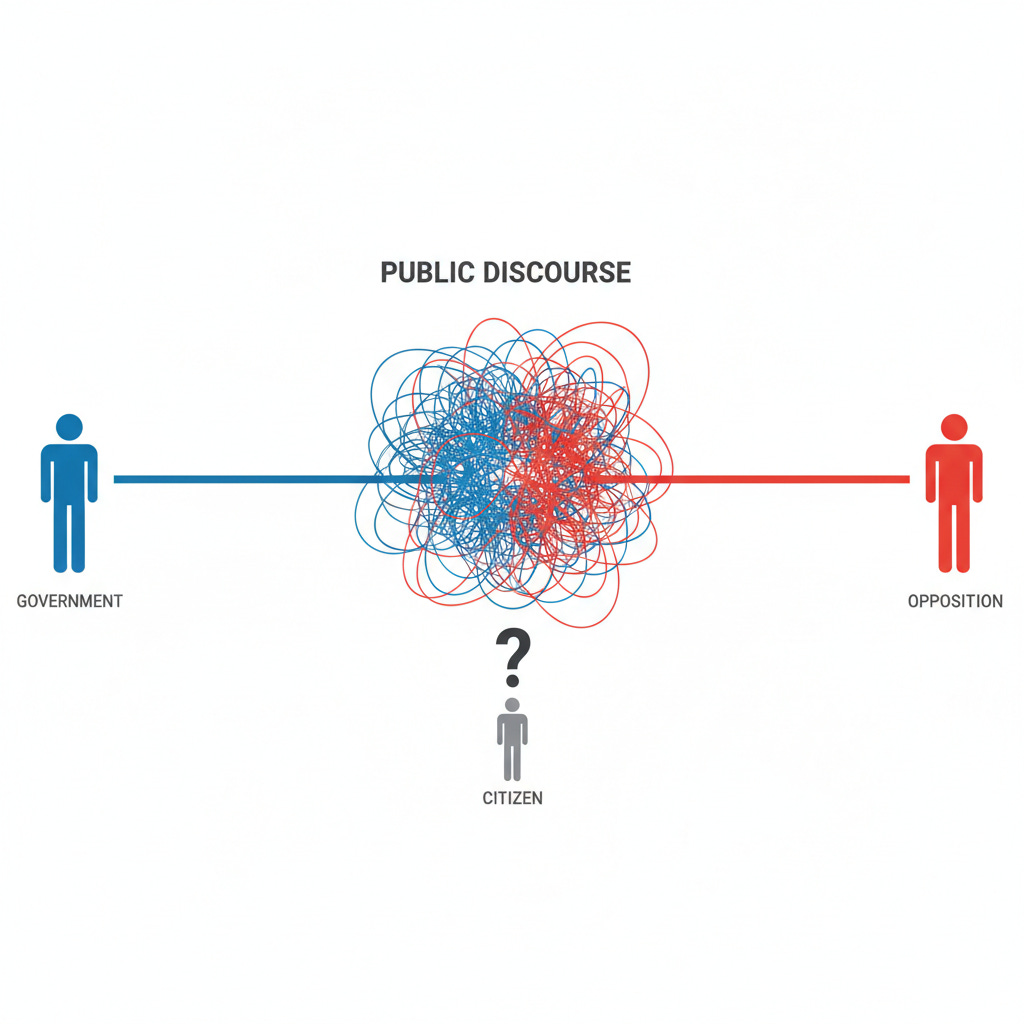
To understand what happens in Question Period, you need to abandon the idea that the goal is communication. The goal is strategic obfuscation. Think of the process as Parliamentary Signal Scrambling. In this model, politicians are not broadcasters trying to send a clear message to a general audience. Instead, they are operators using specific frequencies to reach their core supporters, while simultaneously jamming the frequencies of their opponents. The intended outcome is not a well-informed public, but a well-motivated base and a confused, disengaged middle. The noise is the message.
The September 24th exchange on firearms is a masterclass in this technique. The core of the dispute was a simple factual question: which specific firearms is the government banning? Instead of an answer, the public received two entirely different, scrambled signals.
Deconstructing the Conservative Signal
The Conservative approach was built on three tactics: personalizing the attack, simplifying the target, and amplifying the negative outcome. The Leader of the Opposition did not begin by questioning the policy’s details. He began by questioning the Public Safety Minister’s integrity, claiming the minister privately admitted the program was a politically motivated failure. This immediately frames the debate not as a disagreement over policy, but as an exposure of government hypocrisy.
Next, the Conservatives meticulously avoided the government’s preferred language of “assault-style firearms.” Instead, they framed the ban as an attack on law-abiding, relatable Canadians. Mr. Poilievre insisted the ban applies to firearms used by “farmers and duck hunters,” specifically mentioning “10-gauge and 12-gauge shotguns” and “.22-calibre firearms.” This signal is not for urban voters. This is a clear frequency for rural Canadians and firearm owners. The message is simple: the government is not coming for dangerous weapons, the government is coming for you. The strategy found its apex in a single, memorable phrase.
Will the Prime Minister stop wasting money banning gopher guns, read his briefing notes, so he knows what he is talking about, and fire that incompetent minister?
This line is a perfect piece of signal scrambling. It distills a complex regulatory issue into a simple, almost absurd, image of federal overreach. The target is not a dangerous weapon, but a farmer’s tool for pest control. The signal received by the Conservative base is one of solidarity against an out-of-touch urban government.
Deconstructing the Liberal Signal
The government’s response was an equally sophisticated exercise in signal scrambling. The Prime Minister and his ministers consistently ignored the specific questions about which firearms were included and instead repeated their own message on a closed loop. Their signal was designed to reassure their supporters that the government was taking decisive action on gun crime.
The Prime Minister repeatedly framed the program as a plan to provide “fair compensation for Canadians to return illegal firearms and illegal assault rifles.” This language is as deliberate as the opposition’s. “Assault rifles” is a term with strong negative connotations, and its use allows the government to sidestep a debate on the specifics of other firearms. The Prime Minister reinforced this by challenging the opposition leader’s premise, stating, “He described farmers and duck hunters using AR-15s to hunt. I do not see that in my great province of Alberta.” This response entirely ignores the question asked about other types of firearms, focusing only on the AR-15.
The government’s secondary tactic was to pivot from defending its policy to attacking the opposition’s credibility. The Prime Minister accused the Leader of the Opposition of having “voted against every single piece of gun legislation.” The Minister of Justice later echoed this, accusing the Conservatives of a “completely lackadaisical approach to protecting Canadians against gun violence.” This scrambles the signal away from the current policy and toward the opponent’s general character and record, a frequency designed to energize the Liberal base against a perceived extremist opposition.
The Unanswered Question
Here is the detail I find most revealing. After six full questions and answers on this one topic, the central factual dispute remained completely unresolved. Is the government banning common shotguns and small-calibre rifles, or is it not? A citizen watching the exchange is no closer to an answer. This is not an accident. Neither side has an incentive to clarify the point.
For the Conservatives, maintaining ambiguity allows them to continue broadcasting their signal that the government is targeting “Grandpa Joe’s hunting rifle.” For the Liberals, ambiguity allows them to broadcast their signal that they are only targeting “assault rifles,” a far more popular position. A definitive, factual list of banned firearms would force one or both sides to abandon their most effective talking points. Therefore, clarity is avoided by mutual, unspoken consent.
The Principle of Performed Accountability
Question Period is not a mechanism for accountability. It is a performance of accountability. The frustration you feel when you watch these exchanges is a natural response to a system whose purpose you have been led to misunderstand. You are looking for information, while the participants are creating ammunition. The entire exercise is a form of political theatre staged not for Parliament, but for the clips that will be shared on social media and the talking points that will echo through news panels.
This understanding is where your agency lies. Once you stop expecting clear answers, you can begin to analyze the performance for what it is: a strategic battle of narratives. You are no longer a frustrated citizen demanding information from a broken system. You are a clear-eyed analyst decoding a system working exactly as planned. The goal is not to fix the system, but to see it for what it is.
The moment you stop listening for answers and start analyzing for strategy, you are no longer a spectator, but an interpreter.
Sources:
House of Commons. (2025, September 24). House of Commons Debates (Vol. 152, No. 028). 45th Parliament, 1st Session.