


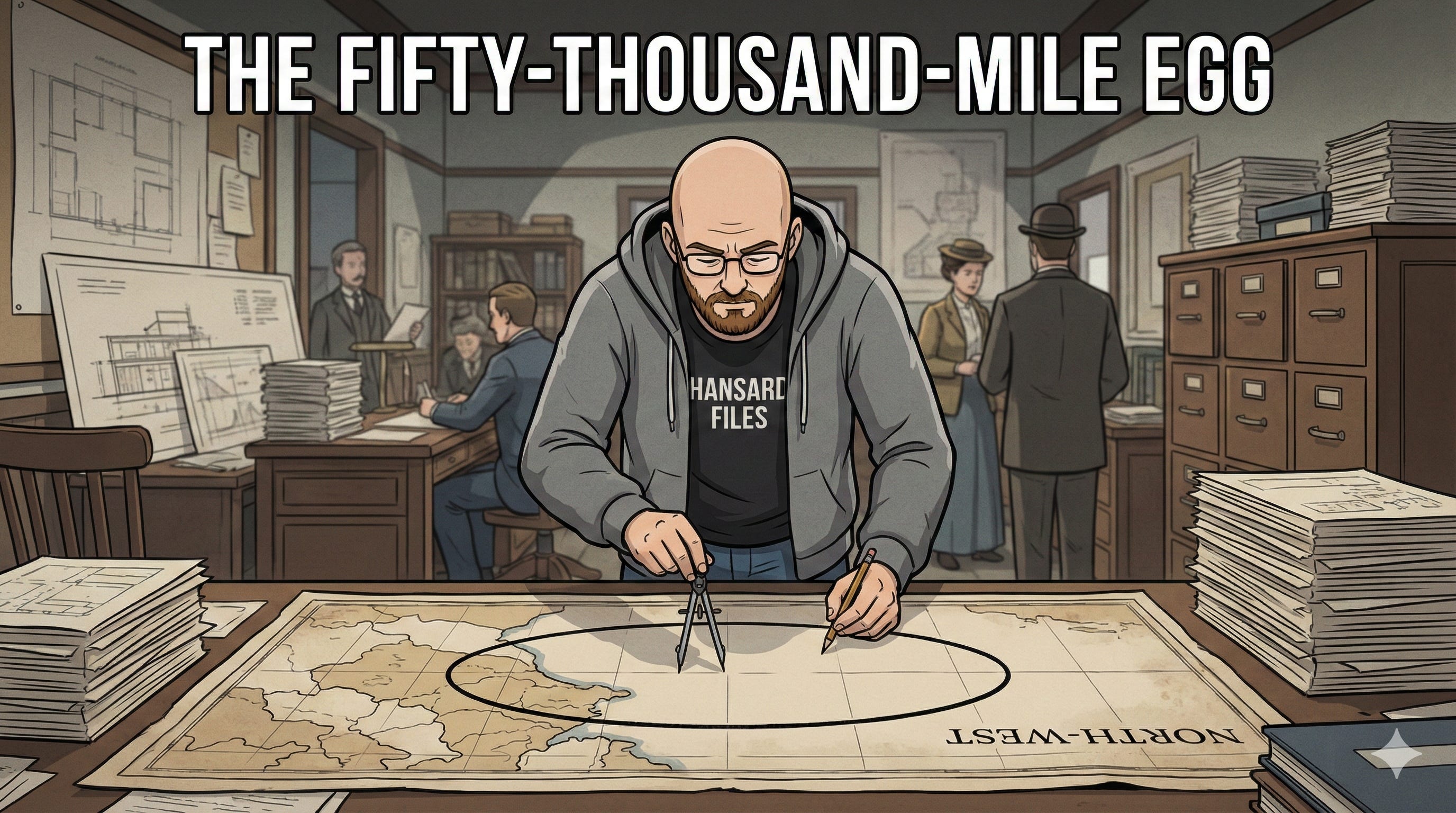
In June 1906, inside a crowded government office in Winnipeg, J. Obed Smith, the Commissioner of Immigration, performed a piece of theater that explained the future of the British Empire. He took a map of the vast, terrifying emptiness between the Great Lakes and the Rocky Mountains—a region that had swallowed explorers and fortunes for two centuries—and sketched a rough, small egg shape in the blank space between the Canadian Pacific and Canadian Northern railway lines.
To the uninitiated, the egg looked massive, covering fifty thousand square miles. To Smith, it was a drop in the bucket. “Practically all the settlement of last year went into this egg,” he told the visiting journalist F.A. Acland.
This was the reality of Western Canadian settlement in the summer of 1906. It was a year of smoke, mud, and “raw ambition,” a moment when the dominion decided to forcefully industrialize the wilderness. Smith’s egg represented 34,845 homesteads claimed in a single year—a “rush to the land” that defied the cautious geography of the nineteenth century. The government of Prime Minister Wilfrid Laurier was no longer politely asking the world to consider Canada; they were engineering a demographic explosion to secure the territory before the United States or stagnation could claim it.
The Neck of the Bottle
To understand the frenzy of 1906, one had to stand in Winnipeg. It was the “neck of the bottle,” the inevitable choke point through which every immigrant, every steam plow, and every bag of Red Fife wheat had to pass. In just five years, the city had doubled its population, surging past 100,000 souls. It had outgrown its own infrastructure so violently that it began to resemble a boomtown on the verge of a nervous breakdown.
The city was gripped by a “passion for spaciousness”. Portage Avenue was being widened into a massive thoroughfare, preparing for a traffic volume that didn’t yet exist, while real estate values spiraled upward. The frantic growth birthed a new architectural curiosity previously unknown in the West: the apartment house. Toronto had reached 200,000 people before it needed flats; Winnipeg, breathless and crowded, was building them by the dozen.
The reason for this shift to apartment living was not just land value, but a severe crisis in domestic labor. The “Western temperament” had proved too seductive for the traditional servant class. Doukhobor elders refused to let their daughters leave their villages, fearing they would be corrupted by the city. Incoming British and Irish girls, intended to staff the kitchens of the wealthy, were “married out of hand” by bachelor farmers and mechanics often within weeks of arrival.
The shortage was so acute that wages for domestic help had risen to “terrifying” heights—between $30 and $40 a month. In the desperation of the labor vacuum, the city’s wealthy families were forced to turn to “the Chinaman for aid,” or simply abandon the idea of a large house altogether, retreating to the compact efficiency of the new flats.
But the optimism remained boundless. In negotiations for electric power from the Winnipeg River, city officials and contractors operated under a staggering assumption: that Winnipeg would hold 300,000 people by 1911 and 800,000 by 1941. It was a prediction of exponential growth that fueled every brick laid and every dollar borrowed.
The American Invasion
If Winnipeg was the chaotic funnel, Regina was the shock wave. Stepping onto the platform of the “long, rambling station” in the capital of the newly formed province of Saskatchewan, the change in atmosphere was instant. The accent here was not British, but distinctly American.
“It is the American element that predominates at this point,” Acland noted. These were not the destitute refugees of European slums. These were experienced farmers from Iowa, the Dakotas, and Minnesota—men who had sold high-priced land in the United States to buy cheap, virgin soil north of the border. They brought with them capital, machinery, and an aggressive optimism that unsettled the old guard.
In just ten months ending April 1906, over 43,000 Americans had crossed the border, an increase of more than 11,000 from the previous year. They were reshaping the economy of the plains. In Regina, the result was a real estate fever dream.
Ten years prior, a young man had purchased an option on two small lots for $8 each, eventually buying only one because he lacked the funds. By 1906, he sold that single $8 lot for $20,000. Another citizen, who had purchased four lots for $200 (carrying a $400 mortgage he never bothered to pay off), refused an offer of $50,000.
This “American invasion” was not a military conquest, but a commercial one. They were buying up land at $9 and $10 an acre, speculating on a future where the Canadian West would feed the continent. They saw what the government promoters saw: a “vast fertile district” of 40 million acres around Regina alone, of which less than a million had yet been touched by a plow.
The Green Englishmen of Lloydminster
While the Americans brought capital, the British settlers brought a desperate, naive courage that provided the era’s most human drama. Nowhere was this more evident than in the Barr Colony at Lloydminster, a settlement teetering on the edge of disaster.
Led by Archdeacon Lloyd, a chaplain who had marched with the Queen’s Own Rifles in 1885, this colony was a “section of the whole population of England” dropped onto the prairie. It was composed not of farmers, but of shoemakers, shopkeepers, carpenters, and clerks from London—men who didn’t know a plow from a harrow.
The initial years were a nightmare of disorganization. Supplies ran out, prices skyrocketed, and the “harpies who are always willing to fatten on the unfortunates” descended on the camp. At one point, the financial situation was so dire that Archdeacon Lloyd mortgaged his entire year’s stipend to secure a $3,000 loan just to buy food for the settlers.
Yet, they stayed. Acland recorded the story of a small shopkeeper from Holloway, London, who had never worked the land. He spent the brutal winter of 1903—the coldest in years—freighting goods across the frozen trails. By 1906, he had a house, a farm, and a refusal to ever return to London. Another settler, a cobbler from Yorkshire, had his entire homestead—house, stock, and crops—wiped out by a prairie fire. Penniless, he borrowed money for a team of horses, went back to freighting, and by 1906 was debt-free and farming again. This was the “pluck” that underpinned the statistics—the silent, grinding endurance of the greenhorn.
The Passing of the Range
Further west, in Alberta, the “rush to the land” became a war between the past and the future—between the rancher and the farmer. For thirty years, the semi-arid lands around Calgary and Macleod had been the domain of the cattle kings, a romantic era of open ranges initiated when the North-West Mounted Police first arrived in 1874 to reclaim the land “from the Indian and the buffalo”.
But by 1906, the “Great Lone Land” was being fenced in. The cattle industry, which had exported only 902 head in 1896, had exploded to over 13,000 head by 1905, but it was doomed to be displaced. The arrival of “Winter Wheat” was the final nail in the coffin of the open range.
Experiments in Red Deer and Calgary had proven that the soil could support massive grain yields—up to 54 bushels per acre. This discovery shattered the old assumption that Alberta was only good for grazing. Land that was once “considered of little use” was suddenly gold.
The transformation was physical and violent. The soil, a “rich black vegetable mould” up to thirty-six inches deep, was being broken by steam plows. In the south, the Alberta Railway & Irrigation Company was digging canals to water a million acres, backed by the foresight of the Galt family. The “dry farmers,” like John Silver from Utah, were turning $8-an-acre land into wheat fields, proving that the desert could bloom.
The Last Best West
In Edmonton, the northern gateway, the change was even more dramatic. Once a remote trading post where trains arrived only three times a week, by 1906 it was served by crowded daily trains equipped with dining cars. The city boasted thirteen hotels, all kept full by “cautious travellers” who wired ahead for rooms.
Here, the optimism took on a horticultural edge. Mr. Tom Daly, a pioneer who arrived with one dollar in his pocket, was experimenting with apple trees, convinced he could acclimatize them to the northern latitude. He had a single tree that had produced a few apples, a fragile promise that “Daly apples may yet be as famous as Fyfe wheat”.
This was the spirit of 1906. It was a belief that the “Eastern man,” with his “ideals of law,” could impose order on any wilderness. It was a world where boards of trade held banquets to discuss the “vast importance” of the future, where young men dominated the conversation, and where poverty seemed to have been “practically eliminated”.
As the summer of 1906 faded, the “roar of the threshing” began—a sound that would come to define the Canadian West for the next century. The buffalo were gone, the open range was closing, and the “Great Lone Land” was being carved up, quarter-section by quarter-section, in a desperate, muddy, profitable race for the future.
Our researchers comb through thousands of forgotten government reports to uncover the origins of the world we live in today. Subscribe to Hansard Files to support independent archival journalism.
Source Documents
Department of the Interior. (1906). The Canadian West: Its Present Condition and Future Possibilities.
"... they were engineering a demographic explosion to secure the territory before the United States or stagnation could claim it."
I don’t know how you can turn out interesting, well-written pieces like this on a wide variety of subjects — I particularly appreciate your wide-ranging interests — faster, it seems, than I can read them! I feel like a laggard.