


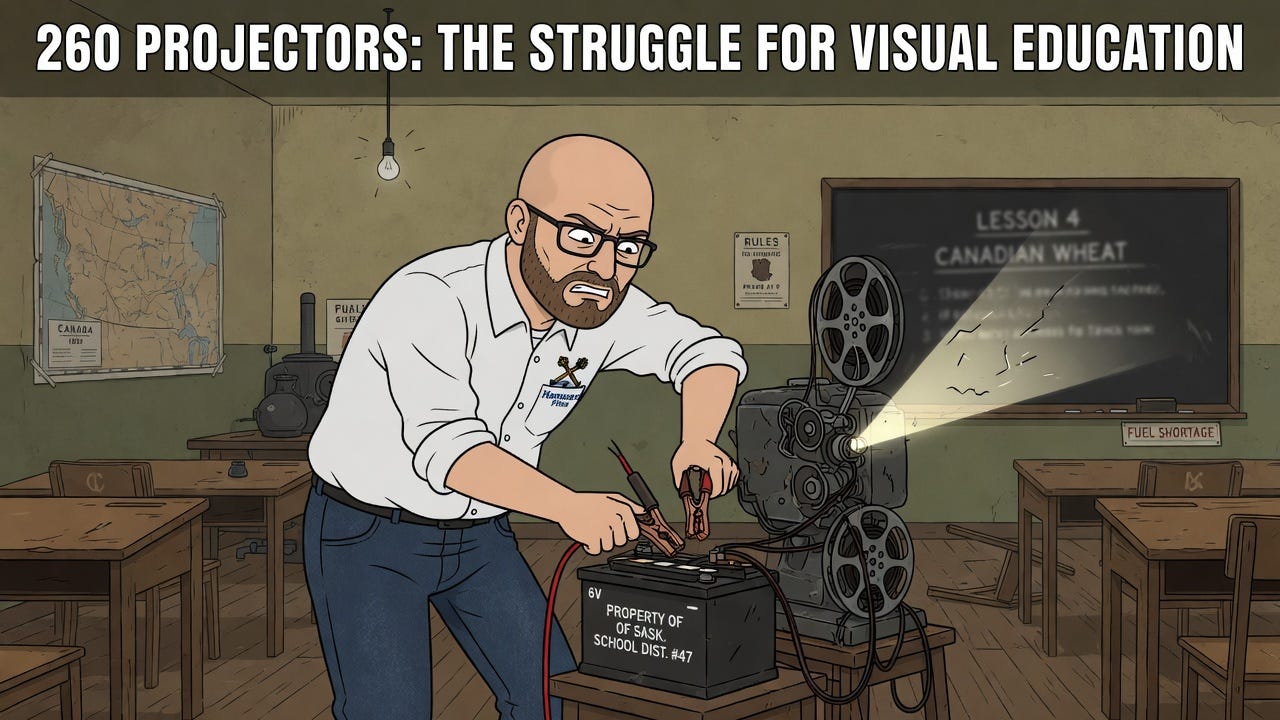
The year is 1937. In the flickering darkness of a Berlin classroom, a student watches a 16mm film reel spin, one of 32,000 distributed by a government intent on molding a generation. In New York, thousands of projectors hum in city schools, standardized and funded. But in the Dominion of Canada, the screen is dark. Across the entire second-largest landmass on earth, in a nation of millions, there are only 260 motion picture projectors in the school system.
This is the forgotten crisis of visual education history: a moment when the moving image was no longer a novelty but a geopolitical weapon and a pedagogical necessity, and Canada was almost entirely offline.
The report that landed on the desk of the Minister of Trade and Commerce that September was thin, clinical, and devastating. Titled The Use of Films and Slides in Canadian Schools, it painted a portrait of a school system paralyzed by the Great Depression, where “visual education” was a luxury available to the lucky few, and where the geography curriculum was quietly being outsourced to railway companies and oil corporations because the Department of Education couldn’t afford to buy its own reels.
The Great Disparity
The numbers presented by the Dominion Bureau of Statistics were stark enough to cause alarm in Ottawa. In the United States, city schools boasted over 10,000 motion picture projectors. France had embraced the medium with thousands of machines. Even Scotland was moving faster.
But the most chilling comparison came from the rising totalitarian powers. The report noted, with a dry neutrality that belied the gathering storm in Europe, that “the German, Italian and Russian governments appear to have found school motion pictures of particular value.” The German government alone had placed 7,700 projectors and 32,000 films in its schools in a single year. While authoritarian regimes were industrializing the projection of their narratives, Canadian educators were scavenging for scrap equipment.
In Canada, the ratio was abysmal. Allowing for population differences, the United States had four times the equipment. France had eight times. In the entirety of Canada’s city school systems, fewer than 200 projectors existed. The remaining 60 or so were scattered in rural outposts, often purchased by the teachers themselves out of their own meager, Depression-slashed salaries.
The disparity wasn’t just a matter of hardware; it was a matter of national consciousness. While other nations were standardizing a visual curriculum, Canadian students were being left behind in a pre-cinematic age, dependent on lantern slides and the occasional, grainy silent film.
The Silent 16mm
If a school was lucky enough to own a projector, it was almost certainly a silent machine. Of the 260 units in the country, only 32 were capable of playing sound. The “talkie” revolution had swept Hollywood a decade prior, but in the Canadian classroom, silence still reigned.
The technological barriers were physical and immutable. In the vast rural stretches of Saskatchewan and Alberta, the lack of electricity rendered modern equipment useless. The report noted that while “accumulateurs électriques” (storage batteries) could theoretically power a silent projector, sound equipment required a steady current that simply didn’t exist in the one-room schoolhouses of the prairies.
Innovation, therefore, was born of necessity. The Nova Scotia Department of Education, attempting to bridge the gap, began fitting film-slide projectors with special attachments allowing them to run off automobile batteries. It was a jury-rigged solution for a country trying to modernize on a shoestring—teachers dragging lead-acid car batteries into wooden schoolhouses to project a flickering beam of light against a wall.
Sponsored Geography
With no budget to buy films, Canadian schools turned to the only organizations willing to provide them for free: corporations.
The list of “Motion Picture Sources in Canada” included in the report reads less like a library catalog and more like a stock market ticker. If a teacher wanted to show a film, they didn’t write to a publisher; they wrote to the Canadian Pacific Railway, the Ford Motor Company, or Imperial Airways.
Geography lessons were brought to students by the Travel and Industry in British Columbia reels, courtesy of the provincial information bureau. Science classes watched films on “the manufacture and use of explosives,” kindly provided by Canadian Industries Ltd. The Bakelite Corporation of Canada offered a silent film on its plastics. The Tea Market Expansion Bureau provided footage of Ceylon.
This was the “Corporate Classroom” of 1937. The report explicitly noted that “industrial concerns... are mentioned more frequently as the source of school motion pictures than are the commercial distributors of educational films.” The reason was blunt: cost. Schools couldn’t afford the rental fees of legitimate educational distributors. Instead, they accepted “industrial publicity”—marketing disguised as curriculum. Students learned about the world not through unbiased documentaries, but through the lenses of the entities extracting its resources.
The Customs Wall
For the few educators who tried to secure high-quality, independent educational films, the Canadian government itself stood in the way.
The United States possessed a “variety... of infinite variety and at moderate rentals” of educational content. But Canadian principals reported that they were effectively blockaded from accessing it. Customs regulations treated educational reels like commercial goods, imposing tariffs and bureaucratic hurdles that made renting a film from New York “practically impossible.”
One Ontario principal vented his frustration to the Bureau: “Canadian importers... discouraged the use of these films on the grounds that it would be difficult to have them returned to their owners.” A Nova Scotia counterpart added that while US sources offered “films of great educational value,” the border regulations “almost completely prevent importation.”
While the League of Nations was drafting conventions to facilitate the “international circulation of films of an educational character,” Canada’s own border policy was effectively embargoing knowledge, forcing teachers back into the arms of the railway companies and their free, sponsored content.
A Luxury in Lean Times
Underlying every shortage, every broken projector, and every silent film was the crushing weight of the Great Depression.
When asked why they didn’t use motion pictures, the number one reason given by school authorities—by a landslide—was “Lack of money.” The report somberly noted that “school revenues generally have not recovered from the losses since 1930.” Teachers had seen their salaries slashed; in some rural areas, they were barely being paid at all. In this climate, a $300 projector was not just a luxury; it was an insult.
Inspectors reported that some communities viewed films as “frills.” How could a school board justify buying a movie machine when they couldn’t afford coal for the stove or textbooks for the students?
Yet, the hunger was there. The report found that despite the poverty, despite the lack of electricity, and despite the customs blockades, teachers were organizing “amateur concerts” and community entertainments to raise scraps of cash to rent a single reel for a single day. They understood what the government had not yet fully grasped: that the screen was not a toy. It was the future. And in 1937, Canada was in danger of missing it entirely.
If you believe that history is found in the margins of forgotten reports, subscribe to Hansard Files. We read the archives so you don’t have to.
Source Documents
Dominion Bureau of Statistics. (1937, September). The Use of Films and Slides in Canadian Schools (Education Bulletin No. 3). Government of Canada.
Even into the 60s film projectors were a rare thing. I recall that the grade 8 (1964) class I was in at Queen Elizabeth Public School in Kirkland Lake organized the once a week assemblies where we projected songs with what I believe was a lantern projector. I think that I didn't see a film projector in school until late high school (Algonquin Composite, North Bay), and to be honest, I am not absolutely certain. I am sure that there was no film/audio video club.