


It happens in silence. There is no shattering glass, no screech of a crowbar against metal, and often, not even the bark of a neighborhood dog. A figure approaches a driveway in the suburbs, holding a small device that looks innocuous, perhaps like a tablet or a tangled mess of wires. Inside the house, the car keys sit on a hallway table, safe behind a locked front door. But safety is an illusion. The device outside amplifies the faint signal from the keys inside, bridging the gap to the vehicle. The car believes its owner has arrived. The lights flash, the locks disengage, and the engine purrs to life. By the time the owner wakes up, their vehicle is already in a shipping container headed overseas.
This is the face of the modern vehicle theft crisis in Canada. It is a technological arms race where organized crime groups currently hold the upper hand, utilizing sophisticated electronic tools to bypass security systems that were designed for a different era. The government has now signaled that the era of easy thefts is coming to an end. In a sweeping regulatory move, the Department of Transport has proposed significant amendments to the Motor Vehicle Safety Regulations, specifically targeting theft protection. The goal is to force manufacturers to harden their targets against the very digital tools that have turned Canadian driveways into open-air showrooms for global crime syndicates.
The Digital Key to a Physical Crime
The statistics are staggering, and the method is clinical. Since 2021, vehicle theft has surged across the country, prompting a National Summit on Combatting Auto Theft in early 2024. The consensus from that summit was clear: the thieves have evolved, but the regulations governing vehicle security have not. The current standards rely on outdated immobilization technologies that were effective against the hotwiring methods of the past but are defenseless against the “electronic attack tools” of the present.
These tools are not the stuff of science fiction. They are readily available devices that exploit the convenience of modern driving. The regulatory impact analysis provided by the Department of Transport identifies three specific categories of weapons in this new war. First, there are on-board diagnostics key programmers, which allow thieves to plug into a car’s data port and program a blank key in seconds. Second, there are emulators, devices that mimic the encrypted handshake between a key and a car. Finally, there is the relay attack, the most insidious of them all, which extends the reach of a legitimate key fob to trick the car into starting.
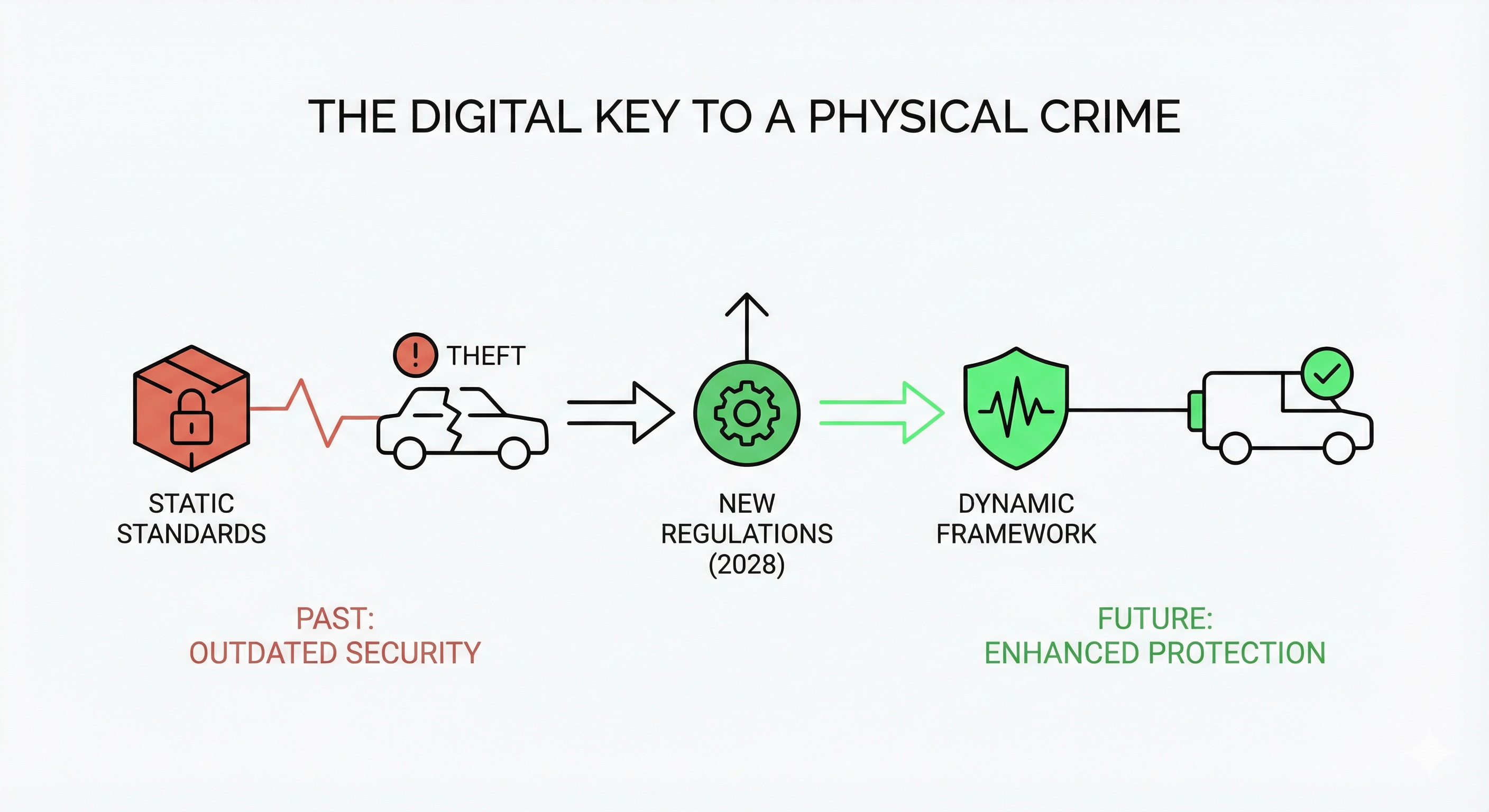
For years, manufacturers have been playing a game of whack-a-mole, patching vulnerabilities as they appear. However, the regulations they were following incorporated static, outdated standards that did not account for this digital onslaught. The proposed amendments aim to change the rules of engagement by modernizing the Canada Motor Vehicle Safety Standard 114. This is not just a paperwork update. It is a mandate for robustness.
Escaping the Static Trap
The core of the problem lies in how Canada writes its rules. For decades, regulations often used “static incorporation,” meaning the law pointed to a specific version of a safety standard from a specific year. If the standard was updated internationally to address new threats, Canadian law remained frozen in time until a new regulation could be passed. In the fast-moving world of cyber-security and electronic theft, this lag is a fatal flaw.
The new proposal introduces “ambulatory incorporation” for United Nations Regulation No. 162. This legal mechanism allows the Canadian regulations to automatically evolve. When the United Nations updates its standards to counter the next generation of theft tools, Canadian law will effectively update itself in real-time. This ensures that the requirements for immobilization systems remain dynamic.
This shift aligns Canada with the global community, particularly European nations that have already adopted these stricter UN standards. It also brings the Canadian market in line with the latest updates from the Underwriters’ Laboratories of Canada. The new CAN/ULC standard explicitly includes a category for “electronic attack tools,” forcing manufacturers to test their systems against the very devices used by organized crime.
The implications for the industry are significant but manageable. The analysis predicts that approximately forty-five companies will be affected, facing a total administrative cost of roughly 800,000 dollars over ten years to update their compliance documentation. It is a small price to pay for national security. Manufacturers will be given a two-year transition period to bring their fleets into compliance, meaning that by 2028, every new vehicle rolling off the line should be significantly harder to steal.
The Human Cost of Family Reunification
While the Department of Transport works to secure physical assets, the Department of Citizenship and Immigration is grappling with the intense demand for family reunification. In a separate notice, the government released Ministerial Instructions regarding the Parents and Grandparents Program for the coming years.
The demand to bring loved ones to Canada far outstrips the system’s capacity to process them. To manage this bottleneck, the government is maintaining a strict cap. For the 2026 calendar year, the intake of new permanent resident visa applications for parents and grandparents is frozen. The department will not be opening a new pool of potential sponsors. Instead, they will continue to process applications from the pool of “interests to sponsor” that were submitted back in the fall of 2020.
The instructions authorize a maximum of 10,000 sponsorship applications to be accepted for processing in 2026. These applications will be drawn from invitations issued to the remaining hopefuls in the 2020 backlog. The process relies on a randomized selection, a lottery system that determines which families will be reunited and which must continue to wait. The instructions are rigid. Applications must be submitted electronically, and strict deadlines are enforced. If a sponsor fails to submit a complete application within sixty days of an invitation, the opportunity is lost. This administrative freeze highlights the immense pressure on the immigration system and the difficult choices the government faces in balancing intake levels with processing capacity.
Protecting the Arctic Frontier
Far from the suburbs and the processing centers, another regulatory battle is playing out in the frozen waters of the North. The Minister of Transport has issued Interim Order No. 3 prohibiting the carriage of certain oils on board vessels in Arctic waters. This order is a direct response to the environmental fragility of the region.
As climate change opens the Arctic to increased shipping traffic, the risk of a catastrophic spill grows. Heavy fuel oils, once the lifeblood of maritime commerce, pose a unique threat in icy waters. They break down slowly and are incredibly difficult to clean up in freezing conditions. The interim order applies to both Canadian and foreign vessels, including pleasure craft, operating within Canadian jurisdiction in the Arctic.
There are exceptions, carved out for vessels dedicated to spill response and for ships with specific fuel tank protections that minimize the risk of rupture. However, the message is clear: the commercial exploitation of the Arctic cannot come at the cost of its destruction. This order acts as a stopgap, a rapid response mechanism to deal with a direct risk to the marine environment while broader regulations are likely developed.
A Spectrum of Governance
The scope of government oversight extends into the invisible infrastructure of the nation as well. Innovation, Science and Economic Development Canada has released a decision regarding the licensing framework for high-frequency bands. The decision affects the 21.2 to 21.8 gigahertz and 22.4 to 23.0 gigahertz bands, frequencies that are critical for fixed services.
While this may seem esoteric compared to car theft or immigration, the management of the radio spectrum is the backbone of the modern economy. These frequencies support the backhaul networks that connect cell towers and data centers. As the demand for data explodes, efficient use of this invisible real estate is essential for everything from streaming video to emergency communications.
The Gazette also details the human element of public service. The Governor General has announced a series of honours, recognizing bravery and merit across the country. From the Cross of Valour awarded posthumously to Patrick L’Abbée Chouinard, to the appointments within the Order of Merit of the Police Forces, these lists serve as a reminder of the individuals who stand on the line to protect their communities. It is a stark juxtaposition to the dry regulatory text: the laws are written on paper, but they are enforced by people who often risk their lives in the process.
The Long Road to Security
The thread connecting these disparate notices is the concept of modernization. Whether it is updating vehicle safety standards to fight digital theft, managing an overwhelming backlog of immigration applications through digitization, or banning dangerous fuels in an increasingly accessible Arctic, the government is attempting to update its operating system.
The vehicle theft regulations are perhaps the most urgent for the average Canadian. For too long, the regulatory environment allowed manufacturers to produce vehicles that were vulnerable to cheap, handheld hacking tools. The shift to dynamic, international standards suggests a new approach to governance, one that acknowledges that the speed of technological change requires laws that can adapt without the need for constant parliamentary intervention.
By 2028, the car in the driveway may finally be safe again, not because of a new lock or a louder alarm, but because the regulations governing its computer brain have finally caught up to the criminals trying to hack it. Until then, the silent war continues.
Source Documents
Government of Canada. (2025, December 27). Canada Gazette, Part I, Vol. 159, No. 52.