


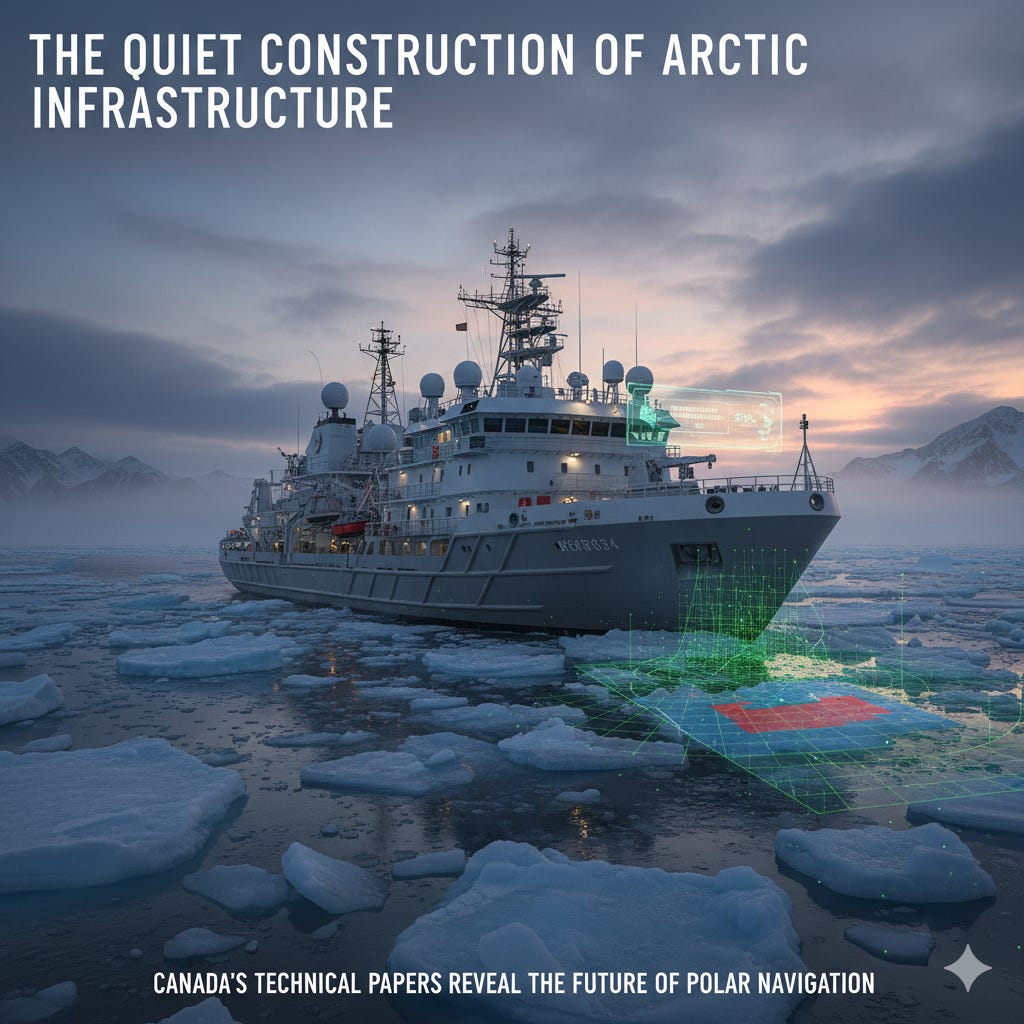
As the Arctic ice recedes, the Northwest Passage is shifting from a historical ambition to a geopolitical and economic reality. This transformation presents Canada with a monumental opportunity, but also a set of profoundly difficult technical challenges. Navigating and operating in these waters is not a simple matter of sailing through a newly opened lane. It involves confronting some of the harshest environmental conditions on the planet. While public discussion often revolves around sovereignty claims and shipping routes, the foundational work of making this future possible is happening almost entirely out of sight.
A series of technical papers from a 2025 ocean engineering conference, co-authored by researchers at the National Research Council of Canada (NRC) and Transport Canada, offers a rare window into this deep work. These documents are not political press releases. They are methodical, scientific accounts of how Canada is systematically solving the core problems of an Arctic future. They reveal a side of governance that is patient, technical, and focused on long-term capability. What they show is the quiet construction of our country’s next generation of essential infrastructure.
How a Machine Sees in a Storm
Before a ship can navigate autonomously, it must first have situational awareness far beyond that of a human crew. The first research paper, “Development of a Sensor Testbed for Maritime Autonomous Surface Ship Situational Awareness,” details a multi-year collaboration between the NRC and Transport Canada to solve this fundamental problem. The project’s goal was to create a platform to test how the sensors essential for autonomy—like LiDAR, radar, and advanced cameras—perform in the uniquely difficult marine environments of Canada.
The researchers built and deployed this “sensor testbed” on a 5.5-meter inflatable boat in the waters off Newfoundland. They conducted trials in varying conditions, maneuvering near port infrastructure and alongside other vessels to capture data in realistic scenarios. This wasn’t a theoretical exercise. It was a painstaking, real-world effort to understand and overcome the limitations of technology when faced with heavy waves, sea spray, fog, and ice. The work answers a critical question: when a machine is piloting a vessel through a chaotic Canadian sea, what information can it truly trust?
Building the Infrastructure of Knowledge
This meticulous testing is the first layer of what we can call Civic Infrastructure. We are accustomed to thinking of infrastructure as physical things like ports, railways, and highways. But in the 21st century, the most critical infrastructure is often composed of data, systems, and specialized knowledge. These NRC projects are not just science experiments. They are the deliberate construction of a foundational technological capability for the nation.
This becomes even clearer in the second paper, “A Sensor Fusion Platform for Semantic Segmentation of Sea Ice Imagery.” Here, researchers tackle a more specific challenge: it is not enough for a ship to simply see ice. It must understand it. An on-board expert can find it difficult to distinguish between different ice types that pose vastly different levels of risk. To solve this, the researchers developed a system that fuses data from multiple sensors, including visual, thermal, and polarization cameras.
By combining these different data streams, the system can identify characteristics of ice that are invisible to the human eye. To test their system, they collected unique data of river ice along the Ottawa and St. Lawrence rivers. This points to a critical insight: safe Arctic navigation requires a perception system that performs better than a human expert. This project is building the knowledge base to create that system.
A third paper, “Textured Panel for Ice-Induced Vibration Mitigation,” addresses the problem of what happens when contact with ice is unavoidable. When a large ice sheet crushes against a fixed structure like a wind turbine or a ship’s hull, it can create a cycle of intense, rhythmic vibrations that can cause catastrophic failure. The NRC has developed a novel technology to prevent this. They designed a metal panel with a finely textured pattern of microscopic ridges. These ridges disrupt the physical process of ice crushing, breaking one large, dangerous impact into many thousands of tiny, harmless ones. The paper details the lab tests that prove its effectiveness, showing a dramatic reduction in both the vibration-inducing load spikes and the overall average load on the structure.
This situation creates an asymmetric stress field in the ice that increases its susceptibility to fracture, thereby further reducing its load-bearing capacity. That is, the average load is also reduced.
This isn’t a brute-force solution of adding more steel. It is an elegant, physics-based technology that makes structures smarter, not just stronger. It is another piece of Civic Infrastructure—a specialized tool designed to solve a uniquely Canadian problem, enabling safe and sustainable economic activity in the Arctic.
The Real Work is Done in the Details
Taken together, these projects reveal a powerful principle of proactive governance. While our political discourse often feels reactive and focused on the short term, this research shows a different, more durable form of nation-building. This is the government acting as a national R&D lab, methodically solving fundamental problems that are too complex and too long-term for any single company to tackle. The work is not glamorous, but it is essential. It is the source of our future national competence in a critical domain. By understanding this, you gain a new lens through which to view government action, allowing you to look past the daily noise and see the substance underneath.
The future of the country is not just being debated in Parliament; it is being built, piece by meticulous piece, in a laboratory.
Sources:
Duan, R. R. J., Scott, A. K., MacMillan, C. G. J., Gash, R. M., & Pan, Z. (2025). A sensor fusion platform for semantic segmentation of sea ice imagery. Proceedings of the 28th International Conference on Port and Ocean Engineering under Arctic Conditions (POAC’25).
Gagnon, R. E. (2025). Textured panel for ice-induced vibration mitigation and reduction of associated average load. Proceedings of the 28th International Conference on Port and Ocean Engineering under Arctic Conditions (POAC’25).
Gash, R. M., Murrant, K. A., & Mills, J. W. (2025). Development of a sensor testbed for Maritime Autonomous Surface Ship situational awareness. Proceedings of the 28th International Conference on Port and Ocean Engineering under Arctic Conditions (POAC’25).