


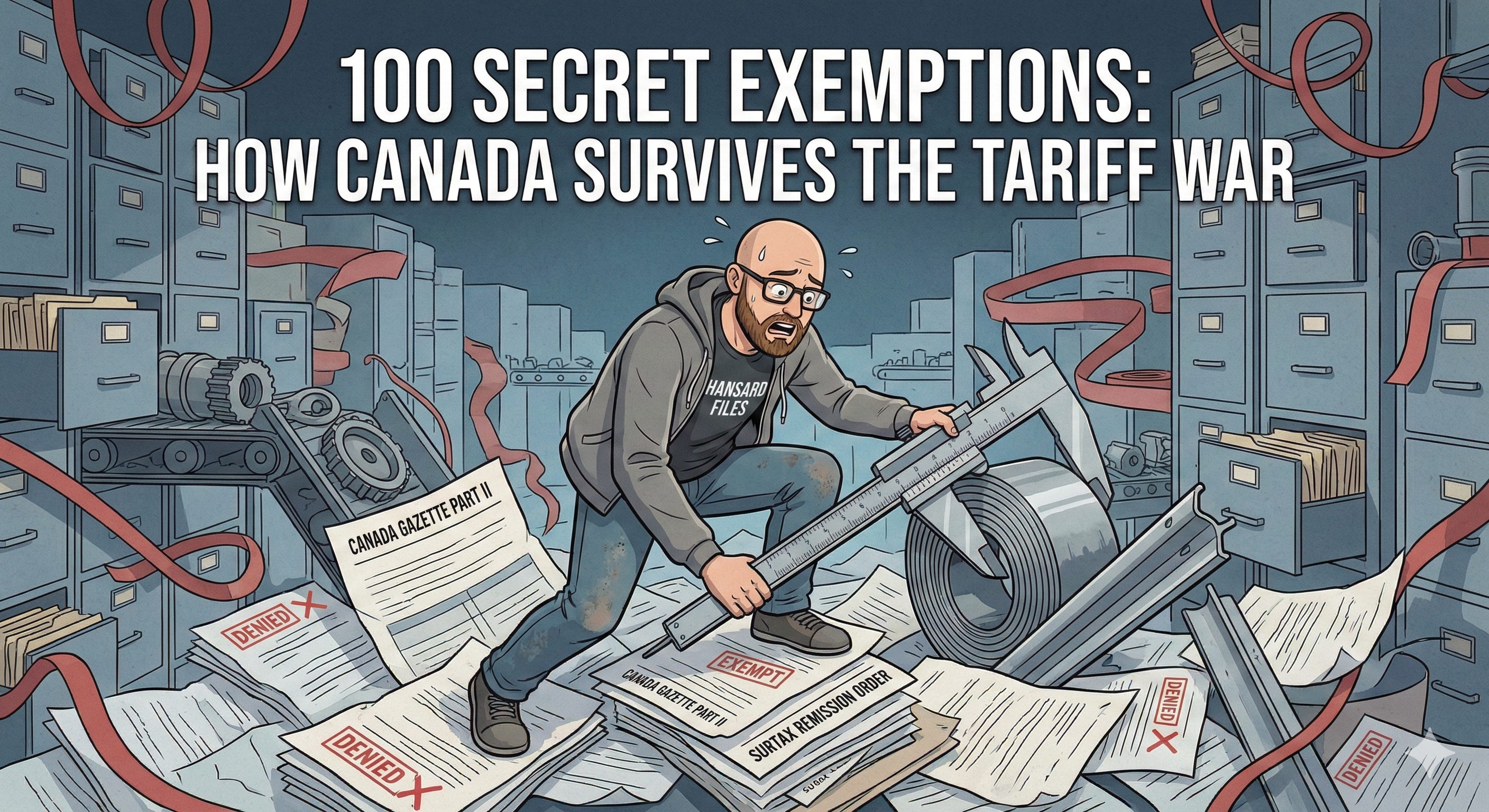
The snow sweeping across Parliament Hill on the morning of February 25, 2026, was nothing compared to the chill gripping the Canadian manufacturing sector. For months, industrial supply chains have been choking under a heavy blanket of cross-border tariffs. But deep within the dense, bilingual pages of the Canada Gazette, Part II, Volume 160, Number 4, a quiet lifeline was just published. The primary mechanism of this relief is the United States Surtax Remission Order, an obscure regulatory amendment that dictates exactly which businesses will survive the ongoing trade friction and which will be left to freeze.
To read the newly published Schedule amendments is to look at the exposed wiring of the North American economy. It is a vast, hyper-specific ledger of desperation and bureaucratic grace, detailing over eighty separate categories of exemptions for steel, aluminum, and manufactured goods. There are no political speeches in these pages. There are only cold, hard metrics calculating who gets to bypass the crippling surtaxes and stay in business.
The Bureaucracy of Survival in the United States Surtax Remission Order
The United States Surtax Remission Order (2025), specifically the amendments listed under SOR/2026-16, is a masterclass in bureaucratic precision. Signed by the Governor General on the recommendation of the Minister of Finance, this document does not offer blanket forgiveness. It offers surgical strikes of mercy.
Consider the level of detail required to bypass the border taxes. Item 28.21 of Schedule 2 does not simply exempt basic industrial steel. It exempts flat-rolled products of carbon steel, in coils, hot-rolled, pickled and oiled, of grade A506 4130 annealed, possessing a minimum spheroidization of 95 percent. The thickness must be at least 3.98 millimeters but not exceed 4.20 millimeters. The width must be exactly 600 millimeters or more. If a Canadian manufacturer imports steel that is 3.97 millimeters thick, they pay the punitive tax. If they import steel that is 3.98 millimeters thick, their profit margins are saved.
This is the reality of modern trade wars. The political rhetoric is broadcast in broad, patriotic strokes, but the economic survival of individual companies is negotiated in fractions of a millimeter. Every exemption listed in the sixty-plus pages of the amendment represents a frantic negotiation, a panicked supply chain manager pleading with federal regulators, and a quiet victory in the halls of the Department of Finance.
Guardrails, Hospitals, and the Human Cost of Tariffs
When nations impose surtaxes on each other, the collateral damage often extends far beyond the factory floor. The Gazette reveals that public health, municipal safety infrastructure, and even the grocery store aisle were caught in the crossfire.
Under Schedule 1, Item 6, we find a stark exemption for inter-hospital transfer vans with fewer than ten passengers. The fact that such a specific, critical piece of medical equipment required a formal tariff remission order speaks volumes. Hospitals moving patients between facilities were suddenly facing inflated procurement costs due to a geopolitical spat over steel and aluminum manufacturing. The exemption, classified under tariff number 8703.24.00.92, ensures that health networks can continue buying these vehicles without the devastating surtax.
Similarly, the safety of Canadian highways is quietly preserved in the margins of Schedule 4.1. The document explicitly allows the import of semi-rigid guardrail end device systems and steel cables. The condition attached to this exemption is incredibly narrow. The goods are imported exclusively for sale to the Quebec Ministry of Transport and Sustainable Mobility to fulfill exact provincial contract numbers, including 851011526 and 851025982.
Without this carve-out, the cost of securing Quebec’s roads would have skyrocketed. The inclusion of these public infrastructure components proves that the federal government is acutely aware of the self-inflicted wounds caused by retaliatory tariffs. They are quietly patching the holes, ensuring that bridge repairs, road safety, and medical transfers are insulated from the broader economic conflict. Even everyday consumer goods required a bailout, with Item 45.12 granting a specific exemption for aluminum food can easy-open ends. The tariff war was literally making it more expensive to open a can of soup.
The Border Patrol’s Impossible Task
To truly grasp the magnitude of the Surtax Remission Order, one must imagine the reality at the border. When a freight train carrying coils of flat-rolled alloy steel pulls into a Canadian customs checkpoint, the documentation must be flawless. The Gazette outlines exemptions that are razor-thin.
Take, for instance, Item 38.15 in Schedule 2. It exempts steel tubes, drawn over mandrel, of grade 4130, but only if they meet one of seventeen precise dimensional combinations. A tube with a 1.375-inch diameter and a 0.188-inch wall thickness is exempt. A tube with a 2.0-inch diameter and a 0.25-inch wall thickness is exempt. If a shipment arrives containing tubes with a 2.0-inch diameter and a 0.20-inch wall thickness, it does not match the list. The remission is denied, and the surtax is ruthlessly applied.
The administrative burden this places on both the importer and the Canada Border Services Agency is staggering. Importers must maintain absolute traceability of their materials from the United States mill directly to the Canadian factory floor. They must rely on metallurgical certificates, high-precision micrometers, and legal counsel to ensure their products fall within the safe zones carved out by the Ministry of Finance. A single rounding error on a shipping manifest could result in hundreds of thousands of dollars in unexpected taxes.
This level of scrutiny reveals a hidden friction in international trade. The political goal of a tariff is to shift macroeconomic behavior, but the operational reality is a nightmare of paperwork and metallurgical testing. It transforms customs agents into amateur engineers and supply chain managers into compliance attorneys.
The Anonymous Winners in the Supply Chain
The back half of the remission order reads like a covert ledger of corporate winners. Schedule 4 and Schedule 4.1 do not list the names of the companies receiving these lucrative exemptions. Instead, they list the nine-digit Business Numbers, hiding the beneficiaries behind a veil of numerical anonymity.
For example, Business Number 100180868 is granted an exemption for high-speed, low-headroom rapid roll overhead doors made of anodized aluminum. Business Number 103615142RM0001 is permitted to import prefabricated modular building components, specifically steel wall and ceiling sections, strictly for sale to two other anonymous companies.
Perhaps most striking is the massive block of exemptions granted to a single entity for importing furniture. Page after page lists tariff classifications for seats, wooden furniture, and metal cabinets, all designated for sale to Business Number 13123106 between April and September 2025. This reveals how deeply intertwined the North American economy truly is. A domestic retailer simply could not source these items locally at a competitive price, forcing the federal government to step in and waive the surtax to prevent consumer prices from soaring.
These anonymous exemptions raise critical questions about access and influence. Who gets a remission order? How does a company convince the Minister of Finance that its specific aluminum tubing, or its precise grade of cold-rolled carbon steel, is worthy of a tax break? The Gazette does not provide the lobbying records. It only provides the results, printed in stark black and white.
The Chemical Tripwire in the Consumer Market
While the Department of Finance dictates the flow of thousands of tons of steel, the Department of the Environment is simultaneously regulating the invisible elements of Canadian life. The very same issue of the Gazette introduces Order 2025-87-20-01 (SOR/2026-15), which amends the Domestic Substances List under the Canadian Environmental Protection Act, 1999.
This section zeroes in on cyclohexanamine, commonly known as cyclohexylamine. The chemical does not occur naturally in the environment. It is synthesized for use as a corrosion inhibitor in water treatment, a boiler-cleaning agent, and strangely enough, an ingredient in aerosol hairsprays and gel fuel canisters used in indoor fireplaces.
The regulatory approach detailed here provides a fascinating contrast to the tariff laws. The federal screening assessment concluded that cyclohexylamine does not meet the strict criteria for a toxic substance under the law. However, the government determined that it possesses properties of concern that could pose a risk if exposure levels were to suddenly increase. Rather than banning it, the Minister of Environment applied the Significant New Activity (SNAc) provisions.
This means that any company wanting to use the chemical in a consumer product at a concentration greater than 0.1 percent by weight (or 0.3 percent for gel fuel canisters) must notify the government ninety days in advance. They must submit exhaustive data detailing the environmental and human health impacts. It is a proactive, rather than reactive, form of governance. The government is essentially placing a chemical tripwire in the consumer market. If a manufacturer crosses the concentration threshold, the alarm sounds, and the rigorous regulatory review process begins.
A Masterpiece of Administrative Control
Reading the Canada Gazette is akin to reading the raw source code of the nation. It lacks the fiery rhetoric of Question Period or the polished talking points of a televised press conference. Instead, it offers the cold, unvarnished truth of how the state actually manages risk.
In the case of the United States Surtax Remission Order, the risk is macroeconomic collapse. The government is attempting to walk a geopolitical tightrope. On one hand, Canada must maintain a strong retaliatory posture against United States trade actions. On the other hand, it must prevent its own manufacturing, construction, and healthcare sectors from being crushed by the very tariffs designed to protect them. The solution is this sprawling, hyper-specific document that grants relief millimeter by millimeter, and business number by business number.
In the case of cyclohexylamine, the risk is public health. The government cannot ban every synthetic chemical outright, as industry relies on them for everything from water treatment to cosmetics. The solution is the SNAc provision, a regulatory net that catches anomalies without stopping the flow of everyday commerce.
Both orders share a common, underlying philosophy. They rely on intense, almost overwhelming administrative control. Whether it is a customs agent measuring the wall thickness of an imported steel pipe or a health official calculating the mass concentration of a hairspray ingredient, the Canadian state operates through microscopic interventions.
As global trade becomes increasingly volatile and environmental standards grow more complex, these quiet regulatory mechanisms will only become more common. The public may focus on the headline-grabbing announcements, but the real battles of survival are fought in the fine print. The companies that survive the next decade will be the ones that know how to navigate the dense appendices of the Canada Gazette, securing their exemptions and filing their notifications while their competitors remain entirely unaware of the rules of the game.
Hansard Files spends countless hours digging through dense archives and complex regulatory texts to uncover the stories that shape our nation. Support independent investigative journalism and subscribe today.
Source Documents
Government of Canada. (2026, February 25). Canada Gazette, Part II, Volume 160, Number 4.
I think the business number that got a furniture exemption is intriguing, and gets to the heart over Ottawa picking corporate winners.
But I imagine the comments around the steel specifications are a little dramatized; I would think these very specific numbers came from importers telling the government their process needs these very specific dimensions and grades, and Canada doesn't make these dimensions and grades, and they need to buy steel of that dimension and grade from a plant in the US. I doubt it's very difficult to track the supply chain, and in the event something that didn't match the specification was imported, I think the importer would likely be quite upset.
That said I'll admit to the bias of being broadly supportive of the actions.
Hansard, with regard to these myriad regulations; do Canadian businesses and CBSA have an easily accessible database or references? I find the Canadian government websites from defence to CPP somewhat dated and challenging to use.