


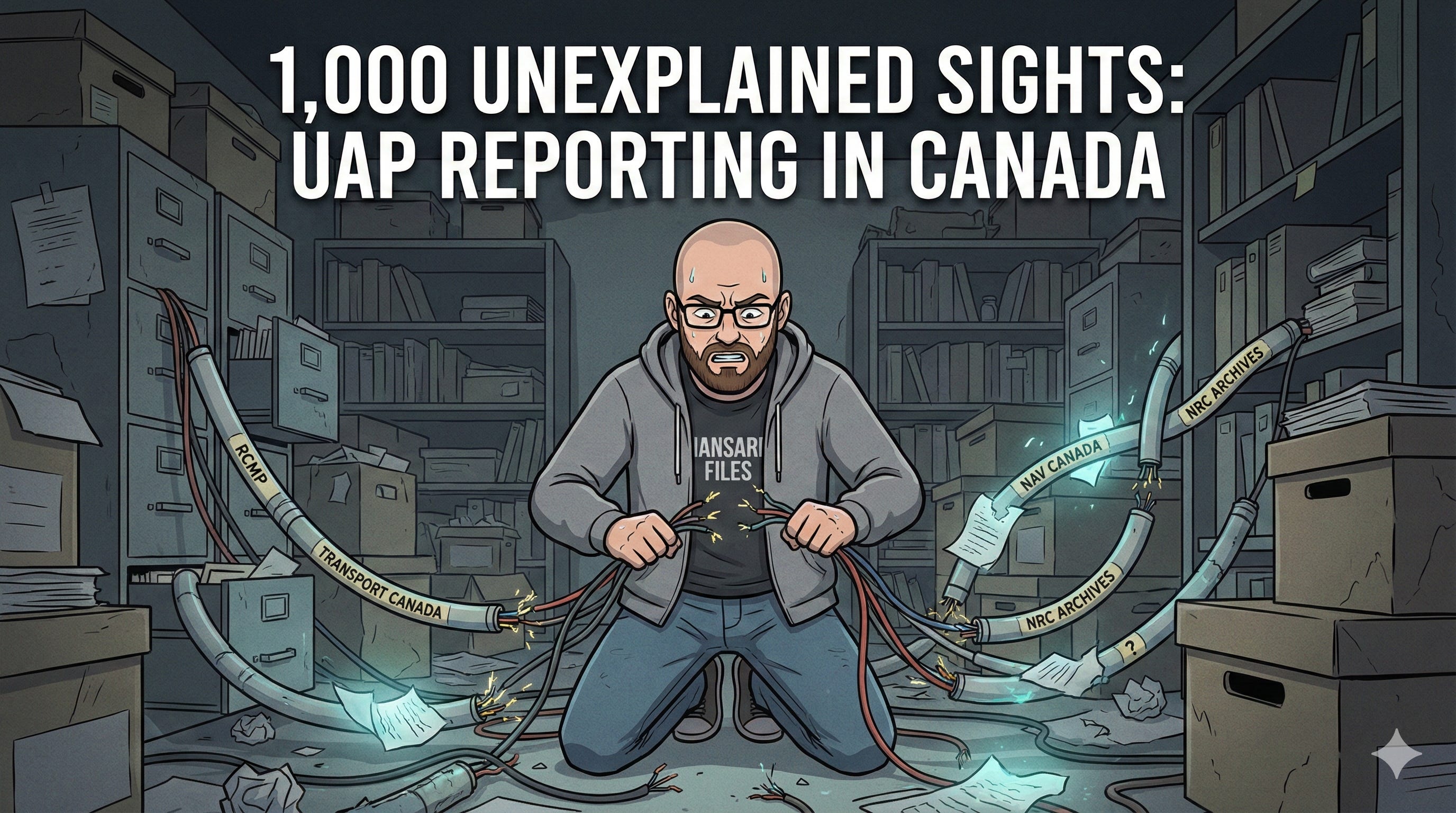
It was early February 2023 when the North American skies suddenly felt much more crowded, and far more unpredictable. Over a span of just two weeks, military forces ordered the downing of multiple unidentified objects. One was a massive, high-altitude balloon carrying sophisticated equipment that drifted across western Canada before meeting its end off the coast of South Carolina. . Days later, the North American Aerospace Defense Command ordered a strike on a smaller object over the Yukon, followed rapidly by another over the frigid waters of Lake Huron. These dramatic interventions dominated global news cycles, but they also laid bare a glaring national vulnerability. When Canadian citizens, commercial pilots, or police officers look up and see something they absolutely cannot explain, there is no single, unified authority listening to them. The current state of UAP reporting in Canada is a fractured web of dead ends, ignored databases, and forgotten history.
Now, a landmark document titled the Report of the Sky Canada Project has pulled back the curtain on this systemic dysfunction. Published by the Office of the Chief Science Advisor of Canada, the investigation reveals a startling disconnect between public experience and government action. According to the report, between 600 and 1,000 unidentified anomalous phenomena sightings are logged annually across the country. Yet, the official government response is virtually non-existent, leaving a dangerous void where rigorous scientific inquiry and airspace security monitoring should be.
The Disconnect Behind UAP Reporting in Canada
To understand the immense scale of the problem, one must look closely at the numbers. Independent surveys commissioned for the Sky Canada Project indicate that one in four Canadians claims to have personally witnessed an unidentified anomalous phenomenon in their lifetime. Despite this widespread exposure across the population, a staggering 90 percent of these witnesses never formally report what they saw. For those who do decide to step forward and share their accounts, the process is fraught with bureaucratic confusion. Fully 40 percent of survey respondents admitted they would have absolutely no idea who to contact if they witnessed an event.
Currently, if a citizen decides to report a strange light or an anomalous movement, their testimony might end up in a variety of disconnected institutional silos. They might call their local Royal Canadian Mounted Police detachment. The RCMP provides policing services to roughly 73 percent of Canada’s landmass, making them a default point of contact for many rural and remote communities. However, the RCMP operates with a mandate focused strictly on public safety and criminal investigations. They possess no formal policy, guidelines, or classification system for logging anomalous aerial phenomena. A call about a hovering object might simply be filed under “suspicious vehicle” or get permanently lost in a mountain of unrelated, non-criminal logs under the Aeronautics Act. Consequently, the national police force is entirely unable to provide baseline statistics on how many such reports they actually receive.
The situation is equally disjointed in the skies above. Commercial and private pilots frequently observe unusual visual phenomena that they cannot immediately identify. They typically report these incidents to the nearest air traffic control tower, which then files an Aviation Occurrence Report with NAV CANADA. This critical information eventually trickles down to Transport Canada, where it is entered into the Civil Aviation Daily Occurrence Reporting System. . Yet, within this vast technical database, these specific sightings account for a microscopic fraction of overall events. In 2023, media analysis identified a mere 17 reports from pilots that fit the criteria for unexplained phenomena, representing roughly 0.08 percent of all logged incidents. Because these specific events rarely pose an immediate, verifiable physical threat to aviation safety, Transport Canada has no operational incentive to dedicate resources to investigating them. The reports sit dormant in the archives, unexamined and completely unexplained.
The Forgotten Legacy of Project Magnet
Canada was not always so dismissive of the unknown. The Sky Canada Project report dives deep into a forgotten era when the federal government actively, and sometimes publicly, sought to understand these mysteries. In 1950, a Department of Transport engineer named Wilbert Smith launched an initiative known as Project Magnet. Smith was officially granted permission to investigate whether these mysterious craft might be utilizing the Earth’s magnetic field as a novel source of propulsion. He pushed the boundaries of the department, eventually launching a monitoring balloon over Ottawa and setting up a dedicated observatory on the outskirts of the city. But Smith’s ambitions outpaced the tolerance of his superiors. Failing to produce concrete scientific evidence and attracting highly unwelcome media scrutiny to the department, Project Magnet was abruptly shut down in 1954.
Around the exact same time, the military took its own quiet look into the skies. In 1952, the Defence Research Board established a specialized committee called Project Second Storey. Chaired by distinguished astronomer Dr. Peter Millman from the National Research Council, the committee’s strict mandate was to review sightings passing over Canadian territory as reported by military personnel. They developed a standardized reporting form to track observer details and object positions, but the initiative was notoriously short-lived. By 1954, after holding just six meetings, the committee concluded that the phenomena posed no national security threat and held zero scientific value, effectively recommending the end of all investigations by the Canadian military.
The burden of responsibility eventually shifted entirely to the National Research Council in 1967. Dr. Millman curated a specific file for “non-meteoritic sightings,” attempting to apply cold scientific logic to reports flooding in from the RCMP, municipalities, and ordinary, bewildered citizens. Most cases were easily explained away as misidentified planets, meteors, or complex optical illusions. But in 1995, the NRC formally ceased all data collection efforts. The entire historical catalogue, comprising an estimated 15,000 pages of raw public curiosity and official bewilderment, was boxed up and shipped to Library and Archives Canada. From that moment on, the Canadian government effectively washed its hands of the entire subject.
The Scientific Method and the Search for Signatures
The modern quest to understand these sightings intersects deeply with broader scientific disciplines, including advanced astrobiology and planetary science. While popular culture frequently equates unexplained phenomena with extraterrestrial visitors, the scientific community approaches the subject with profound caution and skepticism. Renowned astronomer Carl Sagan famously declared that extraordinary claims require extraordinary evidence. Applying the strict scientific method to these elusive events means systematically moving from observation to hypothesis, requiring rigorous data that can be objectively verified through experimentation and peer analysis.
Currently, there is absolutely no verified evidence of extraterrestrial life, let alone advanced non-human technology operating within Earth’s atmosphere. Yet, the scientific search for life beyond our solar system has never been more active or better funded. Instruments like the James Webb Space Telescope are actively analyzing the volatile atmospheres of distant exoplanets searching for distinct bio-signatures, while independent initiatives like the Search for Extraterrestrial Intelligence tirelessly scan the cosmos for anomalous radio techno-signatures. . Because the physical distances between solar systems are overwhelmingly vast, interstellar travel presents immense, perhaps insurmountable, physics and engineering challenges. This is primarily why the consensus among scientists strongly leans toward Earth-bound explanations for atmospheric anomalies.
When trained investigators are provided with sufficient, high-quality data, the vast majority of mysterious sightings dissolve into the mundane. French investigators have documented that all but 3.2 percent of their comprehensively logged cases can be definitively explained. Common culprits include conventional aircraft viewed at unusual angles or in poor visibility, natural weather phenomena like lenticular clouds or temperature inversions, and astronomical objects such as Venus or bright meteorites. . Increasing atmospheric clutter from commercial drones, high-altitude telecommunication balloons, and low earth orbit satellite constellations further muddies the observational waters. However, a stubborn fraction of reports remains genuinely unexplained, almost entirely due to a lack of precise, instrumented data. This persistent, data-starved unknown is exactly what drives the necessity for a serious, centralized investigative framework.
Further compounding the issue is the fact that academic research into this specific field remains heavily stigmatized. A recent survey of American university faculty revealed that 53 percent believed researching these phenomena would actively jeopardize their tenure or academic promotion. This chilling effect is mirrored deeply in Canada, where the major federal research funding agencies have recorded virtually zero grant applications directly related to the topic over the past 25 years. Breaking this entrenched stigma requires bold institutional leadership. By officially validating the study of the sky, the federal government can empower universities and independent researchers to tackle the problem without the looming fear of professional ruin.
The Misinformation Vacuum and Global Standards
Nature abhors a vacuum, and in the modern digital age, informational voids are quickly and aggressively filled by pure speculation. The Office of the Chief Science Advisor highlights a critical modern danger facing the public. The absolute lack of a centralized, transparent authority for reporting these phenomena directly fuels the rapid spread of misinformation and disinformation. When citizens encounter an unexplainable event and find no official channel to turn to for guidance, they inevitably seek answers on social media. Here, recommendation algorithms amplify sensationalism over rigorous science.
The Sky Canada Project emphasizes that disinformation provides false, yet sometimes psychologically comforting, narratives that strongly appeal to existing cognitive biases. Once deeply entrenched conspiracy theories take root within a community, they are notoriously difficult to dismantle with retroactive fact-checking. The report strongly advocates for a proactive public communication strategy known as “prebunking,” where trusted scientific institutions provide rapid, factual explanations ahead of time to prevent falsehoods from organically spreading. Currently, without a dedicated federal service managing these reports, Canada has no institutional voice capable of executing this vital public education.
Meanwhile, peer nations across the globe are rapidly adapting to the realities of crowded airspace. In the United States, the Department of Defense established the All-domain Anomaly Resolution Office in 2022 to rigorously investigate military sightings, standardize data collection protocols, and transparently communicate findings. The National Aeronautics and Space Administration followed suit, releasing an independent study and creating a new directorship specifically to coordinate research efforts and transition the topic from mere anecdote to serious, measurable science. France has maintained a government-funded office within its national space agency since 1977, employing dedicated investigators and utilizing a massive network of trained volunteers to assess public reports. . Chile operates a similar, highly respected scientific body under its General Directorate of Civil Aeronautics, publishing comprehensive monthly reports to ensure absolute public transparency regarding closed cases.
A 14-Point Blueprint for Canadian Skies
Recognizing that Canada has dangerously fallen behind its international allies, the Chief Science Advisor outlines a comprehensive roadmap to pull the nation’s aerospace monitoring out of the dark. The report delivers 14 precise, actionable recommendations designed to bring scientific rigor, public trust, and ultimate accountability back to the study of the sky.
The core recommendation is the immediate identification and designation of a lead federal department to actively manage public data. The report intelligently suggests that a trusted, globally recognized scientific organization, such as the Canadian Space Agency, could be ideal for this critical oversight role. This designated lead agency would immediately establish a dedicated public service to collect testimonies, investigate complex cases using modern tools, and proactively publish its scientific analyses for all Canadians to review.
Furthermore, the strategy demands a fundamental cultural shift within the entire aviation sector. Transport Canada must actively encourage commercial pilots, cabin crews, and air traffic controllers to report unusual, anomalous sightings without the lingering, career-ending fear of professional stigmatization. By collaborating closely with NAV CANADA, federal aviation authorities could systematically track emerging trends and provide real-time, fact-based explanations to flight crews, thereby effectively reducing dangerous visual distractions in the cockpit during critical phases of flight.
Data accessibility is another major structural pillar of the proposed reforms. The report insists that all collected data should be open and easily accessible to the public and the broader academic scientific community to support peer-reviewed research. To support this immense logistical effort, the government should invest heavily in digital tools, such as bilingual mobile applications and interactive web platforms, allowing citizens to easily log their precise observations and continuously contribute to participatory science initiatives. Engaging the public directly not only massively expands the available data pool but actively improves scientific literacy, acting as a powerful, organic countermeasure against internet-driven conspiracies.
Finally, the ambitious blueprint calls for deep, ongoing international collaboration. Canada must aggressively share information, research methodologies, and investigative best practices with established foreign entities like the American All-domain Anomaly Resolution Office and the French national space agency. Unidentified aerial phenomena do not respect drawn national borders, and unraveling their true physical origins requires a completely unified, global scientific effort. The time for fractured, silent databases has passed.
At Hansard Files, we dig through the archives and dense government reports to uncover the policies shaping our world, holding the powerful to account. Subscribe today to support independent, uncompromising investigative journalism.
Source Documents
Office of the Chief Science Advisor of Canada. (2025). Management of Public Reporting of Unidentified Aerial Phenomena in Canada: Report of the Sky Canada Project.
" ... one in four Canadians claims to have personally witnessed an unidentified anomalous phenomenon in their lifetime. Despite this widespread exposure across the population, a staggering 90 percent of these witnesses never formally report what they saw."
Well, and as always thoughtfully, written. Nevertheless, IMO you’ve not made a convincing case that “dangerous” is a term that can reasonably be applied to this gap in data collection, analysis and reporting.
“Recognizing that Canada has dangerously fallen behind its international allies[…]”
Particularly not with all the new, more immediate and far more convincingly dangerous priorities which now compete for the focus of our efforts and limited resources.
If a case could be made that a significant percentage of sightings which have been investigated result in the identification of a foreign national intrusion risking our national security, that may justify the effort described by the report’s recommendations.
Instead, the major harm in continuing to focus efforts elsewhere seems to be reputational — “See, Janice, I *told* you the government’s hiding aliens from us and is using their gizmos to spy on (slash control) us!”
A rational, evidence-based, approach to collecting, analyzing and reporting these sightings is not going to make much headway against these folks. We’d probably achieve almost as much by simply maintaining a couple of web pages hosting the case against UAP sightings as indicators of extraterrestrial visitors, with sections written by various Canadian subject experts explaining the typical breakdown in annual sightings — including, delicately, what percentage are multi-reports by the same small number of individuals or groups.
There are many more reasons to continue as we are, for the moment at least, than to create a new UAP reporting system. Let’s give ourselves 10 years to make the dramatic, *necessary*, expensive and disruptive changes nationally to accommodate the new world that has been thrust upon us, and then see if we have the bandwidth to spare for this low priority effort.