


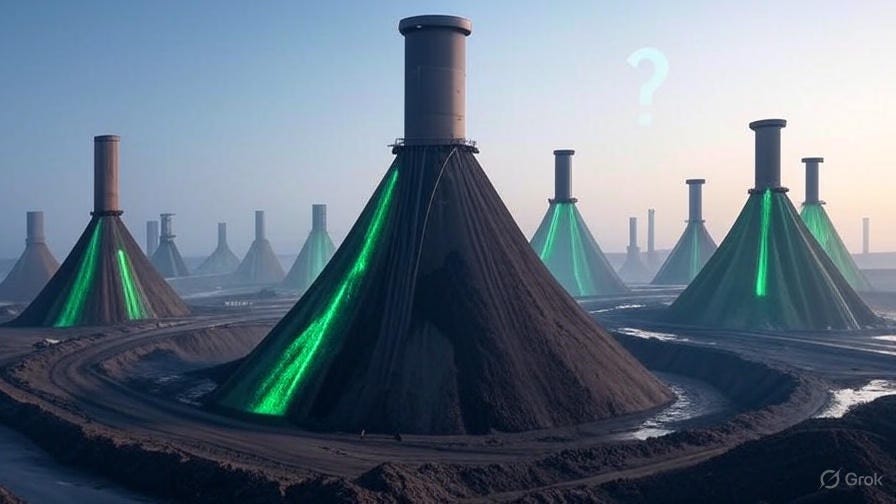
Ever wondered if the mountains of industrial waste piling up in Canada could be a secret weapon against climate change? Picture this: the gritty leftovers from steel mills and mines—stuff we’d rather forget—transformed into a CO₂-eating superhero. Ex situ carbon mineralization, a fancy term for locking carbon dioxide into stable minerals using industrial waste, is making waves as Canada chases its net-zero emissions goals by 2050. It’s a bold idea, backed by the National Research Council (NRC) and tied to Canada’s $15B carbon capture investment. But here’s the kicker: while Canada ranks second globally, capturing 29.4 million tonnes of CO₂ yearly, some argue it’s an expensive distraction from cheaper renewables. Let’s unpack this high-stakes climate gamble and why it’s sparking heated debates.
What’s Ex Situ Carbon Mineralization, Anyway?
Think of ex situ carbon mineralization as a high-tech recycling plant for greenhouse gases. Instead of burying CO₂ underground (like its cousin, in situ mineralization), this process happens above ground in controlled reactors. It takes industrial waste—like steel slag or mine tailings, rich in calcium and magnesium—and mixes it with CO₂ from factories to create stable carbonates, like limestone. These can be reused in construction, reducing the need to mine new materials. It’s like turning your kitchen scraps into compost, but for carbon emissions.
Here’s the breakdown:
The Chemistry: CO₂ reacts with calcium oxide (CaO) or magnesium oxide (MgO) to form solid carbonates (CaCO₃ or MgCO₃). These are stable for centuries, ensuring no leaks.
The Process: Direct methods mix CO₂ and waste in one go; indirect methods extract metal ions first, then carbonate them. Wet processes use water; dry ones use gas.
Why It’s Cool: It uses existing waste, creates valuable products (like cement additives), and permanently traps CO₂—no risk of it escaping like with geological storage.
Global Impact: Could cut 310 million tonnes of CO₂ directly and 3,700 million tonnes indirectly by replacing carbon-heavy materials. That’s like taking 67 million cars off the road annually
But there’s a catch: it’s energy-hungry, needing 2.7-3.7 MWh per tonne of CO₂ captured, compared to less for underground storage. Critics on X call it a “taxpayer-funded science project,” questioning if the juice is worth the squeeze.
Canada’s Waste-to-Wealth Playbook
Canada’s industrial landscape is a goldmine—pun intended—for this tech. With 282 billion tonnes of abandoned mine tailings and 16 billion tonnes of new waste yearly, we’re sitting on a carbon-trapping jackpot. The NRC highlights Canada’s role, capturing 29.4 million tonnes of CO₂ annually through mineralization, trailing only China’s 132.2 million tonnes. Here’s how we’re doing it:
Steel Slag: Canada’s steel industry, led by giants like ArcelorMittal, produces slag that can capture 17-410 kg of CO₂ per tonne. Finland’s Slag2PCC pilot, producing 100 kg/h of calcium carbonate for paper or paint, is inspiring Canadian trials.
Mine Tailings: UBC’s Gahcho Kué project in the Northwest Territories uses diamond mine tailings to trap CO₂, while Quebec’s Dumont Nickel Project leverages brucite-rich waste for faster reactions. These could sequester 100-200 million tonnes of CO₂ yearly.
Cement Waste: Companies like CarbonCure inject CO₂ into concrete, boosting strength by 7% and locking in 48-55 kg of CO₂ per tonne of kiln dust. It’s a double win: stronger buildings, less emissions.
Did You Know? Canada’s 282 billion tonnes of mine tailings could theoretically store enough CO₂ to offset emissions from 61 million cars for a year. But grinding those tailings to the ideal 38-100 µm size is an energy hog, raising costs to $20-200 per tonne of CO₂ captured.
The NRC’s Industrial Carbon Management program and Canada’s Net-Zero Emissions Accountability Act are pouring funds into these pilots. But here’s where it gets spicy: over 400 academics argue carbon capture, including mineralization, isn’t a true “negative emissions” tech, citing energy demands that could emit more CO₂ than captured if powered by fossil fuels.
The Big Debate: Climate Hero or Greenwashing Villain?
Ex situ mineralization sounds like a slam dunk, but it’s not without critics. Let’s lay out the pros, cons, and the fiery debates heating up on X and beyond:
The Upside:
Circular Economy Win: Turns waste into valuable products like cement or paint fillers, reducing landfill use and new mining.
Permanent Storage: Unlike geological storage, there’s no risk of CO₂ leaking back out.
Economic Perks: Recovering critical minerals like nickel from tailings could fuel Canada’s EV battery industry.
The Downsides:
High Costs: Processing costs ($20-200 per tonne CO₂) are steep compared to industrial CCUS ($15-120).
Energy Demands: Grinding and heating waste eats energy, potentially offsetting gains unless powered by renewables.
Environmental Risks: Poorly managed slag could leach heavy metals, polluting water sources.
The Controversy: Critics, backed by studies like Sekera and Lichtenberger (2020), argue CCUS—including mineralization—may increase net emissions due to energy-intensive processes. X posts label it “greenwashing” for oil and mining giants, with $15-20B in taxpayer funds at stake. Supporters counter that it’s a practical bridge to net-zero, using waste we already have. Is it a smarter bet than the $170/tonne carbon tax, or a distraction from wind and solar, which cost less per tonne of CO₂ avoided?
Did You Know? The IEA projects CCUS could cut 5.9 billion tonnes of CO₂ by 2050, but X users question if Canada’s betting on a tech that’s “20 years from scalability.”
What’s Next for Canada’s Climate Quest?
Ex situ carbon mineralization could be a game-changer, turning Canada’s industrial waste into a climate-fighting asset. With the potential to lock away 100-200 million tonnes of CO₂ yearly from tailings alone, it aligns with Canada’s net-zero ambitions. But the controversy is real: verified studies show it only delivers net gains if powered by renewables, and costs remain a sticking point. Is this a bold step toward a circular economy, or are we pouring taxpayer dollars into a shiny but shaky solution?
Call to Action: Share this article if you think Canada should double down on waste-to-wealth tech—or debate it below! Follow @OnHansard for more on Canada’s policy battles, and dive deeper at onhansard.substack.com. Being an informed citizen means cutting through the Ottawa fog to question what’s really green and what’s just hype.
Sources:
Hamedi, H., Gonzales-Calienes, G., & Shadbahr, J. (2025). Ex situ carbon mineralization for CO₂ capture using industrial alkaline wastes—Optimization and future prospects: A review. Clean Technologies, 7(2), 44. https://doi.org/10.3390/cleantechnol7020044
International Energy Agency. (2021). Net zero by 2050: A roadmap for the global energy sector. https://www.iea.org/reports/net-zero-by-2050
Pan, S.-Y., Chen, Y.-H., Fan, L.-S., Kim, H., Gao, X., Ling, T.-C., Chiang, P.-C., Pei, S.-L., & Gu, G. (2020). CO₂ mineralization and utilization by alkaline solid wastes for potential carbon reduction. Nature Sustainability, 3(5), 399–405. https://doi.org/10.1038/s41893-020-0496-4
Sekera, J., & Lichtenberger, A. (2020). Assessing carbon capture: Public policy, science, and societal need. Biophysical Economics and Sustainability, 5(14). https://doi.org/10.1007/s41247-020-00080-5
National Research Council Canada. (2025). Climate change and sustainability research at the NRC. https://nrc.canada.ca/en/research-development/research-collaboration/climate-change-sustainability-research-nrc