


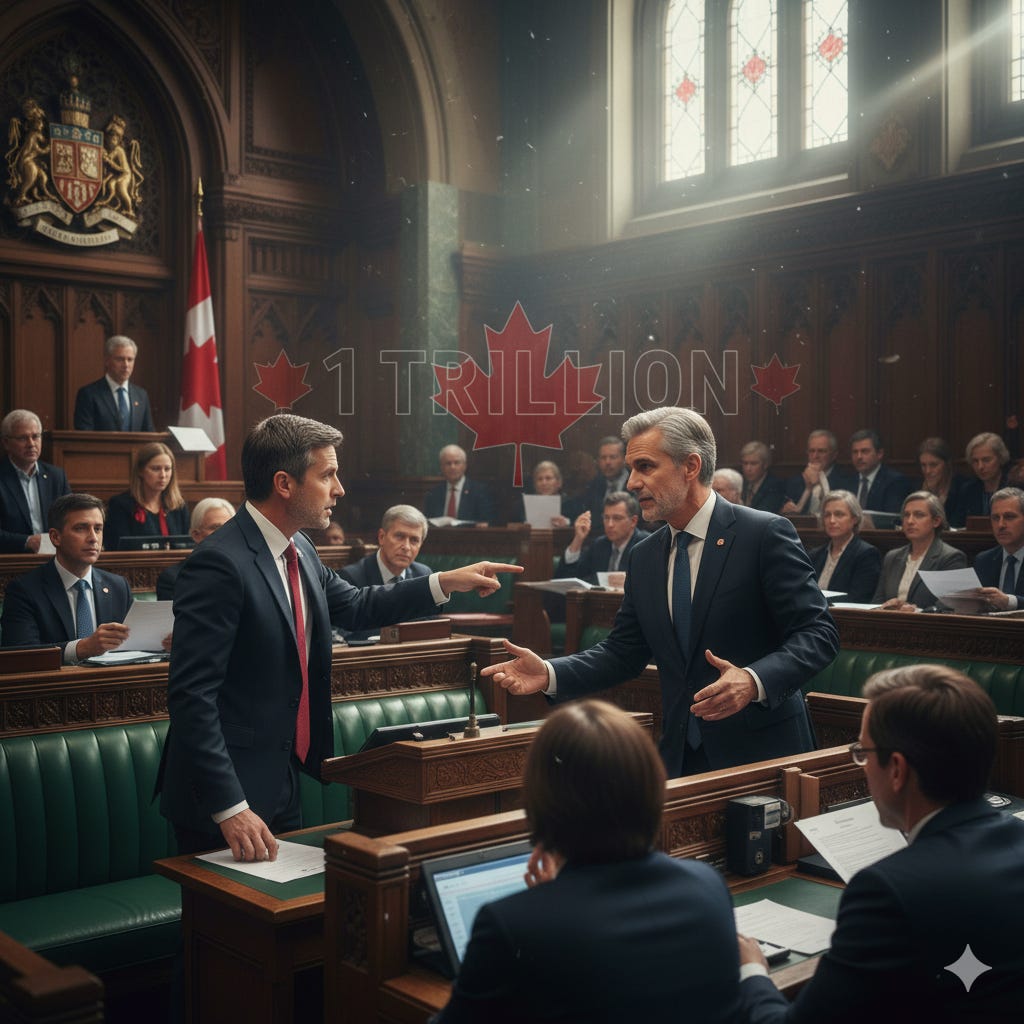
Yesterday’s Oral Questions session in the House of Commons escalated into a fiery confrontation over Canada’s economic future. The Opposition accused the Prime Minister of surrendering a trillion dollars in Canadian investment to the United States, a charge the government vehemently denied while defending its trade strategy. The exchange provides a clear window into the high-stakes battle over jobs, tariffs, and Canada’s place in the North American economy.
Estimated reading time: 4 minutes
INTERNATIONAL TRADE
The “$1 Trillion Gift” Ignites Question Period
Driving the news: Opposition Leader Pierre Poilievre relentlessly questioned Prime Minister Mark Carney about an alleged promise to drive $1 trillion of Canadian investment to the United States in exchange for a new trade agreement.
Catch-up: The questions follow a recent meeting between the Prime Minister and the U.S. President. The Conservative Party repeatedly stated that 86,000 Canadian jobs have been lost and American tariffs, particularly on softwood lumber, have doubled under the current government.
The Big Picture: The government and opposition presented starkly different views of the Canada-U.S. trade relationship. The Prime Minister insisted Canada has “the best deal in the world” and is negotiating from a position of strength for better terms on steel, aluminum, and energy. The Opposition characterized the government’s approach as a “surrender” that is sending mills, mines, and auto plants south of the border.
Why it matters: The debate crystallizes the central economic anxieties facing the country: job losses in key sectors like auto and forestry, the pressure of U.S. tariffs, and the flight of investment capital. The government argues its strategy involves negotiating better, more targeted deals, while the opposition frames it as a massive giveaway of Canadian economic potential that benefits American workers at the expense of Canadians.
What’s next: The Prime Minister stated that government teams are currently negotiating the terms of agreements for the steel, aluminum, and energy sectors.
JUSTICE
Premiers Push Back on Federal Challenge to Quebec’s Bill 21
Driving the news: Five provincial premiers have written to the Prime Minister, demanding the federal government withdraw its legal submission to the Supreme Court in the case against Quebec’s Bill 21.
Catch-up: The premiers argue that the federal government’s legal arguments represent a “complete disavowal of the constitutional bargain” related to the Charter and the notwithstanding clause.
The Big Picture: The federal Minister of Justice, Sean Fraser, defended the government’s position, stating it is “unimaginable” that the federal government would not participate in the case to defend the Canadian Charter of Rights and Freedoms. The Bloc Québécois accused the minister of making an “offensive analogy” by comparing Quebec’s use of the clause to the war in Ukraine, a characterization the minister called a misinterpretation.
Why it matters: This represents a significant federal-provincial conflict over the power of the federal government versus the provinces, the use of the notwithstanding clause, and the protection of minority rights. The pushback from multiple premiers indicates a growing provincial front against what they see as federal overreach into constitutional matters.
NATIONAL DEFENCE
House Debates Overdue Military Justice Reforms
Driving the news: The House of Commons is debating Bill C-11, the Military Justice System Modernization Act, which seeks to reform how the Canadian Armed Forces (CAF) handles sexual offences.
Catch-up: The legislation follows three separate reports over the last decade (Deschamps, Fish, and Arbour) that identified a systemic culture of sexual misconduct and recommended significant changes13. A key provision of the bill is to remove the military’s jurisdiction over sexual offences committed in Canada and transfer investigation and prosecution to the civilian justice system.
The Big Picture: There is broad, multi-party support for the principle of the bill, acknowledging that the current system has failed victims. However, serious concerns were raised about implementation. These include the potential for political interference through new Governor in Council appointments, the capacity of already-strained civilian courts to handle the new caseload, and a lack of clarity for how offences committed abroad will be handled.
Why it matters: This legislation is a critical, albeit long-delayed, attempt to address a crisis of confidence within the military and provide a credible path to justice for survivors of sexual trauma. The debate highlights the challenge of enacting meaningful cultural change and ensuring that structural reforms do not create new problems, like political interference or a two-tiered justice system based on geography.
On The Docket
Canadian Beer Day: MP Tom Osborne recognized the seventh annual Canadian Beer Day, celebrating the economic and cultural contributions of Canada’s brewers, who directly employ 24,000 Canadians.
Aid for Ukraine: MP Kelly McCauley highlighted the work of FireFighter Aid Ukraine, an Edmonton-based organization that has delivered over 450 tonnes of firefighting gear, medical supplies, and rescue equipment to front lines in Ukraine since 2014.
Canadian Soccer Star: MP Ryan Turnbull celebrated Whitby’s Olivia Smith, who, at 20 years old, became the most expensive signing in women’s football history with a world-record transfer fee of one million British pounds to Arsenal Football Club.
Community Support: A fire ravaged Patro Roc-Amadour in Limoilou, destroying over $100,000 in food and disrupting essential community services like meals on wheels. MP Steeve Lavoie praised the community for rallying to support the organization.
In Their Own Words
Bloc Québécois Leader Yves-François Blanchet
“Flatterers thrive on fools’ credulity.”
Why it matters: The Bloc leader quoted the 17th-century writer Jean de La Fontaine during Question Period to criticize Prime Minister Carney’s recent meeting with the U.S. President. Blanchet argued that the Prime Minister returned “empty-handed” on key trade issues like aluminum and softwood lumber, suggesting he was won over by “nice words” and flattery rather than securing a substantive victory for Canadian industries.
Also Noteworthy
The seventh annual Canadian Beer Day was celebrated on Wednesday.
Metcalfe’s Garage in Treherne, Manitoba, is celebrating 125 years as Canada’s oldest family-owned Ford dealership.
Françoise Bouchard, 84, is retiring after 40 years in municipal politics in Dixville, Quebec, where she was the first female mayor.
Police in Durham Region are urging residents to adopt a “9 p.m. routine” to secure their property due to rising crime.
The Livable Cities Forum is taking place in Halifax, gathering 400 leaders to accelerate climate action in Canadian communities.
A petition with over 500 signatures was presented concerning federal policy changes that reduced international student study permits.
Another petition calls for raising the minimum age for social media use to 16 through mandatory age verification.
A bill to declare September as Ukrainian Heritage Month in Canada passed its first reading.
The Data Brief
$1 trillion: The amount of Canadian investment the Opposition alleges the Prime Minister promised would flow to the U.S. over five years as part of a trade deal.
86,000: The number of jobs the Conservative opposition claims Canada has lost since the Prime Minister took office.
$54 billion: The amount of investment capital the Opposition claims has fled Canada for the United States since the election.
16,500: The approximate current personnel shortfall in the Canadian Armed Forces, according to MP Jeff Kibble.
$800: The additional amount of money an MP claims Canadians are spending on food this year.
Sources:
House of Commons. (2025, October 8). House of Commons Debates (Hansard), 45th Parliament, 1st Session, Volume 152, No. 036. Ottawa: Parliament of Canada.