


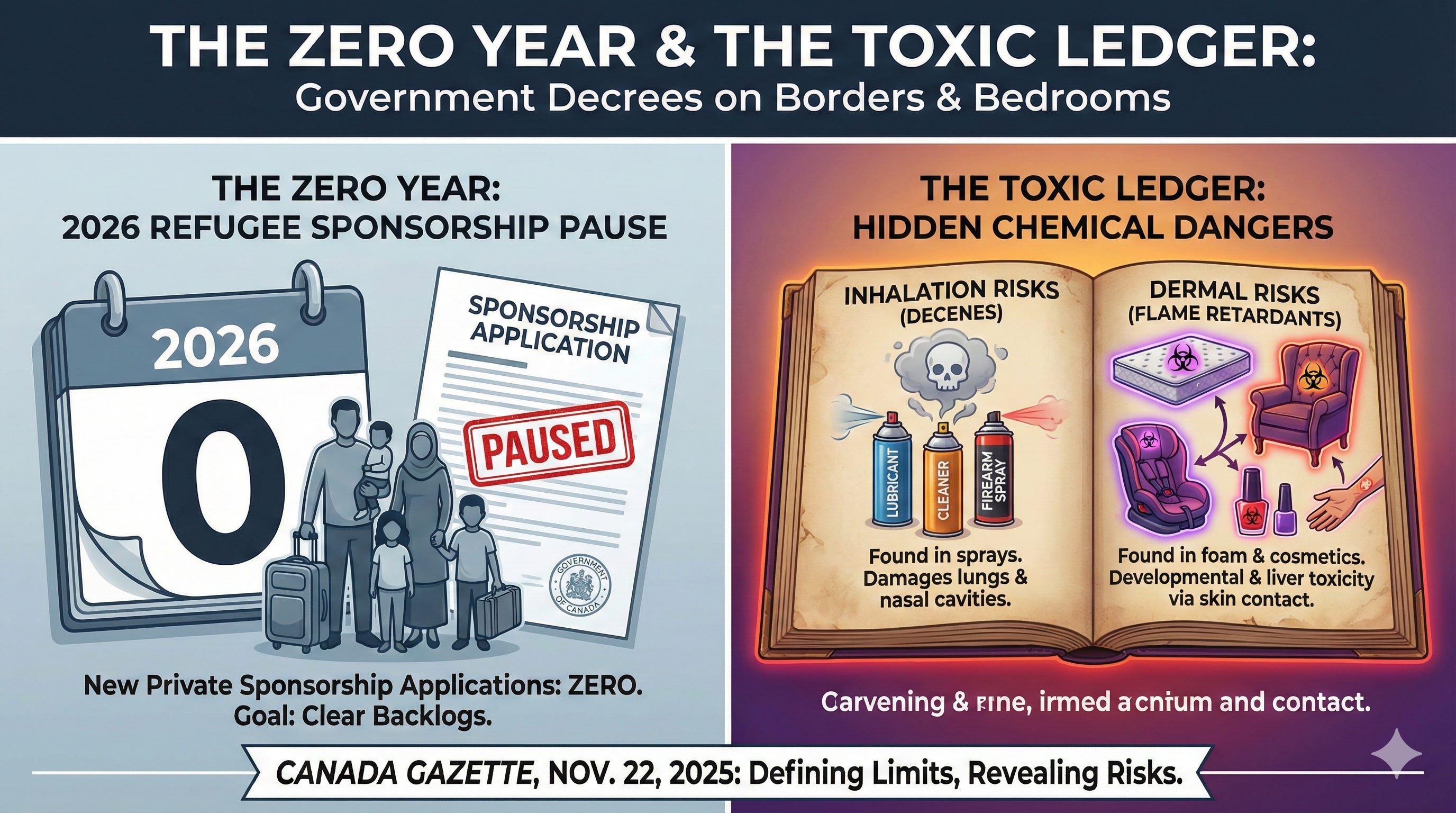
On January 1, 2026, a silent gate will swing shut across the Canadian border. It will not be made of iron or wire, but of paper—specifically, a Ministerial Instruction buried in the dense typography of the Canada Gazette. For twelve months, the number of new applications the government will accept from groups seeking to privately sponsor refugees will be exactly zero.
This stark figure represents a dramatic pivot in the machinery of Canadian immigration. It is a pause button pressed with the weight of the state, designed to halt the influx of paperwork so that an overwhelmed bureaucracy can dig itself out from under a mountain of existing files. Yet, to the ears of those waiting in conflict zones, or the community groups in Winnipeg and Halifax preparing spare bedrooms, that zero will ring out like a thunderclap.
This is the nature of the Canada Gazette. It is the operating system log of the nation, a weekly readout where the abstract concepts of “policy” and “governance” calcify into hard rules that dictate the movement of people, the chemical composition of our furniture, and the flow of billions of dollars. In the edition dated November 22, 2025, the government has laid bare a series of decisions that touch upon the most intimate aspects of life: the air we breathe, the beds we sleep in, and the borders we watch.
The Pause on Hope
The rationale provided by the Minister of Citizenship and Immigration is one of capacity and management. The official text describes the intent clearly: to limit the number of new Private Sponsorship of Refugees (PSR) applications to ensure the department can “continue processing existing applications and meeting Cabinet approved admission targets, without further growing inventories.”
The instruction applies to “groups,” a specific category under the regulations that forms the backbone of Canada’s celebrated private sponsorship model. By setting the intake cap at zero for the calendar year of 2026, the government is effectively declaring a year of administrative catch-up. While humanitarian and compassionate requests accompanying rejected applications will also be turned away, the measure is framed not as a permanent closure, but as a necessary damming of the river to prevent a flood.
This decision illuminates the tension at the heart of modern governance: the friction between the political desire to offer sanctuary and the logistical reality of processing capacity. For 2026, the ledger has been closed before it even opened.
The Invisible War in the Living Room
While the immigration pause dominates the geopolitical landscape of the Gazette, a different kind of battle is being waged on the molecular level. The Department of the Environment and the Department of Health have released a series of damning assessments regarding substances that have quietly permeated Canadian homes for decades.
The government has turned its gaze toward a group of chemicals known as the “Decenes.” These are polyalphaolefins, complex substances used in a dizzying array of products: lubricants, greases, cosmetics, and mining applications. Specifically, the focus is on hydrogenated didecene and a related compound known as HTTD.
The assessment is chilling in its specificity. These substances are not merely industrial additives; they are found in “cleaner/lubricant/preservative spray products available to consumers,” particularly those used for firearm maintenance. The science indicates that when these substances are aerosolized and inhaled, they cause histopathological effects in the nasal cavities and lungs.
The margin of exposure—the buffer between the amount of chemical a person might inhale while cleaning a rifle in their garage and the amount known to cause damage in a laboratory rat—is now considered “potentially inadequate.” Consequently, the Ministers are proposing to add these substances to Schedule 1 of the Canadian Environmental Protection Act, effectively branding them as toxic. The regulatory machinery is now gearing up to restrict their use in spray products, a move that will force a reformulation of the fluids used to maintain everything from hunting rifles to industrial machinery.
Sleeping with the Enemy
The chemical audit does not stop at the garage. It extends into the nursery and the bedroom. The government has released a supplemental risk characterization for the “Flame Retardants Group,” specifically targeting two ubiquitous compounds: TPHP (triphenyl phosphate) and TBOEP (tris(2-butoxyethyl) phosphate).
These acronyms conceal a pervasive presence. TPHP is used as a plasticizer and flame retardant in nail polish, foam, and adhesives. TBOEP is found in floor coverings and paints. But the primary concern lies in where we rest our bodies. Both substances are heavily used in polyurethane foams—the kind found in mattresses, upholstered furniture, and, most critically, infant and child restraint systems.
The science on TPHP has evolved rapidly. Since a draft assessment in 2021, new data has emerged identifying “significant new critical health effects,” specifically related to developmental toxicity. The government’s analysis suggests that for Canadians painting their nails or applying certain lubricants, the risk is too high. But the concern is even more acute for children strapped into car seats or boosters, where prolonged skin contact with foam padding acts as a slow-release delivery system for the toxin.
The case against TBOEP has similarly hardened. Previously thought to be safe, the government has reversed its position. Updated exposure models for sleeping on foam mattresses and sitting in child seats have revealed that the margins of safety are “potentially inadequate” to protect against liver damage.
The response is a comprehensive mobilization of the regulatory state. The government is considering a ban on TPHP in nail care products via the “Cosmetic Ingredient Hotlist” and is exploring regulations to reduce dermal exposure from foam products for all ages. The mundane act of sleeping or driving a child to school has been revealed as a site of chemical exposure, prompting a federal intervention to rewrite the recipes of daily life.
The Grinding Gears of Commerce
Beyond the biological and the humanitarian, the Gazette records the relentless friction of government commerce. The Canadian International Trade Tribunal (CITT) has opened inquiries into three separate disputes, each revealing the high stakes of federal procurement.
In one case, 2Keys Corporation has lodged a complaint regarding a solicitation by Shared Services Canada for a “digital credentials solution.” The company alleges it was denied a fair evaluation due to “undisclosed criteria” and unreasonable interpretations by the government, a claim that hints at the opacity often plaguing the acquisition of complex software systems.
In a more tangible dispute, Maritect Investigations and Security Ltd. is challenging a contract for security system upgrades at the Canadian Coast Guard College. The allegation here is one of chaotic process: Maritect claims the government specified the required door locks only three days before the bid closed, then refused to grant an extension so the company could price the new hardware. It is a microcosm of the frustrations that defined the interaction between private enterprise and public funds—a scramble for clarity in a system prone to sudden, unexplained shifts.
The Final Line
In a document filled with technical assessments and bureaucratic adjustments, one notice stands out for its brevity and finality. The Canada Revenue Agency has issued a notice of intention to revoke the charitable registration of the “Medical Aid for Palestine Association.”
The notice cites a failure to meet specific parts of the Income Tax Act. It provides no narrative, no list of infractions, and no defense. It is simply a termination of status, effective upon publication. In the context of global events, such a revocation carries a weight that far exceeds the few inches of column space it occupies. It serves as a reminder that the government’s power to legitimize—or de-legitimize—organizations is exercised through these quiet, administrative channels.
From the refugee freeze that will define 2026 to the chemical bans that will alter the composition of consumer goods, the November 22, 2025, Canada Gazette is a testament to the reach of the state. It is a ledger of risks calculated and opportunities foreclosed, a document where the invisible forces shaping the nation are, for a brief moment, made visible in black and white.
Source Documents
Canada Gazette. (2025, November 22). Part I, Vol. 159, No. 47.