

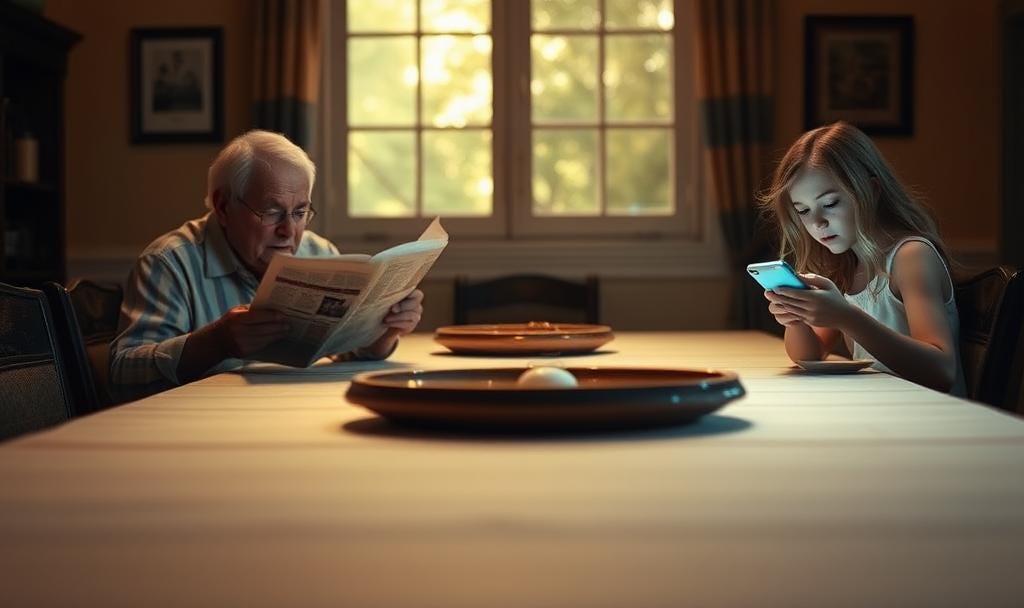
If you’ve ever sat at a family dinner, phone in hand, while a parent or grandparent listens intently to the evening news on the radio, you’ve felt it. It’s a quiet disconnect, a sense that you are both consuming information about the same world, but from entirely different planets. They hear a trusted voice delivering the day’s events; you see a personalized feed of videos, headlines, and arguments algorithmically tailored to your interests.
We talk a lot about the "crisis of trust" in media. The phrase suggests a single, monolithic problem—a universal erosion of faith in journalism. We assume everyone is becoming more skeptical, that the entire ship is slowly sinking.
But what if that’s not the whole story? What if, instead of one slow decline, we are witnessing a great divergence? Recently released perception surveys from Canada's public broadcaster, CBC/Radio-Canada, provide a startlingly clear picture. After analyzing the responses of over 5,400 Canadians, the data doesn’t show a uniform crisis of trust. It shows a chasm. And the single biggest factor defining which side of that chasm you stand on is your age.
This isn't just about different opinions. The data suggests we are living in two parallel media realities, shaped by generations of different habits, technologies, and expectations. By the end of this article, you will understand the profound scale of this generational divide, why it extends beyond mere trust into relevance itself, and what it means for our ability to have a shared national conversation.
The Trust Chasm
Let's start with the most fundamental question: Is the public broadcaster a trusted source of information? The answer depends entirely on who you ask. The Spring 2024 perception survey data reveals a stark divide between the youngest and oldest Canadian adults.
When asked if they agree that "CBC/Radio-Canada is a trusted source of information":
Canadians 65 and Over: 62% agree.
Canadians 18-34: 45% agree.
That is a 17-point gap. It’s not a subtle variation; it is a fundamentally different relationship with a national institution. For a majority of older Canadians, the CBC remains a reliable source. For a majority of younger Canadians, it is not. This single statistic is the bedrock of our story—it shows two distinct Canadas, defined by their date of birth, looking at the same broadcaster and seeing two very different things.
It's Not Just Trust, It's Relevance
This divergence goes deeper than just trust in news. It extends to a more personal feeling: relevance. It’s one thing to not trust a source; it’s another to not see yourself, your community, or your interests reflected in its content at all. This is the relevance gap.
The data here is just as stark. When asked if they agree with the statement "CBC/Radio-Canada has content that I can relate to," the generational split continues:
Canadians 65 and Over: 51% agree.
Canadians 18-34: 36% agree.
Again, we see a massive 15-point gap. For younger Canadians, the issue isn't just a skeptical view of the information's credibility; it's a fundamental disconnect from the content itself. They are less likely to feel that the stories being told, the voices being featured, and the formats being used speak to their lives.
Unpacking the 'Why': Divergent Media Realities
Why does this gap exist? It's tempting to jump to political or ideological conclusions, but the data, combined with insights from other CBC reports, points to a more structural cause: a profound shift in how we consume information.
Older generations, as noted in a recent CBC consultation report, often speak of a "lifelong relationship with CBC Radio that began in their childhood years". Their media diet was formed in an era of broadcast—a few, dominant sources that created a shared public square. The evening news was a national ritual.
Contrast that with younger audiences. The same consultation report notes that young people discover content primarily "through social media platforms including YouTube and TikTok" and that many "do not own a television". Theirs is not a world of broadcast, but of the algorithm. Their "public square" is a personalized, endlessly scrolling feed tailored to their individual clicks, likes, and shares.
This is not a criticism, but an observation of two radically different informational ecosystems:
The Broadcast Model (Older Generations): A shared, curated flow of information from a trusted institutional voice. The relationship is built on habit, authority, and a sense of national cohesion.
The Algorithmic Model (Younger Generations): A personalized, user-driven stream of content from a near-infinite number of creators. The relationship is built on immediate relevance, engagement, and peer-to-peer discovery.
When a 22-year-old and a 72-year-old discuss "the news," they are not talking about the same thing. One is referring to a curated program; the other, to a dynamic, ever-changing feed. It is no wonder, then, that their perceptions of a legacy broadcast institution are worlds apart.
What This Means for Our National Conversation
Understanding this data moves the conversation away from a simple, unhelpful debate about "media bias" and toward a more productive understanding of our fractured reality.
Here are the key implications:
We are operating from different starting points. The generational divide means that national debates often lack a shared set of foundational facts. One generation gets its information from a source trying to create a broad consensus, while the other gets it from sources optimized for niche engagement.
The idea of a "national broadcaster" is changing. For older Canadians, it remains a central pillar of civic life. For many younger Canadians, it is just one of thousands of content options available on their phone, competing for attention with Netflix, TikTok creators, and international YouTubers.
Building trust requires more than just being accurate. To bridge the relevance gap, institutions must not only produce credible information but also deliver it in the formats and on the platforms where younger audiences live. As the data shows, discoverability and relatability are prerequisites for trust.
A New Perspective
The story of trust in the CBC is not a simple tale of decline. It is the story of a great divergence, of a country with at least two different media realities coexisting at the same time. While older Canadians largely remain connected to the broadcast model of a shared national conversation, younger Canadians have moved into a new world of personalized, algorithmic media.
This isn't a problem that can be solved with a single editorial policy or a new program. It is a fundamental shift in our relationship with information itself. The challenge for institutions like the CBC—and for all of us—is not to pine for a lost era of shared reality, but to find new ways to build bridges between these diverging worlds, one trustworthy, relevant, and relatable story at a time.