

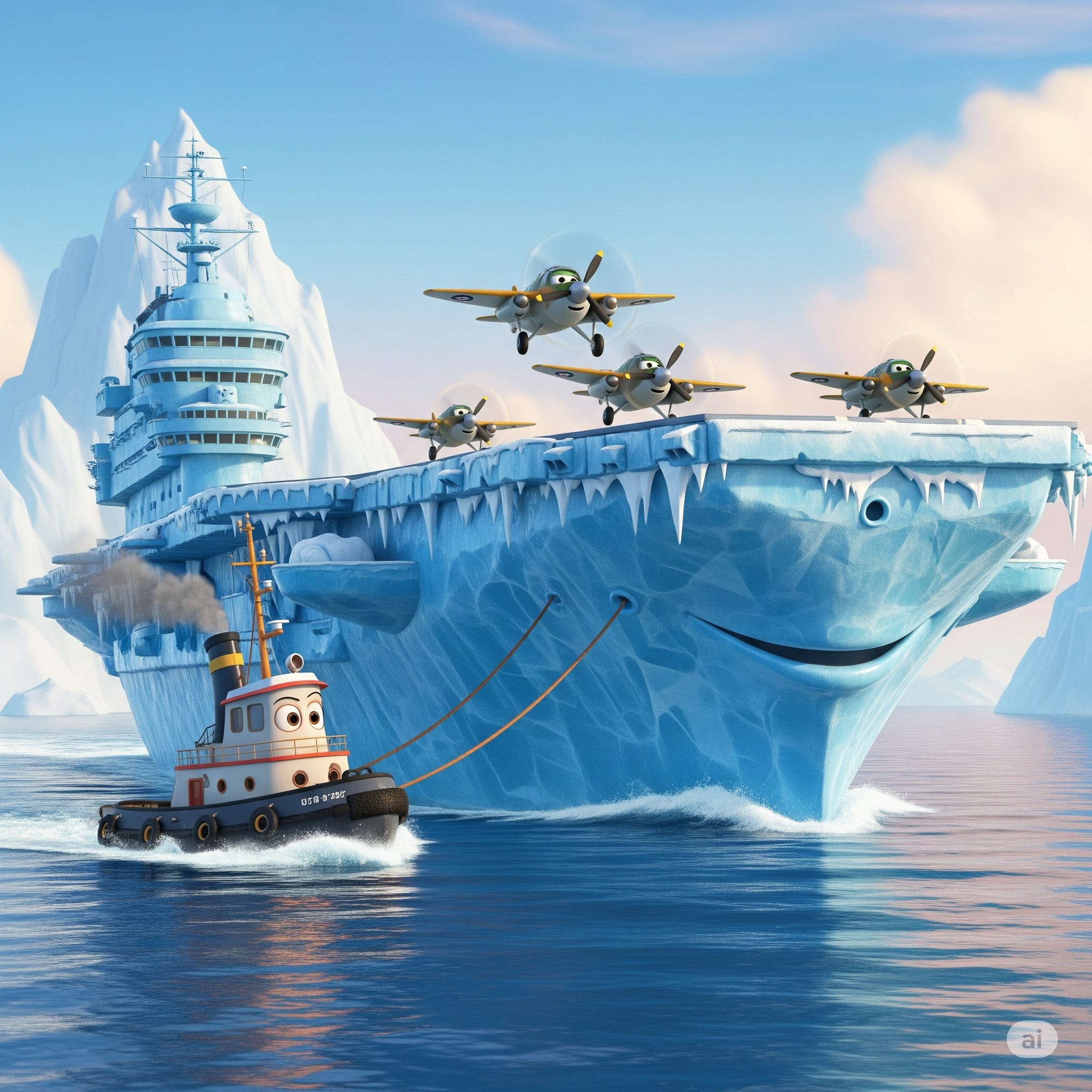
In the darkest days of World War II, the Allies faced a terrifyingly simple problem of geography. In the middle of the Atlantic Ocean, there was a vast, deadly zone known as the "mid-Atlantic gap." It was too far from land for Allied short-range patrol aircraft to reach, and in this blind spot, German U-boats hunted with impunity. They were sinking hundreds of supply ships, cutting off the vital flow of food, fuel, and soldiers to Europe. Winston Churchill knew that keeping these shipping routes open was the single highest priority.
When we think of the great technological leaps of WWII, our minds go to radar, jet engines, and the atomic bomb—innovations of steel, electronics, and immense power. But one of the most audacious plans, championed at the highest levels of the Allied command, involved two materials you're more likely to find in a forest and a freezer: wood pulp and ice.
This is the story of Project Habbakuk, the top-secret plan to build a fleet of massive, unsinkable aircraft carriers from a miraculous frozen material. It’s a story that seems absurd in hindsight, but it’s more than a historical curiosity. It’s a powerful lesson in how creativity, desperation, and collaboration intersect to push the boundaries of what we think is possible.
A Truly Radical Solution
The idea was born from the mind of Geoffrey Pyke, a brilliant but eccentric inventor working for the British Combined Operations Headquarters. He proposed a solution that was elegant in its simplicity. Steel was a scarce resource needed for tanks and ships, so why not use a material that was abundant and free? Why not use ice?
But not just any ice. Pyke championed a new super-material he called Pykrete.
Pykrete was essentially ice reinforced with a small amount of wood pulp—about 14 percent pulp to 86 percent water. When frozen, this mixture created a substance with almost magical properties. It was incredibly strong, melted far more slowly than regular ice, and was so resilient it could ricochet bullets.
The British Combined Operations Headquarters was intrigued. They code-named the plan Project Habbakuk (a misspelling of the biblical prophet Habakkuk) and envisioned a colossal floating airstrip made of this new material. The proposed ship would be 2,000 feet long, with a hull 40 feet thick, capable of carrying 150 aircraft. It would be a massive, inexpensive, and practically indestructible iceberg, a floating island of Allied power parked right in the middle of the U-boat hunting grounds.
From British Dream to Canadian Reality
While the idea was born in Britain, it was Canada that became the laboratory. With its cold winters and vast natural resources, it was the perfect place to see if this frozen dream could become a reality.
A secret prototype was constructed in Alberta to test the concept. Following that, Canada's National Research Council (NRC) was tasked with leading a consortium of Canadian universities and companies to figure out how to build a full-scale version.
This is where the simple idea met complex reality. The NRC's investigation concluded that a massive Pykrete ship was indeed possible, but it wouldn't be simple. To keep the structure from slowly melting, it would need a complex web of onboard refrigeration systems, heavy insulation, and a steel framework. What started as an "inexpensive" alternative to steel now required a hefty investment of its own.
The Thaw of an Idea
In the end, Project Habbakuk was not defeated by its engineering challenges. It was made obsolete by the relentless pace of innovation elsewhere.
As the NRC and its partners worked to solve the problems of building an ice ship, other technologies advanced rapidly. Radar improved, allowing for better U-boat detection. New, long-range patrol aircraft were developed that could cover the mid-Atlantic gap from land bases. The Allies built more escort ships to protect the convoys.
Technology had solved the original problem. The U-boat threat in the mid-Atlantic was neutralized, and the desperate need for a floating, frozen fortress vanished. Operation Habbakuk was quietly abandoned.
What an Ice Ship Teaches Us
It's easy to look back on Project Habbakuk and dismiss it as absurd. But that would be missing the point. The project was a testament to the "innovative, collaborative and desperate measures the Allies were willing to take to overcome challenges and end the war".
It teaches us that true innovation often requires the courage to explore ideas that seem outlandish. Faced with an unsolvable problem, the Allied command didn't just ask for a better version of what they already had; they were willing to entertain a proposal straight out of science fiction.
And while the great ice ship never sailed, the core material, Pykrete, found a practical, albeit smaller, application. It has since been used to strengthen remote, northern runways—a fitting legacy for an idea born in the cold. Project Habbakuk is a powerful reminder that even the most ambitious failures can pave the way for practical success, and that sometimes, the most radical ideas are the ones most worth exploring.