


The Invisible Front
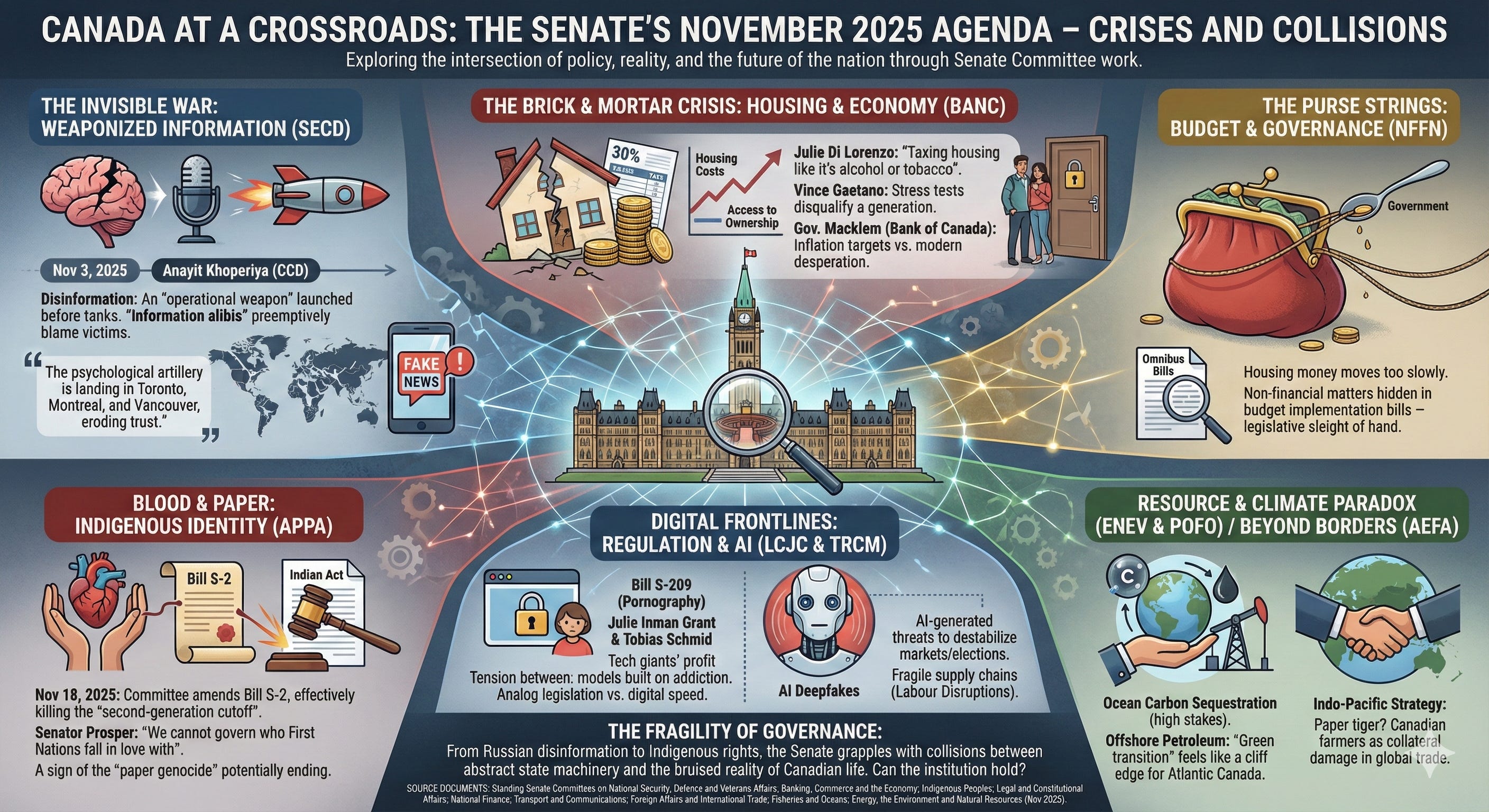
The war didn’t begin with a declaration. It began with a whisper, amplified a million times until it became a roar. On Monday, November 3, 2025, inside the wood-panelled quiet of the Senate Committee on National Security, Defence and Veterans Affairs (SECD), the reality of this new combat was laid bare. The witness was not a soldier, but Anayit Khoperiya from Ukraine’s Center for Countering Disinformation (CCD). Her testimony sent a chill through the room that had nothing to do with the Ottawa autumn.
“Disinformation became an operational weapon that was launched before tanks and missiles,” Khoperiya stated, her voice steady but carrying the weight of a nation under siege. This was not about “fake news” or political spin. This was the “kinetic” weaponization of information, designed to fracture alliances and justify aggression before the first shot was fired. She described “information alibis”—pre-emptive lies designed to blame the victim for crimes the aggressor is about to commit.
The committee, chaired by Senator Hassan Yussuff, listened as the CCD described a “whole-of-society” battle. The frontline is everywhere—from the localized comment sections of Canadian news sites to the encrypted channels of Telegram. As Senator McNair and Senator Cardozo probed the witnesses, the terrifying implication settled over the room: the tanks may be in Ukraine, but the psychological artillery is landing in Toronto, Montreal, and Vancouver, eroding the very trust required to govern.
The Brick and Mortar Crisis
While the security committee scanned the horizon for invisible threats, the Banking, Commerce and the Economy Committee (BANC) was grappling with a crisis visible on every street corner. The “Canadian Dream”—the simple promise that hard work leads to a secure home—is disintegrating.
Throughout late October and early November, the committee turned its gaze to the housing crisis, calling in the heavy artillery of the financial world. On October 30, the testimony was blistering. Julie Di Lorenzo, President of Mirabella Development Corporation, did not mince words. She described a system where “fees, levies, and taxes” now account for nearly 30% of the cost of a new home. The culprit, in her view, is not just the market, but the government itself.
“We are taxing housing like it’s alcohol or tobacco,” one witness remarked, highlighting the absurdity of penalizing a basic human right.
Vince Gaetano of Owl Mortgage and Jordan Kupinsky of Windsor Private Capital laid out the financial carnage: a generation of buyers disqualified by stress tests that no longer reflect reality, and developers unable to build because financing has dried up.
The dialogue exposed a growing chasm between the “ancient mandate” of the Bank of Canada, defended by Governor Tiff Macklem on November 6, and the modern desperation of a generation locked out of ownership. The Governor spoke of inflation targets; the Senators spoke of survival.
The Purse Strings
The housing crisis bled into the National Finance Committee (NFFN), where the abstraction of the “Main Estimates” met the hard reality of policy failure. On November 18, the committee dissected federal programs intended to support housing creation. The consensus? The money is moving too slowly.
But the rot went deeper. On November 19, the committee turned its attention to the practice of stuffing “non-financial matters” into budget implementation bills. It is a legislative sleight of hand that allows governments to pass controversial laws without proper scrutiny. The Senators peeled back the layers of these omnibus bills, revealing a government trying to move a mountain with a spoon, while the citizens outside wait in the cold.
Blood and Paper
On Tuesday, November 18, the abstraction of policy collided with the visceral reality of identity in the Committee on Indigenous Peoples (APPA). The subject was Bill S-2, a piece of legislation intended to amend the Indian Act. For decades, the “second-generation cutoff” has acted as a slow-motion extinction event, stripping legal status from the grandchildren of those who married out.
The government, represented by Indigenous Services Minister Mandy Gull-Masty, had urged caution. Pass the bill as is, she pleaded. Don’t risk the delay. But the committee, led by the impassioned arguments of witnesses and Senators like Paul Prosper, refused to accept half-measures.
“We cannot govern who First Nations fall in love with,” Senator Prosper declared, his voice cutting through the bureaucratic caution. “This change says, love who you love and do not worry because your children will not fall by the wayside.”
In a rare and dramatic defiance of the Minister’s request, the committee voted ten to one to amend the bill, effectively killing the cutoff. It was a moment of legislative courage that underscored the Senate’s unique power: to be the “sober second thought” that refuses to trade rights for expediency. For the families watching—some of whom had fought this battle for fifty years—it was the first sign that the “paper genocide” might finally be ending.
The Darkest Corners
The fight for the future didn’t stop at physical borders or bloodlines. In the Legal and Constitutional Affairs Committee (LCJC), the battleground shifted to the darkest corners of the digital world.
The study of Bill S-209, aiming to restrict youth access to online pornography, brought international heavyweights like Julie Inman Grant, Australia’s e-Safety Commissioner, and Tobias Schmid from the German Media Authorities to the table. The tension here was palpable: how does a democracy police the internet without becoming a surveillance state?
Witnesses described a “wild west” of content distribution where profit models are built on addiction. The exclusion of “internet mediators” from the bill sparked fierce debate. Amy Awad from Canadian Heritage faced tough questions on why the legislation seemed to lack the teeth to bite the tech giants. The testimony revealed a terrifying gap between the speed of digital harm and the sloth of analog legislation.
The Machine and the Mind
The theme of technology outpacing democracy continued in the Transport and Communications Committee (TRCM). On November 25, the committee dove into the “Opportunities and challenges of artificial intelligence.”
If the SECD committee identified the threat of disinformation, the TRCM committee was tasked with understanding the tool. Witnesses described a near-future where AI-generated deepfakes could destabilize markets and elections within minutes. The committee also grappled with the immediate economic threat of labour disruptions in the rail and marine sectors on November 19, hearing from the Canada Industrial Relations Board about the fragile supply chains that bind the nation together.
The Resource Dilemma
Finally, the Energy (ENEV) and Fisheries (POFO) committees grappled with the physical reality of Canada’s land and water.
On October 30, the Fisheries committee explored the frontier of “ocean carbon sequestration.” Witnesses Abed El Rahman Hassoun (GEOMAR) and Anya Waite (Ocean Frontier Institute) described a high-stakes gamble: using the ocean to absorb our carbon sins. It is a scientific frontier that offers salvation but carries unknown ecological risks.
Meanwhile, the Energy committee’s study on Newfoundland and Labrador’s offshore petroleum industry highlighted the eternal Canadian paradox: a nation committed to climate goals yet economically tethered to resource extraction. Witnesses described an industry trying to navigate a “green transition” that often feels more like a cliff edge. The tension between economic survival for Atlantic Canada and the environmental imperatives of the 21st century was not resolved—only exposed.
Beyond Our Borders
While domestic fires burned, the Foreign Affairs Committee (AEFA) looked outward. On November 19, the committee scrutinized the Indo-Pacific Strategy. Weldon Epp, Assistant Deputy Minister for the region, faced questions about whether Canada’s “strategy” was merely a paper tiger.
Earlier in the month, on November 6, the committee heard from the Canadian Cattle Association and the Grain Growers of Canada. Their message was clear: ideology cannot eat. They warned that Canada’s trade relationships are being jeopardized by a lack of pragmatic engagement, leaving Canadian farmers as the collateral damage in a global diplomatic game.
The Fragility of Governance
From the existential threat of Russian information warfare to the intimate definition of Indigenous identity, the Senate’s work in November 2025 reveals a nation at a crossroads.
The transcripts tell a story of a government fighting to maintain relevance. Whether it is the “operational weapon” of lies, the crushing weight of a mortgage, or the right to pass one’s heritage to a child, the stakes are total. The Senate, often dismissed as a sleepy chamber of review, has become the arena where these collisions occur—a place where the abstract machinery of the state meets the bruised and battering reality of Canadian life. The question remains: can the institution hold, or will the pressure from without and within finally crack the foundation?
Source Documents
Standing Senate Committee on National Security, Defence and Veterans Affairs. (2025, November 3). Evidence: Impacts of Russia’s disinformation on Canada. Senate of Canada. https://sencanada.ca/en/content/sen/committee/451/secd/05ev-57314-e
Standing Senate Committee on Banking, Commerce and the Economy. (2025, October 30). Evidence: Housing Crisis. Senate of Canada. https://sencanada.ca/en/content/sen/committee/451/BANC/11EV-57310-E
Standing Senate Committee on Banking, Commerce and the Economy. (2025, November 5-6). Evidence: Housing Crisis & Bank of Canada. Senate of Canada. https://sencanada.ca/en/content/sen/committee/451/BANC/12EV-57326-E
Standing Senate Committee on Indigenous Peoples. (2025, November 18). Bill S-2, An Act to amend the Indian Act. Senate of Canada. https://sencanada.ca/en/content/sen/committee/451/APPA/11EV-57316-E
Standing Senate Committee on Legal and Constitutional Affairs. (2025, October 29; November 6). Bill S-209, An Act to restrict young persons’ online access to pornographic material. Senate of Canada. https://sencanada.ca/en/content/sen/committee/451/LCJC/11EV-57311-E
Standing Senate Committee on National Finance. (2025, November 18). Evidence: Main Estimates. Senate of Canada. https://sencanada.ca/en/content/sen/committee/451/NFFN/06EV-57249-E
Standing Senate Committee on National Finance. (2025, November 19). Evidence: Non-financial matters in budget bills. Senate of Canada. https://sencanada.ca/en/content/sen/committee/451/NFFN/16EV-57317-E
Standing Senate Committee on Transport and Communications. (2025, November 19). Evidence: Labour disruptions. Senate of Canada. https://sencanada.ca/en/content/sen/committee/451/TRCM/08EV-57318-E
Standing Senate Committee on Transport and Communications. (2025, November 25). Evidence: Artificial Intelligence. Senate of Canada. https://sencanada.ca/en/content/sen/committee/451/TRCM/07EV-57305-E
Standing Senate Committee on Foreign Affairs and International Trade. (2025, November 6; November 19). Evidence: Indo-Pacific Strategy & Trade. Senate of Canada. https://sencanada.ca/en/content/sen/committee/451/AEFA/09EV-57309-E
Standing Senate Committee on Fisheries and Oceans. (2025, October 30). Evidence: Ocean carbon sequestration. Senate of Canada. https://sencanada.ca/en/content/sen/committee/451/POFO/08EV-57308-E
Standing Senate Committee on Energy, the Environment and Natural Resources. (2025, November 25). Evidence: Offshore petroleum industry. Senate of Canada. https://sencanada.ca/en/content/sen/committee/451/ENEV/09EV-57321-E