

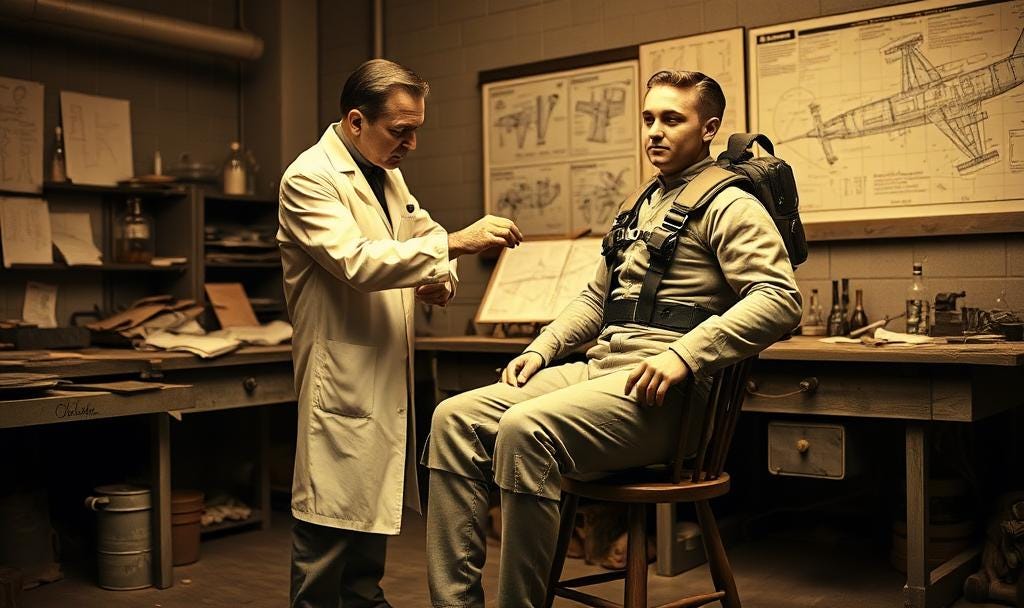
The Second World War was a crucible of aeronautical innovation. Aircraft were becoming faster and more powerful than ever before, pushing the boundaries of what was mechanically possible. But in doing so, they revealed a new, more fragile limit: the human body.
Pilots in high-speed dogfights or pulling out of steep dives were encountering a terrifying, invisible enemy. As their planes executed high-G maneuvers, they would suddenly experience tunnel vision, then a complete blackout. They were losing consciousness for critical, life-or-death seconds. The problem was physiological. The immense gravitational forces, or G-forces, were making it impossible for the heart to pump enough blood up to the brain. The machine was willing, but the pilot’s body was failing.
Solving this problem fell to an associate committee on aviation medical research, led by a Canadian scientist named Dr. Wilbur Franks. He had taken over the work after his renowned mentor, Sir Frederick Banting (the co-discoverer of insulin), died in a 1941 plane crash. Franks inherited a critical mission: find a way to keep pilots conscious when their bodies were being subjected to forces that nature never intended them to withstand. His solution would be unconventional, uncomfortable, and utterly brilliant.
This is the story of how a strange, water-logged suit, first tested on mice with household items, became one of the most crucial pieces of safety equipment in modern aviation and space flight.
The Invisible Enemy
Imagine a force so strong it literally pulls the blood from your head. That was the reality for fighter pilots. In a tight turn, a pilot could experience forces many times that of normal gravity. Under these conditions, the heart, a remarkable pump, simply cannot generate enough pressure to push oxygenated blood "uphill" to the brain against that crushing force.
The result is G-LOC: G-induced Loss of Consciousness. The pilot would slump over the controls, their plane flying wild, a defenseless target for the enemy. Solving this wasn't a matter of building a better engine or a stronger airframe; it was a problem of human plumbing. The military needed a way to help the pilot's cardiovascular system fight back against physics.
A Bizarre, Water-Logged Solution
Dr. Franks theorized that if you could apply external pressure to the lower body, you could prevent blood from pooling in the legs and abdomen, thereby making it easier for the heart to keep it circulating to the brain. His first attempt at a solution was startlingly simple: a suit filled with water. The water, being incompressible, would press firmly on the legs and abdomen during high-G maneuvers, creating the necessary counter-pressure.
To test his theory, Franks began with mice. In a display of wonderfully practical science, his preliminary tests involved surrounding the mice with water-filled condoms to create a tiny, functional G-suit.
After the successful mouse trials, it was time for a human subject. Franks volunteered himself.
He subjected himself to tests in aircraft, personally enduring the immense gravitational forces he was trying to defeat.
This was not theoretical, arms-length research. Franks was in the cockpit, experiencing the gray-outs and gut-wrenching pressure, all to validate his water-filled contraption. His courage and hands-on approach proved the concept worked. The "Franks Flying Suit" was born.
From Water to Air, and into Combat
While effective, water was heavy and impractical for daily use. Later designs, developed by the NRC and its partners, replaced the water with an inflatable bladder system that used air pressure to achieve the same effect. This made the suit lighter, more comfortable, and more reliable for pilots.
The invention didn't stay in the lab for long. The stakes were too high.
The Franks Flying Suit was first used in combat by the British during military operations in North Africa in 1942.
It gave Allied pilots a distinct advantage, allowing them to perform more aggressive maneuvers without blacking out, a capability that could mean the difference between victory and defeat in a dogfight.
The anti-gravity suit was one of many crucial projects the National Research Council initiated to protect aircrews during the war, a direct response to a deadly problem identified on the front lines.
A New Perspective
Today, every fighter pilot and astronaut wears a modern descendant of Dr. Franks's invention. The technology is more advanced, but the core principle remains exactly the same: use external pressure to fight the crushing force of acceleration.
It is a powerful reminder that sometimes the most elegant solutions to complex, high-tech problems are born from simple physical insights, a willingness to experiment with unconventional materials, and the courage to test those ideas on yourself. The next time you see footage of a pilot in a G-suit or an astronaut launching into orbit, remember Dr. Wilbur Franks and his bizarre, water-filled suit—a Canadian invention that conquered gravity and changed flight forever.