

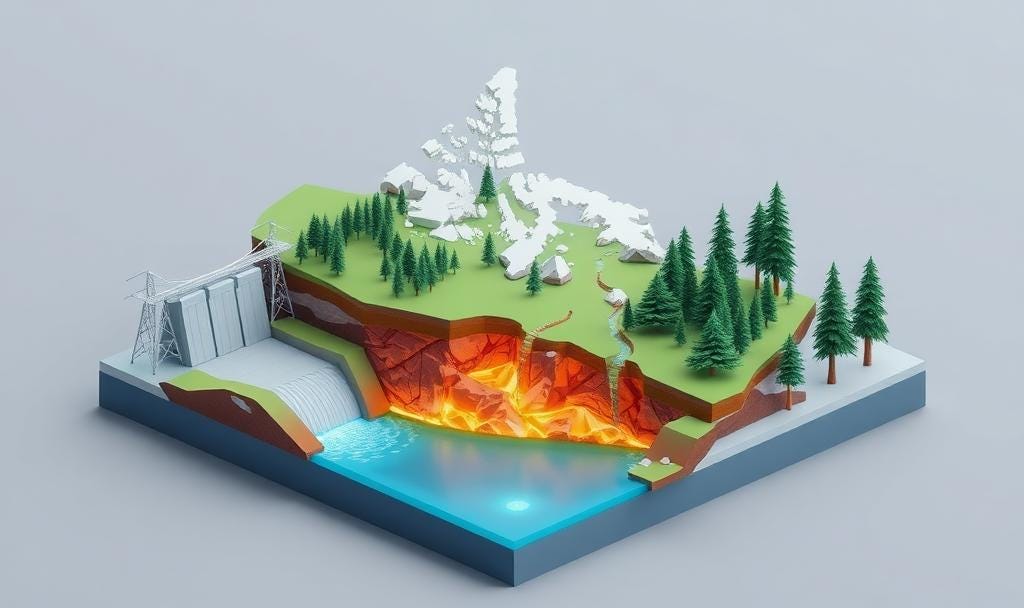
Discussions about the Canadian economy can feel overwhelming. We hear about inflation, housing bubbles, interest rates, and trade deals. It’s a complex web, and it’s easy to get lost in the details. But what if you could cut through the noise with a simple framework that explains the fundamental engine of the country’s wealth?
Beneath the surface of daily headlines lies the bedrock of Canada’s economic power: its natural resources. Understanding this sector isn’t just for economists or policymakers. Understanding it is a cheat code to grasping how Canada truly operates on the world stage.
This is your playbook. We will break down Canada’s vast natural resource economy into three simple, memorable pillars. By the end of this article, you’ll have the key numbers and facts to understand the stories behind the news.
The Big Picture: The Sheer Scale of Resources
Before we break it down, let’s grasp the overall scale. When we talk about Canada's "natural resource sector," we are talking about a gargantuan part of the national economy.
Contribution to GDP: The sector accounts for about 17.8% of Canada's nominal GDP, which was $480 billion in 2023.
Jobs: It employs roughly 1.7 million Canadians, making up nearly 8.5% of all jobs in the country in 2023.
Exports: It provides a staggering 52% of all of Canada's merchandise exports, valued at $370 billion in 2023.
Now, let's break that down into our three pillars.
Pillar 1: Energy (The Engine)
This is the heavyweight. The energy sector is the primary engine of the resource economy, driving a massive share of our exports and economic activity. When you hear about pipelines, oil prices, or our electricity grid, it all falls under this pillar.
The Numbers:
GDP: 10.3% of Canada’s total GDP ($279 billion in 2023).
Jobs: 697,000 direct and indirect jobs.
Exports: $207.2 billion in 2024, accounting for 29% of Canada's total merchandise exports.
The Story You Need to Know: Canada is an energy superpower in multiple categories. It’s the world's 4th largest producer of crude oil and 5th largest producer of natural gas. But here's the surprising part: it's also the 3rd largest producer of hydroelectricity , and roughly 80% of Canada's entire electricity mix already comes from renewable and non-emitting sources.
Pillar 2: Lands & Minerals (The Foundation)
This pillar is the foundation for our technological world. It includes everything from the potash that fertilizes global crops to the critical minerals that power your phone and electric vehicles. It's less talked about than energy, but it's fundamental to modern life and a huge source of employment.
The Numbers:
GDP: 6% of Canada’s total GDP ($159 billion in 2023).
Jobs: 711,000 direct and indirect jobs.
Exports: $151 billion in 2023, accounting for 21% of total merchandise exports.
The Story You Need to Know: Canada is the undisputed global leader in potash production. It also ranks in the top five for producing cobalt, diamonds, gold, nickel, and uranium. This sector is also a leader in Indigenous employment, with Indigenous peoples accounting for 11% of the mining workforce in the 2021 census—one of the highest representations of any industry.
Pillar 3: Forests (The Framework)
The forest sector is the most visible of our resources. It provides the lumber for our homes and the pulp for paper products. While it’s the smallest of the three pillars in terms of GDP, it is the backbone of hundreds of communities across the country.
The Numbers:
GDP: 0.9% of Canada’s total GDP ($21.5 billion in 2024).
Jobs: 352,000 direct and indirect jobs.
Exports: $37 billion in 2024, accounting for 5.1% of total merchandise exports.
The Story You Need to Know: Canada's forests cover half the country, representing 9% of the world's total forests. The sector is crucial for rural Canada, supporting nearly 300 forest-reliant communities. Crucially, Canada has the largest area of third-party certified sustainable forests in the world , and less than 1% of the country’s forested area is harvested each year.
Your New Playbook
There you have it. Three pillars: Energy, Minerals, and Forests.
By keeping this simple framework in your mind, you now have a powerful tool to make sense of the world. When you hear about a new trade deal with the U.S., you’ll know that energy and mineral exports are a massive part of that equation. When you read about building a new battery plant in Ontario, you’ll understand it connects back to the strength of our mineral sector. And when you hear about challenges in a rural community, you might check if it’s one of the 300 that relies on the forest sector.
You now have the playbook for understanding the engine room of the Canadian economy.