


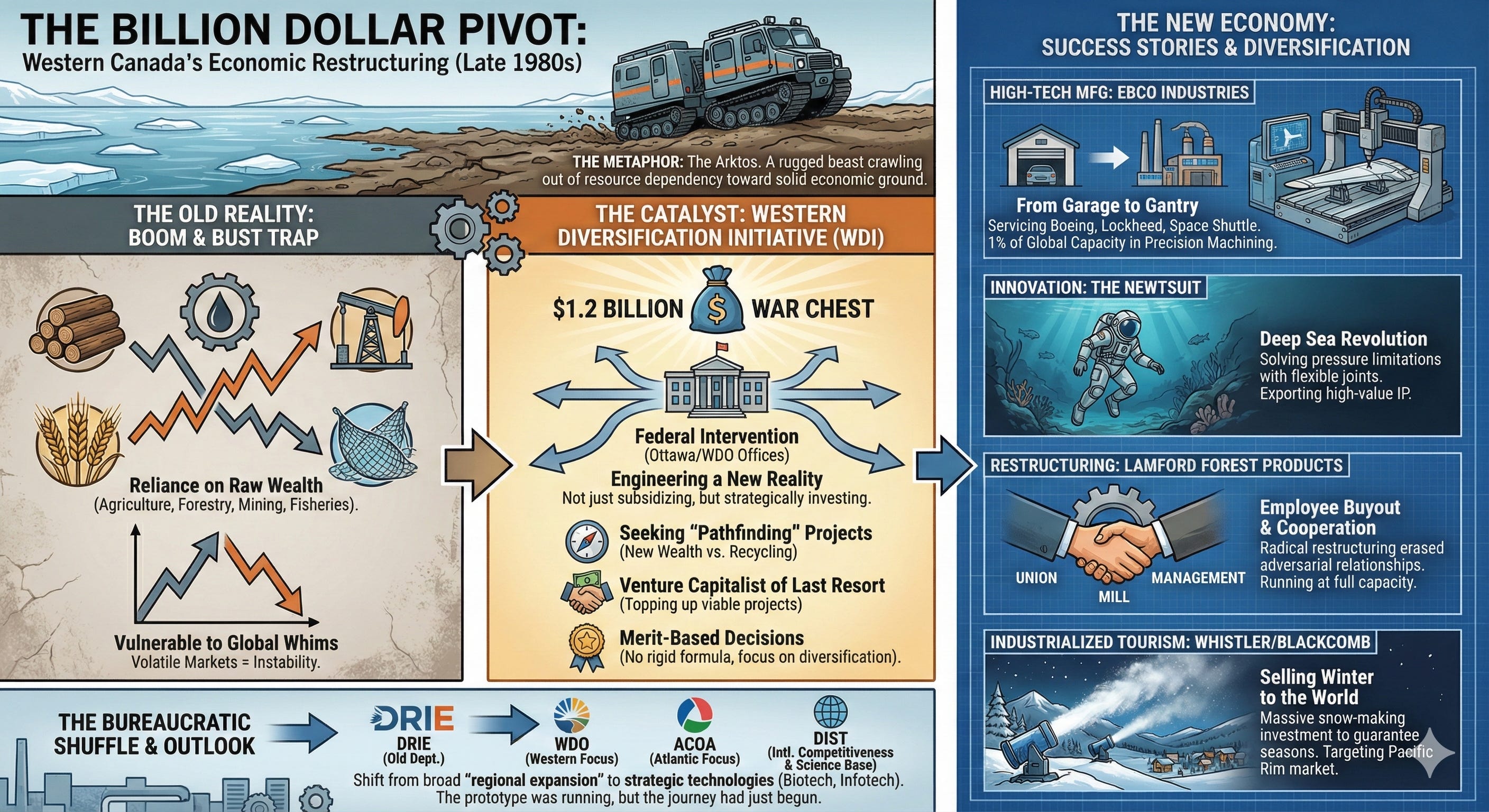
The Mackenzie River is not a forgiving place for a test drive. In June 1986 a strange machine crawled out of the Beaufort Sea and onto the ice at Tuktoyaktuk. It looked like a tank designed by a surrealist, a fifteen-tonne articulated beast composed of two enclosed units linked by a beam. It had navigated two hundred kilometers of river and ice fields from Inuvik without outside assistance. It was called the Arktos.
Named after the Greek word for polar bear, the amphibious craft was more than just a prototype escape vehicle for oil rig workers. It was a metaphor for the economy of Western Canada in the late 1980s: rugged, isolated, and trying desperately to maneuver through treacherous rubble fields toward solid ground.
By the spring of 1988 the Canadian West was attempting a difficult pivot. For a century the provinces of British Columbia, Alberta, Saskatchewan, and Manitoba had relied on the raw wealth of the land. Agriculture, forestry, mining, and fisheries had built the country. But the global markets were fickle. Prices fluctuated violently. The result was a “boom and bust” cycle that left the region’s employment growth and social stability at the mercy of international whims.
The federal government’s solution was a massive bureaucratic and financial intervention known as the Western Diversification Initiative. With a war chest of $1.2 billion, Ottawa was trying to engineer a new economic reality. They were no longer just subsidizing mines and mills. They were betting on atmospheric diving suits, aerospace components, and artificial snow.
The Billion Dollar pivot
The centerpiece of this strategy was the Western Diversification Program. Headquartered in Edmonton with offices in Winnipeg, Saskatoon, and Vancouver, the program represented a shift in how Ottawa handled the West. It was an admission that the old ways of doing business were failing.
The program was designed with intentional ambiguity. John Hansen, the Acting Assistant Deputy Minister of the Western Diversification Office in Vancouver, was candid about the lack of a rigid formula. The $1.2 billion fund was not allocated by a set calculation among the four provinces. Decisions were to be made on the merit of specific projects. The criterion was simple but demanding: the project had to diversify the economy.
This flexibility was essential because the demand was overwhelming. By early 1988 the government had already received over twenty thousand calls and nine hundred proposals. The mandate was to find “pathfinding” projects—ventures that would not just recycle money within the country but bring new wealth into it.
This meant funding service industries and resource-related technology, not just extraction. It meant looking at non-profit business organizations. It meant “topping up” projects that were nearly viable but needed that final push to survive the skepticism of private lenders. The government was effectively acting as a venture capitalist of last resort for an entire region.
From Garage to Gantry
One of the clearest beneficiaries of this new philosophy was Ebco Industries Ltd. in Richmond, British Columbia. The company had humble beginnings. In 1956 Helmut and Hugo Eppich started a tool and die shop in a Vancouver garage. By the 1980s they had grown into a conglomerate, but they were hitting a ceiling.
The Eppichs saw the future in aerospace. They prepared to launch a massive expansion in 1981, aiming to service the high-tech needs of modern aircraft manufacturers. Then the recession hit. Investors panicked. Aerospace ventures were viewed as high-risk gambles, and the capital markets froze Ebco out. The expansion was put on hold.
It took five years for the ice to thaw. In early 1986 the federal government stepped in with a contribution of over thirteen million dollars under the Defence Industry Productivity Program. It was the signal the private equity markets needed. The government’s buy-in lowered the perceived risk, allowing Ebco to tap into private capital.
By 1988 the result was a four-thousand-square-meter facility in Delta, equipped with four massive, computerized gantry profilers. These machines were rare; there were only about three hundred and fifty of them in the world. Ebco suddenly controlled one percent of the global capacity for this specific type of high-precision machining. They were no longer just a local machine shop. They were manufacturing prototypes for Boeing, Lockheed, and General Electric. They were building components for defense systems and looking toward the space shuttle program. The government’s thirteen million dollars was projected to generate five hundred million dollars in sales over the next decade.
The Deep Sea Revolution
While Ebco looked to the sky, another Vancouver innovator was looking into the abyss. International Hard Suits Inc. had spent years trying to solve a physiological problem that had plagued commercial diving for decades: pressure.
Deep-sea divers were limited by the human body’s frailty. They could only work for a few hours at a time and required days of decompression in special chambers to avoid the bends. It was slow, dangerous, and incredibly expensive.
Phil Nuytten and his team developed the Newtsuit. It was a lightweight atmospheric diving suit that maintained internal pressure at depths of up to three hundred meters. Unlike previous rigid suits that left divers moving like rusted robots, the Newtsuit utilized a breakthrough in flexible joint technology. It allowed for unprecedented dexterity. A pilot inside a Newtsuit could work for extended periods and return to the surface without the need for decompression.
This invention won the company a Bronze Award in the invention category of the Canada Awards for Business Excellence. More importantly, it positioned Canada as a potential world leader in submersible technology. It was exactly the kind of diversification the government was desperate to encourage: high-value intellectual property that could be exported to the world, completely independent of the price of lumber or crude oil.
Survival of the Fittest
Not every success story was about high-tech invention. Some were about sheer survival and the restructuring of labor.
In New Westminster, Lamford Forest Products represented a different kind of experiment. In the summer of 1984 its predecessor company went bankrupt. Three hundred people lost their jobs. In the brutal economic climate of the mid-80s, that should have been the end of the story.
But a group of former employees refused to accept the closure. They believed the mill was still viable. They drew up an operating strategy and took it to their union. The result was a radical restructuring: the management and the union joined forces to buy the company.
By January 1986 Lamford was back in operation. Every employee was a shareholder; to be a shareholder, one had to be an employee. The traditional adversarial relationship between labor and management was erased by necessity. They shared profits and they shared the work. By 1988 the mill was running at full capacity with two shifts and no layoffs. They were exceeding their forecasted performance levels. The federal government recognized this achievement with a Gold Award for Labour/Management Co-operation, holding it up as a model for an industry that was often paralyzed by strikes and lockouts.
The Bureaucratic Shuffle
Behind these individual success stories, the machinery of government was undergoing a profound transformation. The Department of Regional Industrial Expansion (DRIE), the agency responsible for these programs, was being dismantled.
Prime Minister Brian Mulroney had announced the creation of a new flagship department: the Department of Industry, Science and Technology (DIST). This was not just a name change. It was an admission that the old “regional expansion” model was too broad and unwieldy.
Robin Dodson, the Regional Executive Director for DRIE in British Columbia, described the shift as a fundamental change in approach. The old department had tried to pursue regional development and national industrial policies simultaneously. It hadn’t worked. The experience of the previous five years had proven the difficulty of serving two masters.
The solution was to split the mandate. Regional development would be handed off to specific agencies: the Atlantic Canada Opportunities Agency (ACOA) in the east and the Western Diversification Office (WDO) in the west. The new central department, DIST, would focus strictly on “international competitiveness” and “industrial excellence.”
The language was shifting. It was no longer about “support” or “expansion.” It was about “strategic technologies”—biotechnology, information technology, and advanced industrial materials. The government was trying to pivot the entire Canadian economy from a resource base to a science base.
Selling Winter to the World
The diversification effort extended beyond factories and laboratories. Tourism was being aggressively industrialized. The government recognized that the Pacific Rim was not just a destination for exports but a source of wealthy visitors.
Japan was identified as the market with the greatest potential for growth. In 1986 visitor numbers from Japan had jumped nearly thirty-five percent. The government responded with a targeted marketing campaign, aiming at “silver age” travelers and young women. They were selling the vastness of the Canadian landscape.
At Whistler and Blackcomb Mountains, this marketing push was backed by heavy infrastructure investment. Nature was proving too unreliable for the international market. To guarantee a ski season of one hundred and eighty days, the resorts installed a massive snow-making system.
The project cost $4.5 million. A joint federal-provincial loan covered $3.2 million of that tag. The system, using “airless” guns that were quieter than traditional models, allowed snow production to happen at night near the village without waking the guests. The economic calculus was precise: the snow-making capability was expected to generate an additional ninety thousand skier visits in the first year alone, translating to $13.5 million in revenue. It was a factory approach to leisure.
The Long Road North
Back in the Arctic, the Arktos crawler was ready for production. Watercraft Offshore Canada Ltd., the Richmond-based company behind it, had moved into a larger facility. They were building units for the Canadian Coast Guard and looking at larger and smaller derivatives of the design.
Bruce Seligman, the president of Watercraft, noted that while others had spent more time and money trying to develop similar vehicles, his team had succeeded by synthesizing the best of sixty-three different concepts. It was a hybrid solution for a hybrid world.
This was the state of Western Canada in the spring of 1988. It was a region trying to synthesize a new identity. It was building specialized gears for spacecraft while still cutting cedar shakes for American roofs. It was selling high-tech diving suits while trying to market the rugged wilderness to Japanese tourists.
The government had poured over a billion dollars into the gas tank, hoping to drive the economy out of the mud. Like the Arktos, the region was attempting to crawl out of the icy grip of a resource-dependent past and find traction on the unstable ground of the future. The prototype was running, but the journey had only just begun.
Source Documents
Department of Regional Industrial Expansion. (1988, Spring). DRIE in British Columbia.