


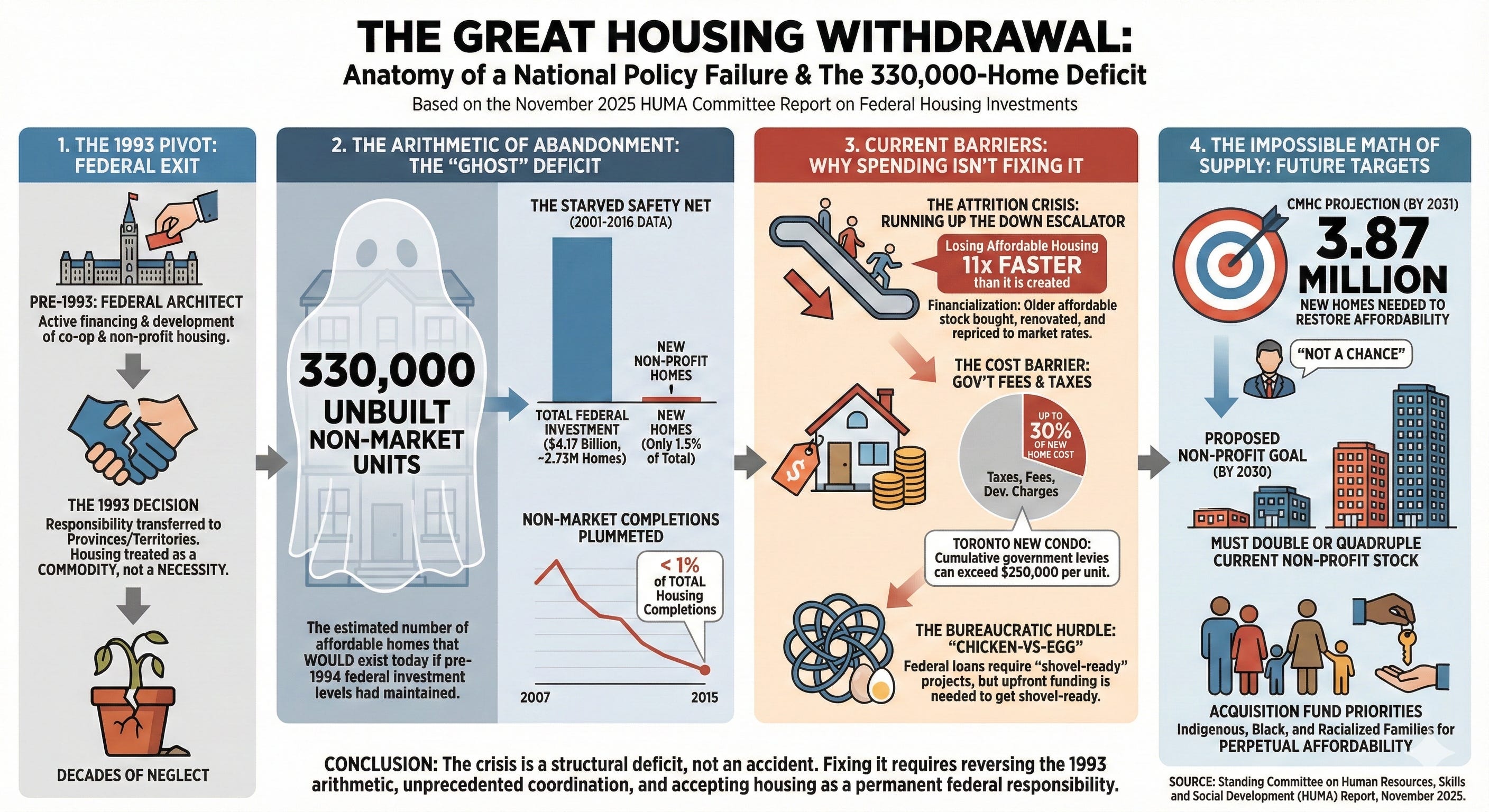
In the sprawling committee rooms of Parliament Hill, where policy is usually debated in the abstract language of percentages and jurisdictions, the ghosts of unbuilt homes took a seat at the table. It is November 2025. The Standing Committee on Human Resources, Skills and Social Development (HUMA) has released a report that reads less like a policy paper and more like an autopsy of a national policy failure.
The witnesses who appeared before the committee described a catastrophe decades in the making. They painted a picture of a federal government that, for thirty years, treated housing as a commodity rather than a necessity, allowing the nation’s stock of affordable units to wither. The numbers presented were stark. Between 2007 and 2015, non-market housing completions plummeted to less than one percent of total housing completions.
The testimony revealed a grim consensus: the crisis is not an accident of the market, but the mathematical result of a federal exit strategy executed in 1993. As the 45th Parliament confronts a housing shortage that threatens the social fabric of the country, the question is no longer just how to build more homes, but how to resurrect a role the government abdicated a generation ago.
The Arithmetic of Abandonment
To understand the current paralysis, one must look back to the mid-1960s. For three decades, the federal government was a primary architect of the Canadian housing landscape, financing and developing co-operative and non-profit housing at scale. This era ended abruptly in 1993 when Ottawa transferred responsibility for housing to the provinces and territories, effectively washing its hands of the file.
The consequences of this withdrawal were quantified with devastating precision by Steve Pomeroy of the Canadian Housing Evidence Collaborative. He told the committee that had the federal government maintained its pre-1994 investment levels, Canada would today possess an additional 330,000 units of non-market housing. Instead, those units exist only in the counterfactual history of a country that prioritized affordable living.
Even when the federal government re-engaged in the early 2000s, the capital did not flow where it was most needed. Between 2001 and 2016, federal investments totaled $4.17 billion, helping create roughly 2.73 million new homes. Yet, Pomeroy noted that a mere 1.5 percent of these investments were allocated to new non-profit homes. The market was fed, but the safety net was starved.
Carolyn Whitzman, a housing policy researcher from the University of Ottawa, framed the crisis as a collision of neglect and demography. She pointed out that while Canada’s population surged by 60 percent between 1976 and 2016, the supply of housing remained anemic. The record was “dire,” she testified, setting the stage for the chaotic market conditions of 2025.
The Impossible Math of Supply
The sheer scale of the construction required to fix this deficit borders on the fantastical. The Canada Mortgage and Housing Corporation (CMHC) has previously projected a need for 3.87 million homes by 2031 to restore affordability. When asked about the feasibility of this target, Richard Lyall of the Residential Construction Council of Ontario was blunt: there is “not a chance” it is attainable.
The obstacles are not merely physical but bureaucratic. Witnesses described a “chicken-versus-egg” dilemma within flagship federal programs like the Apartment Construction Loan Program. The program requires applicants to have “shovel-ready” projects to qualify for loans, yet securing the initial funding to reach that shovel-ready state is often impossible without the loan itself.
Furthermore, the definition of “affordable” remains a moving target. The committee heard repeated criticisms that federal funds often flow to projects that are not truly affordable to those in greatest need. André Castonguay of the Réseau québécois des OSBL d’habitation argued for a strict definition: housing costs should not exceed 30 percent of an individual’s gross income. Without this income-based anchor, the National Housing Strategy risks subsidizing units that remain out of reach for the working poor.
To make a dent in the crisis, Meg McCallum of the Alliance to End Homelessness Ottawa estimated that Canada must double its non-profit housing stock by 2030. Some reports suggest the stock needs to quadruple. In a market where non-market completions have hovered near zero for years, this demand requires a mobilization of resources unseen since the post-war era.
The Government Hand in the Developer’s Pocket
While the federal government pushes for more supply, industry experts argued that government fees are actively suppressing it. A significant portion of the cost of a new home, up to 30 percent, is composed of taxes, fees, and development charges levied by various levels of government.
Beau Jarvis, CEO of Wesgroup Properties, highlighted a perverse compounding effect: the federal government charges GST on development cost charges paid to municipalities. Effectively, Ottawa is taxing the taxes collected by city halls. In Toronto, the cumulative weight of these government levies on a new condominium can exceed $250,000. This pricing structure essentially locks first-time buyers out of the market before the first brick is even laid.
Witnesses proposed immediate tax reforms to unclog the pipeline. Suggestions included removing the GST from purpose-built rental projects and ensuring that federal funding, such as the Housing Accelerator Fund, is conditional on municipalities balancing their own tax structures. There were calls to shift the municipal tax burden away from new developments and onto existing homes through higher property taxes, a politically radioactive suggestion that nonetheless highlights the desperation for a solution.
The committee also heard that capital gains taxes act as a brake on reinvestment. Reducing this tax, or allowing for deferrals if the gains are reinvested into new rental construction, was pitched as a way to keep capital circulating within the housing sector rather than fleeing to other assets.
Running Up the Down Escalator
Perhaps the most alarming statistic presented to the committee came from Lori-Ann Gagne of Victoria Park Community Homes. She testified that Canada is losing affordable housing eleven times faster than it is being created. This attrition is largely due to the financialization of housing, where older, affordable rental buildings are purchased by investors, renovated, and repriced at market rates.
To combat this, housing advocates are calling for a robust “Acquisition Fund” to allow non-profits to purchase existing rental properties and take them out of the speculative market. Tim Richter of the Canadian Alliance to End Homelessness urged that this program operate on a massive scale to stop the “erosion” of the housing stock.
However, simply buying the buildings is not enough. The committee noted that an acquisition strategy must include funding for capital repairs. Many of the buildings available for acquisition are aging and require significant infrastructure investment, such as roofs, heating systems, and structural repairs, to remain habitable. Without money for maintenance, an acquisition fund would merely transfer liabilities from the private sector to the public ledger.
Proponents argued that these funds should be targeted aggressively. Recommendations included prioritizing housing for Indigenous, Black, and racialized families, and ensuring that acquired units remain affordable in perpetuity. Marie-Josée Houle, the Federal Housing Advocate, suggested that legislative changes are needed to allow non-market actors to leverage their assets, freeing them from total dependence on government cash flow.
The Federation’s Gordian Knot
Lurking beneath the funding debates is a structural dysfunction in Canadian federalism. Housing is a provincial jurisdiction, yet the fiscal power resides in Ottawa, and the zoning power sits with municipalities. This disconnect creates a system where responsibility is everywhere and nowhere.
Carolyn Whitzman summarized the imbalance: municipalities are responsible for approximately 70 percent of infrastructure but collect only 9 percent of tax revenues. New housing requires new sewers, roads, and transit, yet cities lack the fiscal capacity to build them without begging for transfers. The committee heard that growth in housing cannot happen without a parallel surge in infrastructure spending.
This fragmentation leads to a lack of coordination from the “30,000-foot level”. While the federal government attempts to incentivize construction through the Housing Accelerator Fund, it ultimately lacks the power to force zoning changes or expedite approvals at the local level. The committee’s report emphasizes the need for “better coordination,” a polite euphemism for the tangled mess of inter-jurisdictional squabbling that slows every project.
A House Divided
The committee’s report was not unanimous. The dissenting opinion from the Conservative Party of Canada offered a blistering critique of the Liberal government’s approach, labeling it a “failed” strategy that has rewarded bureaucratic gatekeepers.
The Conservatives focused on the Housing Accelerator Fund, noting that despite billions in spending, housing starts have actually declined in major recipients like Toronto and Vancouver. Their dissent argued that the fund does not build homes but rather subsidizes municipal dysfunction. Their proposed solutions pivot away from direct government investment and toward tax relief: cutting the GST on new homes under $1.3 million, eliminating the “Underused Housing Tax,” and tying infrastructure funding strictly to results rather than promises.
The Bloc Québécois, in their supplementary opinion, rejected the premise of federal intrusion altogether. They argued that the most effective solution is a single, unconditional transfer of funds to Quebec, allowing the province to manage its own housing strategy. They also called for lower interest rates to facilitate social housing construction and tougher anti-flipping legislation to cool the speculative market.
The Uncounted Crisis
As the committee concluded its work, a fundamental flaw in the government’s approach remained: the lack of data. Marie-Josée Houle warned that “we can’t count what we don’t know, and we can’t address what we’re not counting”. The report calls for a massive improvement in data collection, including tracking who is excluded from the housing market and providing transparency on the outcomes, not just the outputs, of federal spending.
The November 2025 report serves as both a confession and a roadmap. It confesses that the federal withdrawal of the 1990s was a catastrophic error that severed the supply of affordable homes. It provides a roadmap that requires unprecedented coordination, billions in targeted non-market investment, and a willingness to rewrite the tax code.
But as the dissenting opinions make clear, the political will to execute this roadmap is far from unified. Until the arithmetic of 1993 is reversed, and the federal government accepts that housing is a permanent responsibility rather than a temporary program, the ghosts of those 330,000 unbuilt homes will continue to haunt the market, leaving millions of Canadians paying the price for a generation of neglect.
Source Documents
Standing Committee on Human Resources, Skills and Social Development and the Status of Persons with Disabilities. (2025, November). Federal Housing Investments [Report]. House of Commons Canada.