


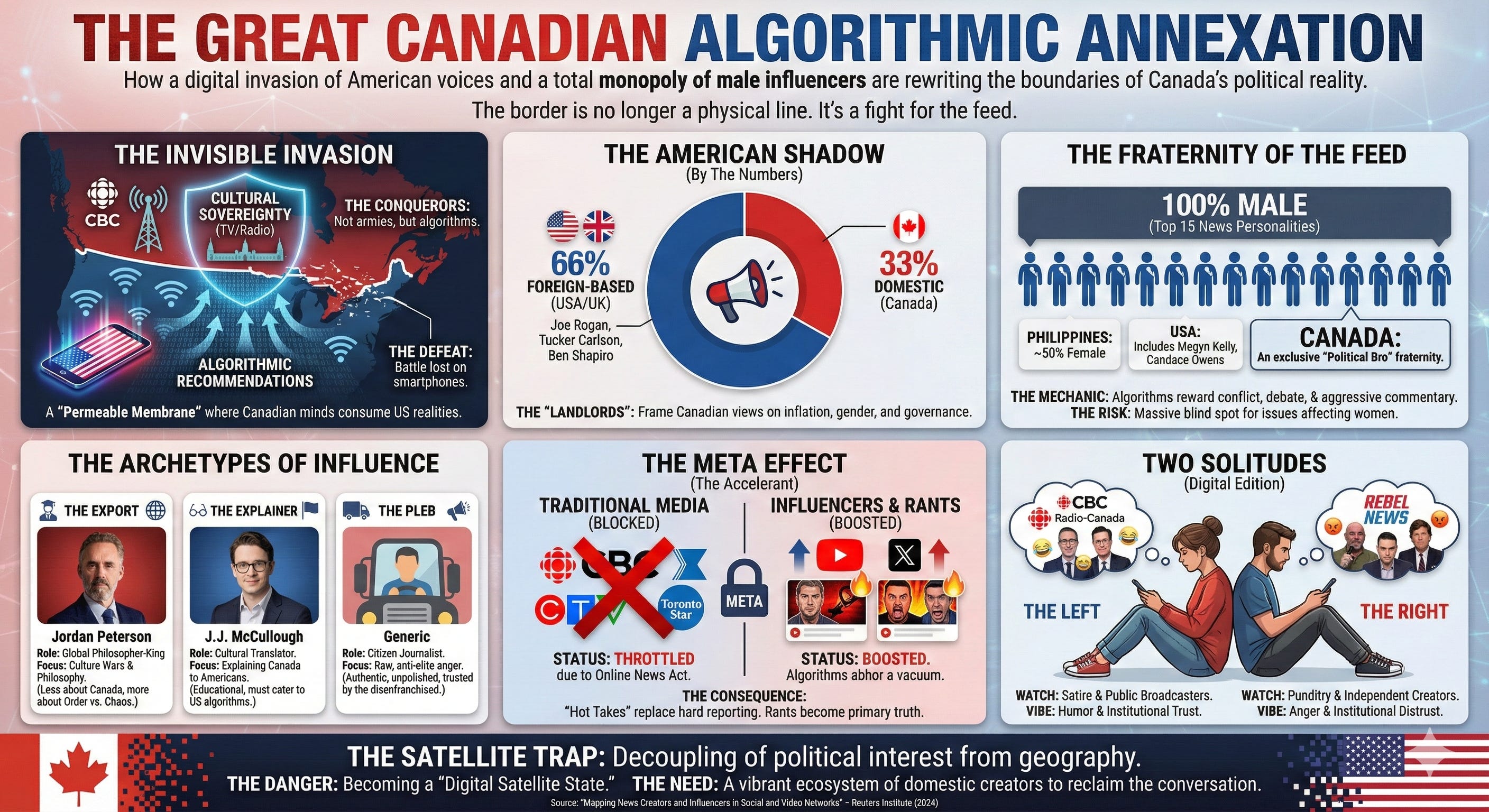
The border is no longer a physical line of demarcation. It does not stop at the Niagara River or the 49th parallel. In the digital age, the border is a permeable membrane, and for the Canadian mind, it has effectively ceased to exist. For decades, Ottawa has obsessed over cultural sovereignty, pumping billions into the CBC and erecting regulatory seawalls to protect Canadian stories. Yet, on the glowing screens of millions of smartphones from Vancouver to Halifax, that battle is already over. The conquerors are not invading armies, but algorithmic recommendations.
A sweeping new analysis of the global information ecosystem has laid bare a startling reality about how Canadians consume news. The data paints a portrait of a nation whose digital attention has been annexed. When Canadians open YouTube or scroll through X (formerly Twitter) for news, they are not looking at their own reflection. They are staring into a mirror that reflects the United States back at them.
In a landscape where attention is the only currency that matters, domestic creators are being drowned out. The most influential voices shaping Canadian political discourse are not broadcasting from Toronto or Montreal. They are podcasting from Austin, Texas, and streaming from Florida. The implications for national identity, political stability, and the very concept of a shared Canadian reality are profound.
The American Shadow
The numbers are stark and unrelenting. Among the top fifteen individuals that Canadians cite as their primary sources for news and commentary on social networks, the majority are not Canadian. Two-thirds of the list is comprised of personalities based in the United States or the United Kingdom.
This is not merely a matter of entertainment. These are the voices shaping how Canadians interpret inflation, immigration, gender dynamics, and governance. Topping the list of attention-getters are figures like Joe Rogan, the podcaster whose conversational sprawl has become the de facto town square for millions of young men, and Tucker Carlson, the conservative firebrand who now operates a digital-first empire. Ben Shapiro, Elon Musk, and Donald Trump himself appear frequently in the Canadian diet.
While other countries in the study, such as Brazil, India, and South Africa, boast vibrant ecosystems of domestic news creators who challenge their local mainstreams, Canada stands out for its importation of narratives. The Canadian digital public square is being sublet to American landlords. The report suggests that for a significant portion of the population, particularly those leaning to the political right, the “mainstream media” is no longer the CBC or the Globe and Mail. It is a constellation of American alternative media stars who peddle a specific brand of anti-establishment rhetoric that transcends national borders.
This phenomenon suggests a decoupling of political interest from political geography. A Canadian viewer in Alberta may feel more ideological kinship with a podcaster in Miami than with a journalist in Ottawa. The shared grievances regarding free speech, “woke” culture, and institutional distrust have created a transnational audience where the American accent is the default voice of resistance.
The Fraternity of the Feed
Beyond the Americanization of the feed, the data reveals a demographic monopoly so absolute it borders on statistical improbability. Of the top fifteen news personalities and creators identified by Canadian respondents, every single one is a man.
This 100 percent male dominance is unique among the countries analyzed. In the Philippines, for instance, the gender split is nearly equal. In the United States, figures like Megyn Kelly and Candace Owens break the male line. But in Canada, the sphere of online political influence is an exclusive fraternity.
This gender gap speaks to the nature of the content that is rising to the top. The algorithmic drivers of engagement on platforms like YouTube and X favor conflict, debate, and aggressive commentary—formats that have traditionally been dominated by male hosts. The “political bro” aesthetic, characterized by long-form discussions into expensive microphones or combative rants against the status quo, has cornered the market on attention.
The absence of female creators in this top tier suggests a massive blind spot in the digital conversation. Issues that might disproportionately affect women or perspectives that differ from the confrontational style of the “manosphere” are being algorithmically sidelined. When the entire roster of top influencers is male, the lens through which current events are filtered becomes singularly focused, potentially alienating half the population or forcing them into niche corners of the internet that lack the gravitational pull of the main stage.
The Export and The Explainer
Amidst the flood of American content, a few Canadians have managed to carve out territory, though their success often relies on their ability to play on the global stage. The most cited Canadian individual is Jordan Peterson. A former University of Toronto psychology professor, Peterson has transcended his academic roots to become a global icon of the culture wars.
Peterson’s inclusion in the list is complex. While he is Canadian, his audience and his focus are international. He functions less as a commentator on Canadian municipal policy and more as a philosopher-king for a global movement concerned with order, chaos, and the perceived excesses of progressive ideology. His reach is vast, with millions of followers across platforms, but he represents an outward-looking orientation. He is a Canadian export, not necessarily a mirror for domestic introspection.
On the other side of the spectrum, or perhaps operating on a different axis entirely, is J.J. McCullough. Based in Vancouver, McCullough has built a subscriber base of over one million on YouTube by acting as an explainer of culture and politics. His content, which ranges from the history of Canadian flags to the quirks of American governance, offers a rare example of successful, educational content that remains distinctly Canadian without being parochial.
McCullough represents a different path for creators—the “Specialist” or “Explainer” archetype. Unlike the partisan firebrands, his value proposition is clarity and context. However, even he must navigate the reality of the algorithm, which often rewards American-centric topics over Canadian ones. To succeed as a Canadian YouTuber often means explaining Canada to Americans, rather than explaining Canada to Canadians.
The Rise of The Pleb
The report identifies a fascinating character in the Canadian mix who embodies the democratization—and radicalization—of news media. “The Pleb” is a former truck driver turned right-wing political commentator. With no newsroom backing, no editorial board, and no journalism degree, he has amassed a following that rivals established columnists.
The Pleb represents the “Citizen Journalist” archetype pushed to its logical extreme. He engages directly with attendees at conservative rallies, live streaming political events and offering a raw, unfiltered perspective that feels authentic to his audience. His rise is symptomatic of a broader collapse in trust toward legacy institutions. For his viewers, his lack of professional polish is not a liability; it is his greatest credential. It signals that he is not part of the “Laurentian elite.”
This grassroots approach allows creators like The Pleb to bypass the gatekeepers entirely. He does not need a broadcast license. He does not need to adhere to the Canadian Association of Journalists’ ethics guidelines. He simply needs an internet connection and a point of view that resonates with the anger and disenfranchisement felt by a segment of the electorate. This is the “news” for a demographic that feels the mainstream media has treated them with disdain.
The Meta Effect and the News Ban
The context for this shift is critical. The survey data comes at a time when the infrastructure of Canadian digital news is fracturing. In response to the Online News Act, which sought to force tech giants to pay publishers for content, Meta (the parent company of Facebook and Instagram) restricted access to news content for Canadian users.
This legislative standoff has had unintended consequences. While legitimate news brands like the CBC, CTV, and the Toronto Star saw their visibility throttled on these platforms, the void was quickly filled. Algorithms abhor a vacuum. Into that empty space rushed the creators, the commentators, and the screenshot accounts.
Because they are individuals rather than designated “news outlets,” many influencers and creators remained visible while actual journalists were blacked out. This has accelerated the shift away from fact-based reporting toward opinion-based commentary. If a user cannot see a news article about a government policy, but can see a three-minute rant by a YouTuber about that policy, the rant becomes the primary source of information. The blockade has inadvertently acted as a subsidy for the opinion economy, privileging hot takes over hard reporting.
Two Solitudes, Digital Edition
The study also highlights a deep polarization in how Canadians consume information. The audiences are not just watching different channels; they are inhabiting different realities.
Left-leaning respondents in the survey tended to pay attention to public service broadcasters like the CBC and Radio-Canada. When they did look south, they gravitated toward satirical news figures like John Oliver and Stephen Colbert—comedians who wrap progressive commentary in humor.
Right-leaning respondents, by contrast, heavily favored the ecosystem of independent creators and American conservative pundits. They are tuning into Jordan Peterson, Rebel News, and the constellation of US-based voices like Ben Shapiro. There is almost no crossover. The shared set of facts that is supposed to undergird a functioning democracy is eroding. One side is watching a comedy monologue about the absurdity of modern politics; the other is listening to a two-hour deconstruction of Western civilization’s collapse.
The Satellite Trap
The findings of this report paint a picture of a media environment that is dangerously lopsided. Canada has always struggled with the gravitational pull of its southern neighbor, but the digital era has removed the friction that once slowed that pull.
The dominance of US voices means that American culture wars are imported wholesale into Canadian politics. Debates about gun control, healthcare, and education are often framed through an American lens, obscuring the distinct realities of Canadian policy. When the most popular political commentators in the country are actually American citizens discussing American problems, the capacity for Canadians to have a distinct national conversation diminishes.
Legacy media brands like CTV, Global, and the CBC still retain significant attention, particularly on platforms like Facebook and X. They have not been wiped out. But they are fighting a war on two fronts: against the economic pressure of the tech giants and against the algorithmic supremacy of personality-driven content.
The “news creator” is not a fad. It is the new dominant species of the information ecosystem. These individuals offer authenticity, intimacy, and a sense of community that institutional brands struggle to replicate. They speak the language of the internet native.
For Canada, the challenge is existential. If the country cannot cultivate a vibrant, diverse, and visible ecosystem of domestic creators—men and women, left and right, explainers and investigators—it risks becoming a digital satellite state. The border may still exist on a map, but in the minds of the scrolling public, it is dissolving one swipe at a time.
Source Documents
Newman, N., Ross Arguedas, A., Mukherjee, M., & Fletcher, R. (2024). Mapping News Creators and Influencers in Social and Video Networks. Reuters Institute for the Study of Journalism.
This is a fascinating and important read — and the data on how much American “attention-culture” has seeped into our feeds is hard to ignore. The annexation of the algorithm is real. But I’m not entirely convinced the outlook for Canadian content is as bleak as the picture suggests.
Part of the challenge is that visibility isn’t the same as influence. Algorithms reward conflict, outrage, and culture-war theatrics — things the U.S. produces at industrial scale. But most Canadians still turn to quieter, more practical sources when it comes to the issues that shape daily life: housing pressures, grocery costs, municipal decisions, healthcare access. That’s the terrain where American influencers simply can’t speak with relevance.
And interestingly, we’re seeing a steady rise in Canadian professionals and civic writers stepping into that space — policy folks, municipal thinkers, economists, food-systems writers, community advocates. They’re not viral, but they’re trusted. They’re building loyal, thoughtful readerships among Canadians who are actively looking for something beyond the CBC vs. algorithm binary. There’s a whole ecosystem forming just outside the glare of the feed — slower, more grounded, and distinctly Canadian.
So yes, the digital noise is loud and often foreign. But beneath that layer, Canadians are quietly rebuilding their own information landscape. It’s less dramatic, less headline-grabbing, but very much alive. The annexation describes a passive Canada; what I’m seeing is a more active one emerging, choosing depth over spectacle.
Willing to be wrong, but the I don't think the centre of gravity hasn’t disappeared — it’s just moved off the algorithm’s main stage.
The question that pops into my mind and refuses to move out of the way so I can actually see to read this post is this: How old are you? Don't you remember the days when all books and literature of any merit were published in Great Britain? Then eventually it all moved to the US. And now, finally, in the 21st century, we have things like Canadian Authors Associations.
I've been posting on internet forums for 19 years. Most of them had more Americans than any other nation or ethnic background. Finding this group on Substack that appears to be mostly Canadian is a huge surprise.
My point: I am not convinced that what you're complaining about is anything new. Maybe you can enlighten me.