


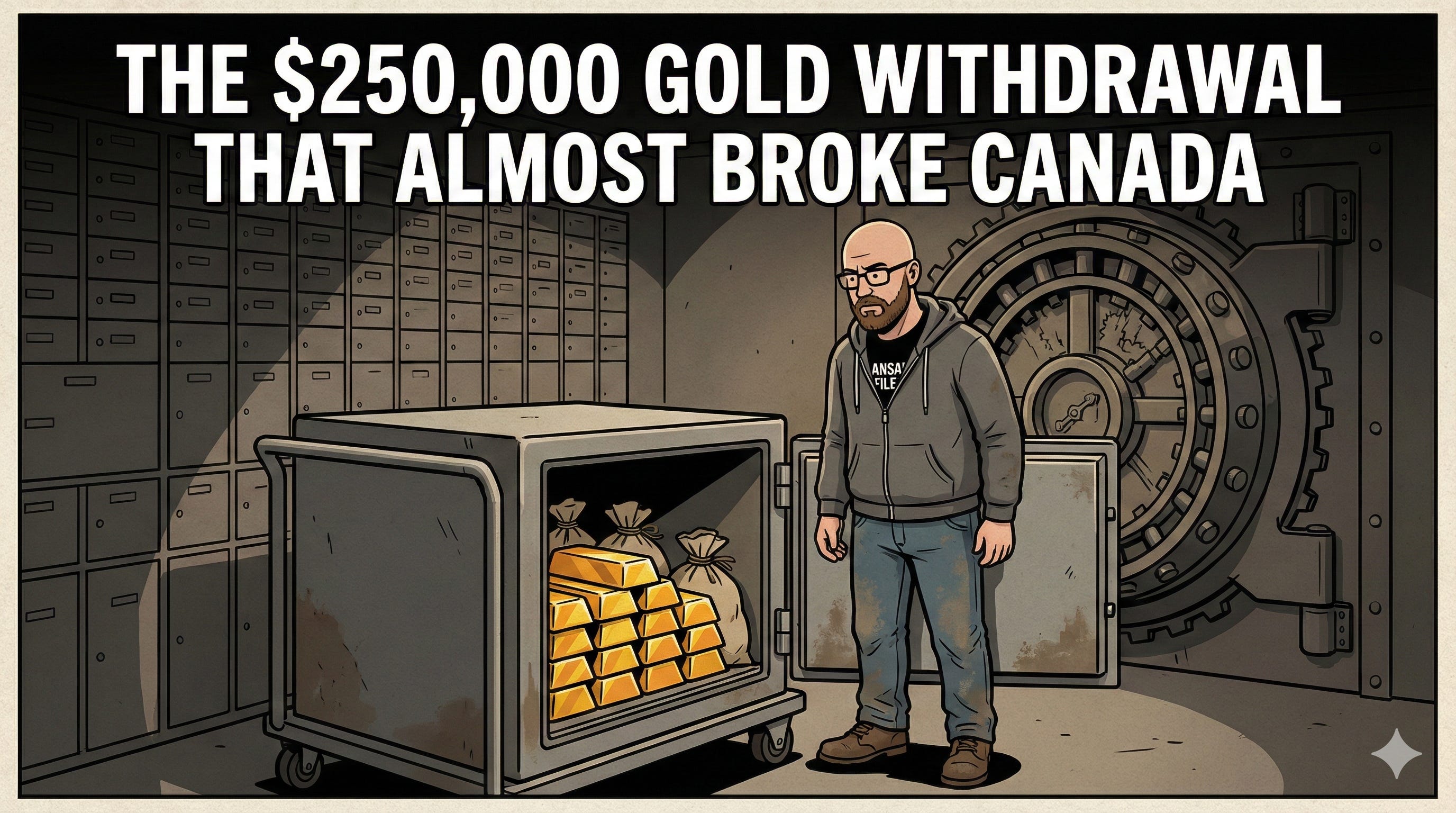
On the morning of Monday, August 3, 1914, a prominent citizen of Toronto walked into the main branch of his bank with a singular and devastating purpose. He did not want a loan. He did not want to discuss investments. He wanted to survive the end of the world.
The customer, whose name remains redacted in the official archives, demanded to see the general manager. When he was shown into the office, he laid out his ultimatum: he required the immediate withdrawal of his entire deposit—$250,000—in gold coin.
The manager attempted to reason with him. He explained that the bank was solvent, that the British Empire was unshakeable, and that if every depositor acted with such panicked self-interest, the very collapse he feared would become a self-fulfilling prophecy. The customer was unmoved. He believed the 1914 financial panic was the beginning of a total societal breakdown. He insisted on his legal rights.
Defeated, the bank staff opened the vault. They spent hours counting out quarter of a million dollars in heavy gold specie, bagging it for the customer, who hauled the fortune away to lock it in a private safety deposit vault.
This was not an isolated incident. It was the first tremor of an earthquake. Across the Dominion, the “Great Bank Run of 1914” had begun. In Montreal and Toronto, lineups were forming outside marble-pillared branches. Trust companies reported a sudden, frantic run on safety deposit boxes as citizens prepared to hoard hard currency. The global stock exchanges—London, New York, Paris—had already closed their doors to stop the bleeding. Now, the panic had reached Canada, and the gold that underpinned the nation’s entire economy was beginning to drain away.
The Minister at Rye Beach
Sir Thomas White, Canada’s Minister of Finance, was not in Ottawa when the crisis began. He was on vacation at Rye Beach in New Hampshire, watching the Atlantic surf and reading newspapers that grew darker by the hour. The headlines from Europe had shifted from diplomatic posturing to mobilization. Austria had served its ultimatum to Serbia. The “conflagration so much dreaded for years” was about to ignite.
On Friday, July 31, White sensed the shift. The New York Stock Exchange, which many had believed immune to European troubles, followed London’s lead and closed. The international exchange system, the delicate web of credit that kept global trade moving, had seized up. Creditors everywhere were demanding gold.
White abandoned his holiday and rushed north, arriving in Ottawa on Sunday, August 2. His first act was to telephone Sir Vincent Meredith, the president of the Bank of Montreal. The news was worse than he expected. Meredith reported that while the panic wasn’t yet universal, the “runs” were spreading. Heavy withdrawals were hitting banks in every major city.
The crisis facing White was structural and terrifying. Under the Canadian laws of 1914, the banking system was a rigid machine built for fair weather. Banks were legally required to redeem their notes in gold upon demand. If a bank could not produce the gold, it was insolvent. It had to close its doors.
In peacetime, this system ensured discipline. Banks kept cash reserves of 10 to 20 percent, which was more than enough for daily business. But no bank in the world—not even the Bank of England—kept enough gold to pay every depositor at once. As White later noted with chilling clarity, “It was obvious that a banking institution, however strong, could not be expected to be in a position to pay all its liabilities upon demand.”
The law was a suicide pact. If the public demanded gold, the law said the banks must die.
The Midnight Conspiracy
Monday, August 3, was a civic holiday, a small mercy that kept the banks closed for one more day, buying the government twenty-four hours to save the system. At noon, a special train arrived in Ottawa from Montreal carrying the captains of Canadian finance: the leading members of the Canadian Bankers’ Association, headed by their president, D.R. Wilkie.
They gathered in White’s hotel room, visibly shaken. They had received telegrams all morning detailing the panic spreading through the provinces. They had no legal tools to stop it. If the banks opened on Tuesday morning under the current laws, they would be stripped of their gold reserves within days.
White listened to their fears and then proposed a solution so radical that it stunned the room. If the public wanted money, the banks should be allowed to pay them—not in gold, but in their own bank notes.
To make this possible, the government would have to fundamentally alter the nature of money in Canada. White proposed that the government act as a backstop, issuing Dominion notes to the banks against the security of their assets. This would ensure that no matter how long the lineups grew, the tellers would never run out of paper currency to hand over the counter. Furthermore, the banks would be authorized to issue “excess circulation” immediately, a privilege usually reserved for the autumn crop-moving season.
There was just one problem: it was completely illegal.
“It is to be noted that all the measures adopted were directly contrary to law,” White later admitted in his memoirs. “The provisions of the Bank Act and other Dominion financial legislation were deliberately over-ridden.”
White didn’t care. He was looking at the collapse of the national economy. He drafted the plan on a notepad during the meeting and called Prime Minister Sir Robert Borden. Borden came to the hotel room, listened to the proposal, and agreed immediately. A Cabinet meeting was hurriedly convened for 8:00 p.m. that evening.
By midnight, the Governor-General had signed the Order-in-Council. White had already arranged for the King’s Printer to issue a special Canada Gazette before dawn. The order suspended the redemption of gold and authorized the banks to pay debts in their own paper. It was a coup d’état against the Bank Act.
When the banks opened on the morning of August 4—the very day Britain declared war on Germany—the tellers were ready. They had stacks of bank notes and the full backing of the Dominion government. The bluff worked. When the public realized the government stood behind the banks, the panic evaporated. The “runs” ceased instantly. The man who had hauled away $250,000 in gold likely found himself holding a heavy, non-interest-bearing liability, while his neighbors went on with their business.
The American Gold Flood
With the domestic panic quelled by the “illegal” Order-in-Council (later legitimized by Parliament as the Finance Act, 1914), White faced a new, bizarre problem: too much gold.
As the war began, the center of financial gravity shifted violently. Britain, the world’s creditor, began calling in its debts to pay for the war effort. The United States owed massive sums to London, but the Atlantic Ocean had suddenly become a hunting ground. With German cruisers stalking the shipping lanes, American firms were terrified to ship gold bullion to England. Insurance rates skyrocketed to prohibitive levels.
The solution was to turn Ottawa into a temporary outpost of the Bank of England. The Bank announced that it would accept gold delivered to the Receiver-General in Ottawa as if it had been delivered to Threadneedle Street in London.
Almost immediately, a “tide of gold” began to flow north. Millions of dollars in American gold coins and bullion arrived at the Department of Finance. It piled up in the vaults, a physical manifestation of the shift in global power. But this concentration of wealth brought a new fear.
On the Pacific coast, the city of Victoria was in a state of high anxiety. Rumors swirled that Admiral von Spee’s German East Asia Squadron was steaming toward British Columbia to bombard the coast and loot the banks. The fear was so genuine that White ordered the gold in the Receiver-General’s vaults in Victoria to be secretly removed and transported inland. The commercial banks followed suit, emptying their coastal vaults and moving their reserves to the interior.
When White asked Sir Richard McBride, the Premier of British Columbia, about the state of the coast defenses that were supposed to protect this gold, McBride offered a response that perfectly encapsulated Canada’s lack of military readiness.
“Yes, and they are very good guns, too,” McBride told him. “Their only drawback is that the breech block of one has been lost and six inches have been broken off the muzzle of the other. But for these defects they are in excellent condition.”
The Pivot to Production
The panic of 1914 was merely the opening act of a financial revolution. Before the war, Canada was a debtor nation, relying entirely on London for capital. The war flipped the script.
In the early months, Canada followed the old colonial pattern. White borrowed £12 million from the British Treasury to pay for the first Canadian contingent. But as the conflict dragged on, Britain’s purchasing power dwindled. The gold that had flowed north from the US began to flow back south to pay for munitions and wheat. By 1915, the “pound sterling was still king,” but it was a king on a shaky throne. Britain needed to buy billions of dollars in supplies from North America, but it was running out of dollars to pay for them.
White realized that Canada could no longer just borrow; it had to lend. The government began issuing domestic war loans—something the financial “experts” said was impossible. They believed Canadians were not investors; they were savers who used savings accounts. “The mass of the people did not know what a bond was,” White wrote.
To bridge the gap, White looked to New York. In July 1915, Canada floated its first loan in the United States—$45 million in notes. It was a cultural collision. In London, if a loan wasn’t fully subscribed by the public, the underwriters quietly held the rest, and it was still considered a success. In New York, White learned, “an issue is not regarded as a success unless the public take it all.” The American market demanded total victory or nothing. The loan was oversubscribed, marking the first time Canada stepped out of London’s shadow.
But foreign loans weren’t enough. White had to teach Canadians how to invest in their own war. The first domestic war loan in November 1915 targeted $50 million. The banks, skeptical of the public’s appetite, agreed to underwrite half of it. They needn’t have worried. The issue was oversubscribed, raising over $100 million. By the end of the war, a nation of only eight million people had subscribed to loans totaling hundreds of millions of dollars.
The Legacy of the Crisis
The financial architecture built during that sleepless night in August 1914—the suspension of gold redemption, the government backing of bank notes—permanently changed the country. The Finance Act transformed the Canadian banking system from a rigid, gold-shackled structure into a modern, flexible instrument capable of financing a total war.
The $250,000 withdrawal that started the panic ultimately triggered the very reforms that made such withdrawals unnecessary. The customer who demanded his gold did not break the bank; he forced it to evolve. And while the breech-blocks at Esquimalt may have been missing, the financial defenses erected by Sir Thomas White proved to be the most effective weapon in Canada’s arsenal.
If you enjoyed this deep dive into the forgotten financial panic of 1914, please consider subscribing. We sift through thousands of pages of archival documents to bring you the stories that history books overlook.
Source Documents
White, T. (1921). The Story of Canada’s War Finance. Montreal, Quebec.
"The customer who demanded his gold did not break the bank; he forced it to evolve."
How curious that more than a century later, the name remains hidden!!