

We are obsessed with the myth of the Grand Vision. We’re taught that innovation springs from a singular, earth-shattering idea conceived in a flash of brilliance. We picture the charismatic founder on a stage, evangelizing a mission to connect the entire world, colonize another planet, or upend a global industry. The heroes of this story are the visionaries, the people who start with an abstract, impossibly large goal and work their way down.
It’s a compelling narrative. It’s also mostly wrong.
This story overlooks a more common, more powerful, and frankly, more accessible path to profound invention. It’s a path that doesn’t start with a grand vision, but with a specific, often tedious, real-world problem. It’s the story of Canada’s National Research Council (NRC) in the decades after World War II, a period of astonishing creative output. And it’s best told through the work of one man, a prolific engineer named George Klein, who didn’t set out to change the world, but did so by solving the problems that were put in front of him.
This article will dismantle the myth of the Grand Vision. By examining the work of Klein and his colleagues, we will uncover a more effective framework for innovation—one grounded not in abstract dreams, but in the genius of solving "boring" problems.
The Myth of the Grand Vision
The conventional wisdom is that you must "think big" to succeed. We're told to find our massive, transformative purpose. We celebrate the pursuit of "moonshots" and ten-year plans. The process is top-down: start with the universe-denting idea, then figure out the details.
This mindset makes innovation feel inaccessible, reserved for a special class of people with a unique gift for seeing the future. It encourages us to search for the one big idea that will solve everything, often at the expense of the small, tangible problems right in front of us that are begging for a solution. But what if that’s backward? What if true, lasting innovation is not a top-down decree, but a bottom-up process of patiently solving one practical challenge after another?
The Surprising Revelation: The Power of Solving a Single, Pressing Problem
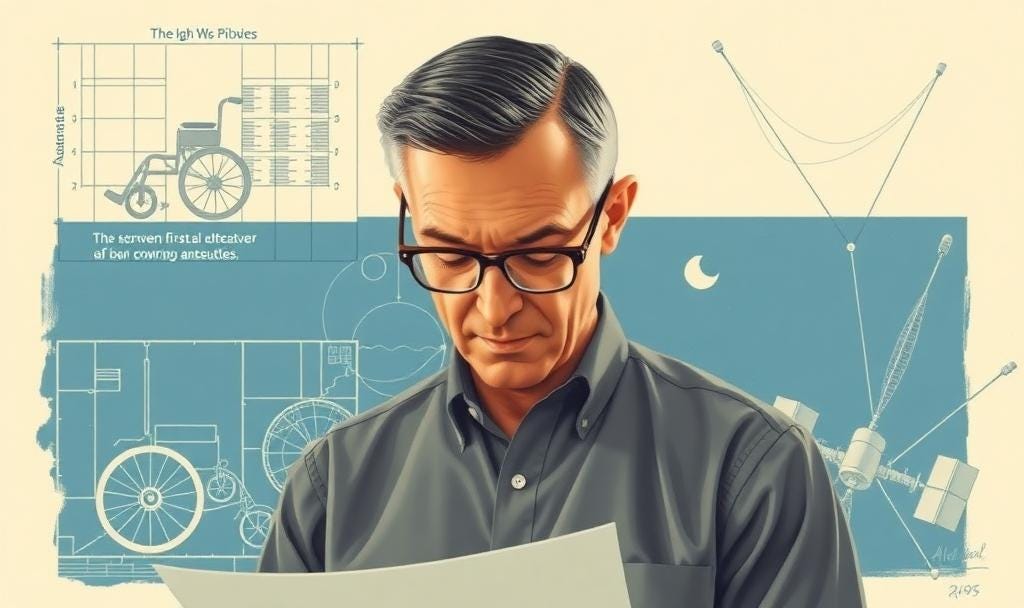
The historical record from Canada's post-war boom reveals a different pattern. The story of the first practical electric wheelchair doesn't begin with a vision to revolutionize mobility; it begins with a specific, human-scale tragedy. Following WWII, thanks to penicillin, more soldiers were surviving grievous injuries, but many returned home as quadriplegics. Manual wheelchairs were useless for those who could not propel them, leaving veterans completely dependent on others.
The problem given to NRC engineer George Klein was not "re-imagine personal transport." It was "fix this." His approach was not to invent from scratch, but to perfect what existed. He methodically addressed the flaws in earlier designs by increasing the electric drive's voltage, adding independent drives to each main wheel so the chair could pivot easily, and, most remarkably, developing a sophisticated controller that resembled the modern joystick.
The result was the first truly practical electric wheelchair—an invention that would change the lives of people with severe disabilities.
This breakthrough didn't come from a 20-year strategic plan. It came from a direct, empathetic response to a "boring" logistical problem. By focusing on the immediate need of a disabled veteran, Klein created a technology that pioneered the entire field of rehabilitation engineering.
Unpacking the 'Why': From Snowflakes to Satellites, The Same Mindset
This was not a one-off success; it was the product of a repeatable mindset. The same engineer, George Klein, was soon tasked with another seemingly mundane problem: nobody could agree on how to describe snow. Descriptions like "wet," "new," or "granular" were too vague, making it impossible to consistently design buildings, roads, or predict deadly avalanches.
Again, Klein didn’t try to change the weather. He focused on the immediate problem of measurement. He designed the instruments and protocols necessary to consistently measure snow's average grain size, hardness, temperature, and other properties. This foundational work led him to co-lead the development of the first International Classification for Snow in 1951, a system that standardized snow measurement for scientists worldwide.
This same problem-solving engine could be pointed at the sky. When Canada prepared to launch its first satellite, Alouette, in 1962, it faced another practical challenge: the satellite needed several long antennae to study the ionosphere, but they had to be light and compact enough to survive launch. Klein adapted a military design he had created: the Storable Tubular Extendible Member (STEM) antenna. This was a telescopic antenna that rolled up like a carpenter's measuring tape.
The design was so simple, robust, and effective that it became standard space technology, increasing the maximum size of satellite antennae from six metres to 45 metres. It was flown on every one of NASA's early crewed Mercury, Gemini, and Apollo missions. A "boring" problem of fitting an antenna into a rocket led to a technology that helped put a man on the moon.
What This Means For You: A New Framework for Innovation
The careers of George Klein and his NRC colleagues offer a powerful, alternative mental model for doing great work. The path to breakthrough innovation isn’t always about having a grand vision. It’s about cultivating the skill of solving the concrete problems in your path.
You can apply this "Problem-First" framework to your own work:
Find the Friction. Look for the real-world constraints and inefficiencies that make people's lives harder. Quadriplegics needed independence. Scientists needed a common language for snow. The Ontario Air Service needed airplane skis that didn't stick to the ice. These points of friction are where the most valuable problems live.
Master the Fundamentals. Klein's genius wasn't magic; it was a deep understanding of mechanical engineering principles that he could apply to any domain. He used the same fundamental thinking to build a better wheelchair, a better measurement tool, and a better antenna.
Solve for the User. The most successful inventions in this story were born from deep empathy. Klein worked closely with patients to perfect his wheelchair, even devising a control system that could be operated with a patient's cheek. The focus was always on the immediate human need, not an abstract market opportunity.
A New Perspective
Our culture glorifies the "what"—the world-changing vision. We are captivated by the "who"—the charismatic founder. But the story of the NRC's golden age suggests the real genius is found in the "how"—the humble, persistent, and practical process of solving one real problem at a time.
The work of George Klein reminds us that you don't need a grand plan to have a grand impact. The most revolutionary work often begins with a simple, powerful question: What is the most immediate, tangible problem I can solve for someone right now?