

For nearly two centuries, the disappearance of Sir John Franklin's 1845 Arctic expedition has been a ghost story told on a global scale. It’s a drama of high ambition, unimaginable suffering, and total mystery. We’ve long been captivated by the big, horrifying questions: Was it lead poisoning from tainted food cans? Did the crew resort to cannibalism to survive? What series of catastrophic events led two of the Royal Navy's most advanced ships to become entombed in the ice, their crews vanishing from the face of the earth?
We assume the answers must be as epic as the tragedy itself—a lost captain's log, a dramatic final message carved into a rock. But the breakthrough isn't coming from a single, grand discovery. It's emerging from the silt and sea life, one mundane object at a time.
The recent archaeological surveys of the miraculously preserved HMS Erebus are showing us that the truth of what happened is not in a sweeping narrative, but in the silent testimony of the everyday items the crew used, wore, and adapted in their final days. By looking closely at a ship's bell, a single leather boot, and an old medicine bottle, we are learning more concrete facts about the Franklin Expedition than decades of speculation have ever provided. This is the story of how the smallest artifacts are solving the biggest mystery.
The Ship's Bell: An Unambiguous Timestamp
When archaeologists from Parks Canada began their first dives on the wreck, they needed one thing above all else: certainty. Was this truly one of Franklin's ships? Inuit oral history, long dismissed but ultimately proven correct, had led them to this spot. The shape of the hull on sonar looked right. But they needed undeniable proof.
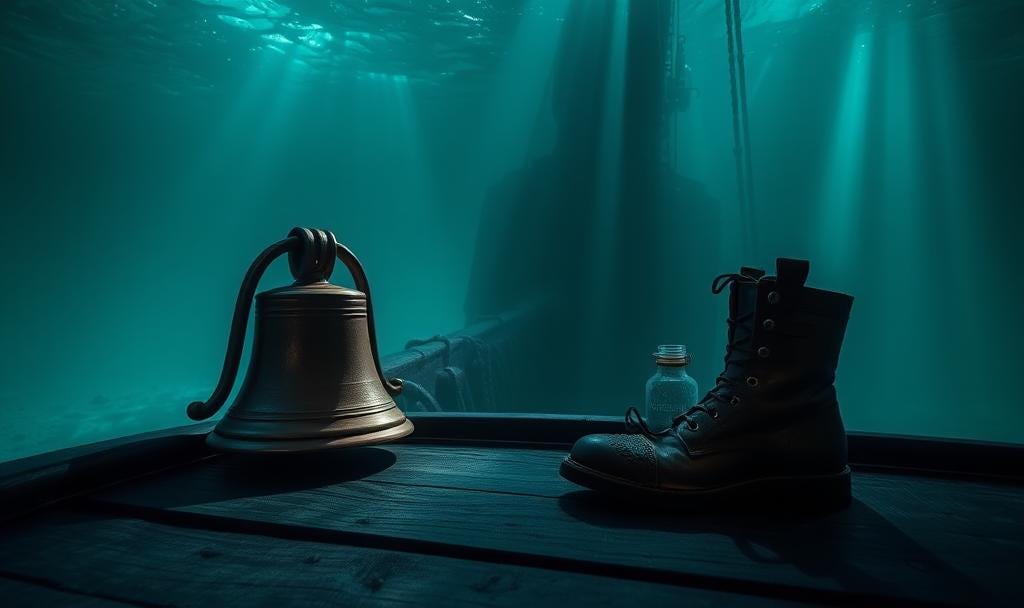
They found it on the upper deck, lying near the massive, displaced windlass. It was the ship's bronze bell. In the silent, frigid water, the embossed markings on its surface spoke volumes. Between two raised lines, just below the shoulder, were the numerals "1845". Below that, a broad arrow, the mark of British government property.
This was the smoking gun. A ship's bell was its soul, used to mark the relentless passage of time in the ship’s daily routine. But this date was special. The bell hadn't been recycled from a storehouse or taken from another vessel; it was cast specifically for this voyage, which departed in May 1845.
That single object provided the definitive, physical link between this sunken vessel and the launch of Franklin's hopeful expedition. It was the alpha and the omega—a piece of equipment forged at the very beginning of the journey, discovered at its final, silent resting place. Its recovery and identification in 2014 confirmed the wreck was Erebus and transformed the site from a promising sonar target into a priceless archaeological treasure trove.
The Officer's Boot: A Human Connection
Deep inside the wreck, in what archaeologists believe was an officer's cabin on the lower deck, they found a boot. It wasn’t a standard-issue military boot. It was a fashionable, hand-stitched civilian design, with a slender sole crooked to fit a left foot. This was almost certainly the personal property of an officer, a man of some means who brought a piece of London style with him to the harshest environment on Earth.
But the real story wasn't just its style; it was what the boot held inside. The team at Lakehead University's Paleo-DNA Laboratory took six small samples from the leather, hoping that friction from wear had left behind traces of its owner.
The result was astonishing. They successfully retrieved a mitochondrial DNA profile from the boot.
Think about that for a moment. After 170 years in the Arctic sea, an everyday object has yielded the genetic signature of one of the lost 129 men. The boot is no longer an anonymous artifact; it is a direct, biological link to a specific human being who walked the decks of that ship. While the profile has not yet been matched to an individual, it represents a monumental leap. The mystery of the Franklin Expedition has always been a collective one, about the fate of "the crew." For the first time, science has given us the tool to potentially uncover the stories of the individuals.
That boot, filled with mud and bivalves when found, contained more than just sediment. It contained an identity.
The Medicine Bottle: A Story of Ingenuity
Among the mess plates and uniform buttons in the forecastle—the living quarters for the seamen and Royal Marines—archaeologists recovered a small, octagonal glass bottle. Embossed on its sides were the words "SAMUEL OXLEY" and "LONDON". Historical records show Samuel Oxley was a chemist who sold a popular remedy called "Concentrated essence of Jamaican ginger root," a cure-all for everything from indigestion to nervousness.
But the crew of the Erebus had found a new use for it. When the bottle's contents were analyzed, there was no trace of ginger essence. Instead, inside were one lead buck shot and 18 smaller lead bird shot. The bottle had been repurposed as a shot flask.
This tells us something crucial: the men were actively hunting, likely for birds, to supplement their dwindling rations. But the story gets even more complex. The analysis also detected traces of gum Arabic and potassium bicarbonate—two standard ingredients from a Royal Navy medicine chest.
This one small bottle reveals a fascinating sequence of events.
It was brought aboard, likely containing its original ginger medicine.
It may have been reused to hold other medicinal compounds from the ship's surgeon.
Finally, in a clear act of improvisation, it was cleaned out and turned into a container for ammunition to hunt for food.
This isn't just a bottle; it’s a perfect microcosm of life aboard the trapped ship. It speaks to the supplies they had, the survival activities they undertook, and the resourcefulness they employed as their situation grew more desperate.
The grand narrative of the Franklin Expedition—what happened, and why—won't be solved by one stunning revelation. It will be pieced together from these quiet, intimate stories. The ship’s bell gives us a definite time. The boot gives us a human connection. And the bottle gives us a glimpse into the crew's final, resourceful struggle for survival. The final story of HMS Erebus won't be found in a lost logbook, but in the silent testimony of the everyday items its crew left behind. Each object is a word, and archaeologists are finally beginning to form the sentences.